Here is information (not intended to be impartial) about the manifestos of four parties as they relate to health. The Conservatives are mentioned only in passing. After 2010 who is to believe them, especially now they are plucking billions of pounds for health out of thin air.
Labour's Health Manifesto is a mixed bag. The promise to repeal the 2012 Health and Social Care Act seems to be presented almost as an unimportant afterthought. Nonetheless several of the specific undertakings we have been looking for are there - restoration of accountability; repeal of the competition framework; some promised security against TTIP; some control of the private sector, plus a number of positive measures. There are promises of moves towards devolution (which some people may read as threats to the NHS) and Labour is now expressing doubt about the Manchester proposals as they stand.
Funding remains an issue although Labour obviously thinks that what can be saved from marketisation red tape (£100m) is considerably less than the much higher and pretty unrealistic figure of well over £5 billion being quoted by some campaigners. This may lead people to suspect that Labour's commitment to reduce the market is weaker than it appears; certainly they do not appear to be abolishing the commissioning approach and nothing is said about the impending privatisation of the Commissioning Support Organisations. The NHS Reinstatement Bill is not mentioned. Labour also steps back here from explicitly endorsing the Five Year Forward Look (again by not mentioning it – though Andy Burnham has said subsequently that it would need adaptation since Labour will be starting from a different place), thus freeing itself from endorsing the financial package of £8 billion extra before 2020 and the further £22 billion of efficiency and other savings which Stevens says are also required if there is to be zero growth. There are also doubts about how quickly Labour's promised extra funding will kick in. Money has to be found for the NHS during 2015-16.
What the manifesto does evidence is some very real thought about the NHS, about integration of services, the impact of cuts elsewhere, and in particular in social care, on the NHS and, to some extent about public health. The promised figures for increases in staffing seem plucked out of the air, but the focus on improving access to primary care is more realistic than Cameron's unfunded and overambitious promise of 7 day working. "The next Labour Government will guarantee the right to a same-day consultation with a doctor or a nurse at your GP surgery, and the right to a GP appointment within 48 hours. We will also ensure patients have the right to book more than 48 hours ahead with the GP of their choice."
Certainly the manifesto is by far the most detailed approach to securing the NHS of any of the parties so far and contrasts with the rose-coloured haze cast over the current working of the NHS by the Conservatives and their apparently unfunded promise of the £8 billion over 5 years requested by Simon Stevens has to be linked with the £22 billion 'efficiency savings' mentioned above. Be sure that this will mean further radical changes.
Undecided voters should seriously consider that Conservative promises on the NHS cannot be trusted. Last time we had 'no top down reorganisation'; this time we have a conjuring promise of extra money with no indication where it will come from nor of how the £12 billion welfare cuts will affect people with severe health needs. Cameron parrots the current fashionable demand for 7 day working, without helping us to any real understanding about what this means, which services it will affect, and how it will be achieved. The apparent commitment to the 5 year forward view suggests that parcelling up of the NHS can be expected to proceed apace. For instance the Wirral which has a privatising CCG has just announced that its vanguard partnership will consist of the hospital trust, other local public sector health providers, Wirral Council and three outside bodies: Cerner UK Ltd - (informatic solutions and population health management) Advocate Physician Partners ACO (USA) - (modelled Accountable Care Organisation deployment and learning" and the King's Fund - (research, learning, evaluation and dissemination).
The Green Party Manifesto has also been launched, with a significant section on health, (pp31-35) https://www.greenparty.org.uk/we-stand-for/2015-manifesto.html some of it written by Sheffield Green Party parliamentary candidate Jillian Creasy. The programme is much clearer in its attack on the market and calls for an end to the commissioning mechanism and to the blanket use of 'commercial confidentiality'. It is specific about PFI (not even mentioned by Labour) and contains a number of brave promises - including bringing addiction services across to the Department of Health. On p74 the Greens confirm opposition to TTIP. There is mention of transferring hospital services to the community without it being clear how this will be done (Labour envisages a continuous institution, which may or may not prove to be a good idea.) Jillian's section on a 'person-centred' NHS is particularly interesting for its intent to enable the time and opportunity for staff to care effectively by being able to respond more directly to patient needs. The manifesto supports the NHS Reinstatement Bill, already introduced to Parliament by Caroline Lucas, but rather glosses over its application. Critics will probably say that it is strong on good intentions but much weaker on delivery, both in terms of structures and the rather optimistic funding mechanisms.
The Lib Dem manifesto contains a lot of fine intentions, but, given that the Lib Dems are not going to lead a government, they have two purposes - one to attract/retain voters in marginal constituencies, the other to act as bargaining points in any sort of coalition or hung parliament.
The Lib Dems say (p73) they will repeal parts of the Health and Social Care Act “which make NHS services vulnerable to forced privatisation through international agreements on free markets in goods and services - so the TTIP pressure is getting through to Clegg. What he won't admit is that it's not just 'parts' of the Act. They don't admit their responsibility for putting the NHS in this situation in the first place. They are more careful about specific promises around staff recruitment - preferring to talk about different ways of accessing GPs rather than 7 day working or unrealistic estimates of GP numbers. They also have specific and often welcome proposals on social care and public health and have clearly majored on mental health. This contrasts with the Tories - whose manifesto is now discovered to contain the threat of benefit sanctions against people who refuse medical treatment.
UKIP's manifesto is a hotchpotch of opportunist and populist proposals designed to reassure prospective UKIP voters that it cares about the NHS whose ills it puts down to demographic change, immigration and the EU. The proposals are, in our view, little more than pub speeches. It contains promises to rebalance funding away from Scotland and towards Wales and England, to insist on health insurance for all migrants, and to increase some GP availability. It enters the staff number lottery by promising 8000 more GPs, 20,000 nurses and 3,000 midwives and will, from somewhere, put a GP in every A&E (presumably paid at extravagant locum rates and deflecting GPs from local practices although they do say they will pay for additional consultants by preventing the current reliance on locums). UKIP claims commitment to the founding principles of the NHS. It will increase funding for mental health, end hospital parking charges and build a new specialist military hospital. Obviously it opposes TTIP as an EU initiative and wants to demand specific exclusion of the NHS. However UKIP will pursue a separate trade deal with the USA.
UKIP will finance improvements in social care (including the end of zero hours contracts for care workers) through a sovereign wealth fund financed by taxes on fracking (assuming any fracking takes place!). So that’s social care down the sinkhole then.
We are a grassroots movement comprising people from all walks of life who are, or will be affected by the government’s austerity measures and spending cuts to NHS Services across England. We also strongly oppose the creeping privatisation of the NHS by successive governments. Privatisation = Profit not Good Patient Care
RESIST THE BREAKUP OF THE NHS THROUGH PRIVATISATION AND CUTS!
BRIEF UPDATE April 2018
(N.B. This site is not currently being regularly updated. )
FOR COMING EVENTS, MEETINGS AND OTHER INFORMATION
SEE BELOW AND THE MAIN SSONHS WEBSITE
To be put on the SSONHS mailing list or for any other queries please email teamssonhs@gmail.com
The government's increasingly desperate attempts to defend their record on the NHS have become less and less credible over the last year. This is partly due to increasingly effective local and national campaigns and partly to the crisis in hospitals, primary care and social care has forced more and more of those involved to speak out against the damage being caused by austerity. But many of those who are being damaged have no voice. Poor people, disabled people and the chronically ill have fewer opportunities to make their case as their benefit and treatment rights become eroded. NHS staff are generally gagged in one way or another. Exit can be the only escape leaving the NHS still weaker and now less and less able to recruit staff from overseas.
Large national demonstrations and industrial action by junior doctors, nurses and others have made the strength of feeling around the country quite clear, to the extent that even the Conservatives have got worried enough to promise the outlines of a new financial deal this summer. But will it be too late? Certainly it will be insufficient to undo the damage inflicted since 2010. Meanwhile the stress on services which affect the need for healthcare becomes more and more acute. The unspupported costs of Social Care (which is subject to means tested charges) is driving local authorities to bankruptcy.
Another threat is the developing reorganisation into Integrated Care Systems (previously known as Accountable Care Systems) which threaten to become Accountable Care Organisations. In our local area the Integrated Care System covers Barnsley, Rotherham, Doncaster and Bassetlaw as well as Sheffield. (See posts below.) Increasing pressure from campaigners and within the Labour Party is deterring local councils to sign up to these in case they become vehicles for further cuts and privatisation.
Across South Yorkshire resistance is building to the threatened implications of the ICS for local services and South Yorkshire Save Our NHS have formed a political party to stand in the Sheffield City Region Mayoral election on May 3rd 2018. See also Barnsley Save Our NHS.
THE NHS IS
 NOT KILLED OFF YET. Campaigning does work whether on the streets, in the press or, increasingly in the lawcourts. The government's high-handed tactics are being subjected to an increasing number of judicial reviews. At national level these have forced a public consultation on Accountable Care Organisations starting in May 2018.
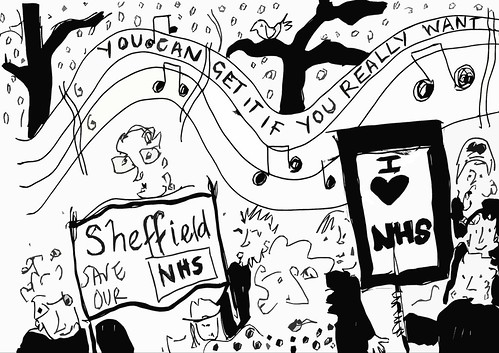
Cartoons by Samantha Galbraith @sgalbraith47
For more national information see Health Campaigns Together and Keep Our NHS Public
FUTURE EVENTS
April 14th 2018 11.45 Regional Demonstration to Save the NHS Leeds
April 25th Soviet Healthcare via Targets: Are Governments Bringing it into the NHS? Roco 2pm or 7pm
April 28th Sheffield Demonstration against proposed closure of the Minor Injuries and Walk-in Centres (see main website for details)
June 27th The NHS is 70 - but what is its life expectancy? Festival of Debate / SSONHS panel discussion and social. Roco 7pm - 11 pm.
June 30th Health Campaigns Together march for the NHS in London See main wesbite for details.
SSONHS planning and information meetings are generally on the first Monday of the month, except for bank holidays. They are usually at 6pm at the United Reform Church. Chapel Walk/Norfolk St S1
To contact us email teamssonhs@gmail.com
PREVIOUS EVENTS
In 2016 abnd 2017 we worked with Sheffield Festival of Debate and other colleagues to promote realistic discussion of the issues facing the NHS. On 4th May 2017 we had a lively meeting debating the future of hospitals and in 2016 we mounted an exhibition on NHS privatisation to coincide with a play, A DUTY OF CARE about Labour and the healthcare market. On 22nd November 2016 we held a panel-led debate on the future of the NHS with local NHS leaders, academics and campaigners. We also held a public meeting on 4th July 2016 to celebrate the NHS anniversary, discuss the STPs, the implications for privatisation in South Yorkshire and North Derbyshire and the consequences of the EU referendum result.
In March 2016 we held a successful workshop Taking Back Our NHS

For our questions to 2017 General Election candidates and canvassers about the NHS see our website campaign page
2016 8th-22nd November Exhibition on NHS privatisation How come we didn't know by London photographer Marion Macalpine
Theatre Delicatessen, The Moor
22nd November SSONHS Festival of Debate event Why is the NHS Under so much pressure? How can we save it for future generations?
Speakers included Dr Tim Moorhead, Chair, Sheffield CCG, Kevan Taylor (Sheffield Health and Social Care Trust) and Professor Sarah Salway (University of Sheffield, Public Health) + local campaigners
Taking Back Our NHS SSONHS workshop
Saturday 12th March 2016, 10am - 2pm
(2015)
Campaigning for GP practices at risk of closure
2nd July Successful SSONHS public meeting addressed by Ray Tallis and speakers from Devonshire Green and Unison.
2nd May SSONHS stall in city centre from 11.30 Come and see us.
The 38 degrees ambulance will also be in Surrey Street at 12pm and conveying the 38 degrees petitions to local Hallam candidates at Wesley Hall in Crookes for 3pm.25th April - March through Sheffield Hallam, with the People's NHS and 38 degrees
28th February 38 degrees petitioning around Sheffield http://www.thestar.co.uk/news/health/local-health/campaigners-take-to-sheffield-streets-in-fight-to-save-nhs-1-7132981
22nd November Leafleting in Sheffield City Centre from 12.00 pm in support of the NHS strikers. For A5 and A4 copies of the leaflet which has more information on it see the Campaigns Page at our website
24th November NHS picket lines from 7am to 11am. Rallies at the Hallamshire and Northern General (Herries Road) at 10 am.
We were proud to support the Jarrow to London march for the NHS, organised by Darlington Mums passing through Sheffield on August Bank Holiday Monday. http://999callfornhs.org.uk/ Thanks to everyone for helping and joining in.
Is our NHS really in crisis? Behind the headlines and soundbites
Panel discussion led by GPs and health experts from the NHS and universities.
For past activities see our website www.sheffieldsaveournhs.co.uk
Friday, 24 April 2015

Saturday, 4 April 2015
Election sparks growing public concern about the future of the NHS
As the election swings under way, public concern about the NHS is mounting and the parties are being pushed to come clean about their intentions. However it is becoming increasingly clear that the main parties are dodging the most serious questions. A further post with more detailed comments will appear here shortly.
The questions SSONHS is asking of candidates are on our website campaign page.
Interest in Sheffield is mainly focused on Sheffield Hallam but Sheffield Central also offers a choice between two strong NHS supporters - Labour's Paul Blomfield and the Green Party's Jillian Creasy.
On 1st April Jillian Creasy kicked off a lively discussion on the NHS as part of the Sheffield Festival of Debate. There was a good audience, including many younger people and NHS workers. For an account of the meeting see Facebook or Twitter
The questions SSONHS is asking of candidates are on our website campaign page.
Interest in Sheffield is mainly focused on Sheffield Hallam but Sheffield Central also offers a choice between two strong NHS supporters - Labour's Paul Blomfield and the Green Party's Jillian Creasy.
On 1st April Jillian Creasy kicked off a lively discussion on the NHS as part of the Sheffield Festival of Debate. There was a good audience, including many younger people and NHS workers. For an account of the meeting see Facebook or Twitter
Saturday, 25 October 2014
Facing up to Simon Stevens' 5 year look forward
So now we have Simon Stevens' five year forward plan setting out what he says is a consensus among NHS leaders about what is needed if we are to continue with an NHS which meets a national commitment to universal healthcare, irrespective of age, health, race, social status or ability to pay; to high quality care for all. He believes his proposals are a viable way to secure a comprehensive tax-funded health care service. It is a readable document 5yfv-web.pdf and the fact that it is neither a gung-ho Lansley/Letwin proclamation of the benefits of competition nor a move towards more healthcare charges appears to have seduced guarded approval from many different quarters.
Stevens is adamant that the NHS needs to change in order to meet new demands, new expectations, higher standards and new technology and suggests that these changes need to be locally designed (within a choice of nationally approved models) and locally led. "England is too diverse for a ‘one size fits all’ care model ... Different local health communities will instead be supported by the NHS’ national leadership to choose from amongst a small number of radical new care delivery options, and then given the resources and support to implement them where that makes sense."
Stevens is reasonably frank about the money needed to finance the NHS (which secures him internal support) and he also makes a perfectly justifiable case that the NHS cannot survive if it is expected to pick up an infinite bill for lifestyle related ill health. He does not present competition as the key dynamic of change, indeed does not explicitly mention it at all, thus enabling Burnham to claim he is on their side and Hunt to mock Burnham for raising false fears.
But behind these bold strokes lie a multitude of problems.
The first question to ask is 'Is this a new version of the Tory "No top down reorganisation" pledge of 2010?' The paper rubbishes frequent changes of direction by politicians wanting to reform the NHS and Stevens insists that he is about changing the front-line, not the back-room. The problem is that this leaves the existing backroom (with its market oriented structure) in place with CCGs having an expanded role. The about to be marketed Commissioning Support Units, which have a big influence of CCGS and may go into the hands of privateers are not mentioned. Councils and elected mayors are seen more as a source of public health support than joint commissioners - Stevens is at best luke warm about Health and Wellbeing Boards - which reflects a general and long-standing hostility within the NHS to being under any sort of direct local political control. Meanwhile we hear that GP-led CCGs will be given more collective responsibility to develop primary care. There are clear and major conflicts of interest here - which have already surfaced in discussions about whether CCGs and NHS England can co-commission local GP contracts. There is little detail about how exactly changes will be brought about but either the existing structure will produce a bias towards the market, or there will be further backroom reorganisation because the current structure is 'not fit for purpose'.
Secondly it is perfectly possible that the front line reorganisations planned will actually, under the disguise of integration, create a number of new local services which CCGs may either want to put out to tender, prompted by the CSUs, if current laws and regulations stay in force, or which will be much more bite-sized enterprises for future privatisation, just as in social care.
Thirdly Stevens tries to give the impression that he recognises the need to carry staff with him especially as the new models will require major adaptation by staff, and he continually speaks the language of incentives, whether for producing better services, or for improving their own health. However if these are on the lines of the arguable unethical offer of payment to GPs to diagnose dementia, they will cause chaos. Yes he says that pay freezes cannot last indefinitely but that's not much reassurance when he talks about ensuring pay is in line with the private sector (which generally means high salaries for the top managers and low wages / zero hour contracts for the rest).
Fourthly there is quite a lot of faith in the benefits of technology - diagnostic, assistive, informational etc. We all fantasise that this might be so, but efficacy and patient benefit are not yet adequately evidenced on a broader scale.
Fifthly we don't yet know what integrated care will actually mean in practice - though there will be a chance to understand it in Sheffield as local proposals for the largest Better Care Fund in England take shape over the next few months. Again the benefits to patients need to be clearly evidenced, and not just be aspirational.
Fifthly the politicians have already run away from the financial analysis. OK it's early days but they don't want this commitment even based on Stevens' optimistic predictions of efficiency gains. Already the NHS is saying that most of the easy efficiency gains have been made. Future efficiency gains will mean job losses and quite possibly more low cost outsourcing. Stevens observes about work-place health that mental health problems have overtaken MSK as sick leave issues. Well, quite. In the NHS, as elsewhere, we all know that this is partly related to squeezing the staff harder as part of efficiency measures. Nothing is said about dismantling the expensive structures for administering a market in healthcare. Nor, as Clive Peedell has pointed out for the NHAP, has Stevens said anything about how the cost of the new investments he proposes will actually be met.
Stevens' financial predictions are also based on more effective prevention services. Well these may or may not happen / be effective, but they certainly won't under this government which has caved in to commercial pressures from the alcohol, tobacco and fast food industries, undermined public provision of all sorts and, through its attacks on benefits, women and disabled people has increased the ill health of the very people whom the NHS identifies as having the most needs.
There's a lot to analyse and debate in Stevens' proposals - and there are plenty of interesting and positive ideas to work with. It is not however any sort of yellow brick road for NHS survival. Indeed a senior lawyer at Price Waterhouse Cooper has commented to HSJ: “There will be a number of challenges including leadership, culture, how money flows in the system, and allowing time for improvement. But the most difficult challenge will be political. The radical agenda will require political leaders to pick up the gauntlet thrown down by NHS leaders. Politicians will need to embrace the reform challenges as well as the resource challenges. Change of this scale will not be pain free. Each political party ahead of the next election will need to set out how it plans to champion changes to local health services including hospitals.”
So pressure needs to be kept on the parties - particularly Labour - to set out how in more detail what their proposals may be: both for finance and for structure. Here are a few possible key points.
The NHS needs a minimum 4% annual real terms increase, and all parties should recognise that NHS funding can't be seen in isolation from what is happening to public services in general.
Even given the need to keep reorganisation to a minimum, the competition regulations must be removed, the market-oriented structure replaced and injurious PFI contracts renegotiated or abolished.
National and local decision making must be democratically accountable and transparent.
NHS staff must be valued with reward not just words and positively enabled to increase their ability to adapt to changing needs.
Rushes into outsourcing must be prevented especially in the likely to be vulnerable community services.
The assumptions of austerity budgeting and a low tax economy need to be challenged
Stevens is adamant that the NHS needs to change in order to meet new demands, new expectations, higher standards and new technology and suggests that these changes need to be locally designed (within a choice of nationally approved models) and locally led. "England is too diverse for a ‘one size fits all’ care model ... Different local health communities will instead be supported by the NHS’ national leadership to choose from amongst a small number of radical new care delivery options, and then given the resources and support to implement them where that makes sense."
Stevens is reasonably frank about the money needed to finance the NHS (which secures him internal support) and he also makes a perfectly justifiable case that the NHS cannot survive if it is expected to pick up an infinite bill for lifestyle related ill health. He does not present competition as the key dynamic of change, indeed does not explicitly mention it at all, thus enabling Burnham to claim he is on their side and Hunt to mock Burnham for raising false fears.
But behind these bold strokes lie a multitude of problems.
The first question to ask is 'Is this a new version of the Tory "No top down reorganisation" pledge of 2010?' The paper rubbishes frequent changes of direction by politicians wanting to reform the NHS and Stevens insists that he is about changing the front-line, not the back-room. The problem is that this leaves the existing backroom (with its market oriented structure) in place with CCGs having an expanded role. The about to be marketed Commissioning Support Units, which have a big influence of CCGS and may go into the hands of privateers are not mentioned. Councils and elected mayors are seen more as a source of public health support than joint commissioners - Stevens is at best luke warm about Health and Wellbeing Boards - which reflects a general and long-standing hostility within the NHS to being under any sort of direct local political control. Meanwhile we hear that GP-led CCGs will be given more collective responsibility to develop primary care. There are clear and major conflicts of interest here - which have already surfaced in discussions about whether CCGs and NHS England can co-commission local GP contracts. There is little detail about how exactly changes will be brought about but either the existing structure will produce a bias towards the market, or there will be further backroom reorganisation because the current structure is 'not fit for purpose'.
Secondly it is perfectly possible that the front line reorganisations planned will actually, under the disguise of integration, create a number of new local services which CCGs may either want to put out to tender, prompted by the CSUs, if current laws and regulations stay in force, or which will be much more bite-sized enterprises for future privatisation, just as in social care.
Thirdly Stevens tries to give the impression that he recognises the need to carry staff with him especially as the new models will require major adaptation by staff, and he continually speaks the language of incentives, whether for producing better services, or for improving their own health. However if these are on the lines of the arguable unethical offer of payment to GPs to diagnose dementia, they will cause chaos. Yes he says that pay freezes cannot last indefinitely but that's not much reassurance when he talks about ensuring pay is in line with the private sector (which generally means high salaries for the top managers and low wages / zero hour contracts for the rest).
Fourthly there is quite a lot of faith in the benefits of technology - diagnostic, assistive, informational etc. We all fantasise that this might be so, but efficacy and patient benefit are not yet adequately evidenced on a broader scale.
Fifthly we don't yet know what integrated care will actually mean in practice - though there will be a chance to understand it in Sheffield as local proposals for the largest Better Care Fund in England take shape over the next few months. Again the benefits to patients need to be clearly evidenced, and not just be aspirational.
Fifthly the politicians have already run away from the financial analysis. OK it's early days but they don't want this commitment even based on Stevens' optimistic predictions of efficiency gains. Already the NHS is saying that most of the easy efficiency gains have been made. Future efficiency gains will mean job losses and quite possibly more low cost outsourcing. Stevens observes about work-place health that mental health problems have overtaken MSK as sick leave issues. Well, quite. In the NHS, as elsewhere, we all know that this is partly related to squeezing the staff harder as part of efficiency measures. Nothing is said about dismantling the expensive structures for administering a market in healthcare. Nor, as Clive Peedell has pointed out for the NHAP, has Stevens said anything about how the cost of the new investments he proposes will actually be met.
Stevens' financial predictions are also based on more effective prevention services. Well these may or may not happen / be effective, but they certainly won't under this government which has caved in to commercial pressures from the alcohol, tobacco and fast food industries, undermined public provision of all sorts and, through its attacks on benefits, women and disabled people has increased the ill health of the very people whom the NHS identifies as having the most needs.
There's a lot to analyse and debate in Stevens' proposals - and there are plenty of interesting and positive ideas to work with. It is not however any sort of yellow brick road for NHS survival. Indeed a senior lawyer at Price Waterhouse Cooper has commented to HSJ: “There will be a number of challenges including leadership, culture, how money flows in the system, and allowing time for improvement. But the most difficult challenge will be political. The radical agenda will require political leaders to pick up the gauntlet thrown down by NHS leaders. Politicians will need to embrace the reform challenges as well as the resource challenges. Change of this scale will not be pain free. Each political party ahead of the next election will need to set out how it plans to champion changes to local health services including hospitals.”
So pressure needs to be kept on the parties - particularly Labour - to set out how in more detail what their proposals may be: both for finance and for structure. Here are a few possible key points.
The NHS needs a minimum 4% annual real terms increase, and all parties should recognise that NHS funding can't be seen in isolation from what is happening to public services in general.
Even given the need to keep reorganisation to a minimum, the competition regulations must be removed, the market-oriented structure replaced and injurious PFI contracts renegotiated or abolished.
National and local decision making must be democratically accountable and transparent.
NHS staff must be valued with reward not just words and positively enabled to increase their ability to adapt to changing needs.
Rushes into outsourcing must be prevented especially in the likely to be vulnerable community services.
The assumptions of austerity budgeting and a low tax economy need to be challenged
NHS strikes reflect staff feelings of injustice
The Unison, Unite, GMB and Royal College of Midwives strikes on 13th October were well supported as was the radiographers' strike on 20th October. Despite Hunt's refusal to budge, mood on the picket lines was buoyant with moving speeches, especially from the groups new to striking like the midwives, about how mistreated and exploited they feel. Radiographers made excellent use of their skeleton motifs.
Management and government cannot ignore how the more and more overt and shameless 'squeezing' of staff to produce more and more will eventually lead to service failure. As experienced staff haemorrhage to better paid and less stressful jobs abroad, managers scrabble around competing with each other to attract nurses and other staff from less well off countries who need their own trained staff. Simon Stevens skirts round this in his Five Year Forward Look, but staff issues need to be addressed directly. Treating staff decently is not a luxury - it is essential to a caring service.
Management and government cannot ignore how the more and more overt and shameless 'squeezing' of staff to produce more and more will eventually lead to service failure. As experienced staff haemorrhage to better paid and less stressful jobs abroad, managers scrabble around competing with each other to attract nurses and other staff from less well off countries who need their own trained staff. Simon Stevens skirts round this in his Five Year Forward Look, but staff issues need to be addressed directly. Treating staff decently is not a luxury - it is essential to a caring service.
Monday, 1 September 2014
Sheffield NHS public meetings in September
Sheffield Clinical Commissioning Group
Thursday 4th September 2014 4pm Darnall. Business meeting in Public . NB Quality reports are beginning to show significant deterioration in performance against targets for the Hospital Trusts and the Ambulance Service and the CCG has applied or is considering contract sanctions. This is important not just because it shows increasing strain in the system but also because if some NHS services are judged not to be providing a satisfactory service, the pressure will grow to put them out to market. There have also been problems with diagnostics, particularly in cardiology leading some GPs to ask whether they can refer direct to Thornbury. The CCG has visited the hospital and is working with the Trust on improvements.
Thursday 11th September 2014 AGM open to the public. 2 – 4 pm The Workstation, Paternoster Row, Sheffield, S1 2BX.
Reserve a place by emailing SHECCG.EngagementActivity@nhs.net. The CCG usually takes questions on the day either answering from the platform or sending a response later but if you want to be sure your question is taken at the meeting email it to the above address or alternatively call them on 0114 305 4609. They were asking for reservations and questions by Friday 22 August but are probably still accepting them.
The CCG has put quite a lot of work into making its website more accessible so it's worth a look and you can read the Annual Report there.
Sheffield Joint Health and Wellbeing Board
Next meeting Thursday 25th September - 2pm Workstation, Paternoster Row. the week before the meeting you can check the agenda at http://sheffielddemocracy.moderngov.co.uk/ieListDocuments.aspx?CId=366&MId=5649&Ver=4
Sheffield Teaching Hospitals Foundation Trust
Monday 22nd September Annual Members Meeting in the Medical Education Centre Northern General . Lecture Theatre 2, 12pm on 22nd September 2014 (refreshements from 11.30) arrive early because it can be tricky to find and last year it was quite full.
Sheffield Health and Social Care Foundation Trust
Annual Members' Meeting on Monday 22 September 2014 from 12.45pm to 3.30pm at the Showroom & Workstation, 15 Paternoster Row, Sheffield S1 2BX It's tends to be pretty busy. You can reserve a place by emailing karen.jones@shsc.nhs.uk
Sheffield Children's Hospital Foundation Trust
Tuesday 23rd September 6.30pm (buffet from 5.30) Lecture Theatre, Stephenson Wing, Children's Hospital.
Healthwatch Sheffield Board meeting
23 September, 2pm, St Mary's Bramall Lane:
Yorkshire Ambulance Service Trust
Annual General Meeting 30 September 2014 1015-1145 and Trust Board Meeting In Public: 1300-1530, Leeds - Thackray Medical Museum.
Thursday 4th September 2014 4pm Darnall. Business meeting in Public . NB Quality reports are beginning to show significant deterioration in performance against targets for the Hospital Trusts and the Ambulance Service and the CCG has applied or is considering contract sanctions. This is important not just because it shows increasing strain in the system but also because if some NHS services are judged not to be providing a satisfactory service, the pressure will grow to put them out to market. There have also been problems with diagnostics, particularly in cardiology leading some GPs to ask whether they can refer direct to Thornbury. The CCG has visited the hospital and is working with the Trust on improvements.
Thursday 11th September 2014 AGM open to the public. 2 – 4 pm The Workstation, Paternoster Row, Sheffield, S1 2BX.
Reserve a place by emailing SHECCG.EngagementActivity@nhs.net. The CCG usually takes questions on the day either answering from the platform or sending a response later but if you want to be sure your question is taken at the meeting email it to the above address or alternatively call them on 0114 305 4609. They were asking for reservations and questions by Friday 22 August but are probably still accepting them.
The CCG has put quite a lot of work into making its website more accessible so it's worth a look and you can read the Annual Report there.
Sheffield Joint Health and Wellbeing Board
Next meeting Thursday 25th September - 2pm Workstation, Paternoster Row. the week before the meeting you can check the agenda at http://sheffielddemocracy.moderngov.co.uk/ieListDocuments.aspx?CId=366&MId=5649&Ver=4
Sheffield Teaching Hospitals Foundation Trust
Monday 22nd September Annual Members Meeting in the Medical Education Centre Northern General . Lecture Theatre 2, 12pm on 22nd September 2014 (refreshements from 11.30) arrive early because it can be tricky to find and last year it was quite full.
Sheffield Health and Social Care Foundation Trust
Annual Members' Meeting on Monday 22 September 2014 from 12.45pm to 3.30pm at the Showroom & Workstation, 15 Paternoster Row, Sheffield S1 2BX It's tends to be pretty busy. You can reserve a place by emailing karen.jones@shsc.nhs.uk
Sheffield Children's Hospital Foundation Trust
Tuesday 23rd September 6.30pm (buffet from 5.30) Lecture Theatre, Stephenson Wing, Children's Hospital.
Healthwatch Sheffield Board meeting
23 September, 2pm, St Mary's Bramall Lane:
Yorkshire Ambulance Service Trust
Annual General Meeting 30 September 2014 1015-1145 and Trust Board Meeting In Public: 1300-1530, Leeds - Thackray Medical Museum.
Sunday, 20 July 2014
999callfortheNHS Darlington Mums to march through Sheffield
Updated 10th August, 13th August, 31st August
It was good to see so many people turn out to support the marchers, especially in the wet on the Bank Holiday. Thanks to all our speakers and to the members of the Socialist Choir and Body of Sound for their performances and all their help, as well as to the Sheffield Street Band for adding oomph on both days.
Meanwhile in Sheffield, cuts both in the NHS and in local authority services which affect health are biting deeper. The new head of the NHS, Simon Stevens, with a strong background in the health market, will be outlining his proposals for the NHS in the next few weeks. Labour and the Lib Dems will be firming up their positions in their Party Conferences. Defenders of the NHS need to be on their toes.
************************************************************************************
The big summer campaigning event for the NHS in Sheffield will be the arrival of the People's March for the NHS, organised by the Darlington Mums. You can see details of the routes and download posters from the march website.
This is a really exciting and spontaneous manifestation of popular support for the NHS and against the fragmentation and privatisation brought in by the current Government. There is a lot of support up and down the country, not only along the route and on each leg the core marchers will be joined by local people, accompanying them on all or part of the way. The marchers are very keen to demonstrate the breadth of support for the NHS and are not tied to any particular organisation. All groupings which support the principles of the NHS are encouraged to participate and support. SSONHS is co-ordinating part of the Sheffield route.
The march is from Jarrow to Parliament and will reach South Yorkshire on Sunday 24th August, overnighting in Barnsley and then setting off for Sheffield from Barnsley District Hospital on August Bank Holiday Monday, 25th August. After a night in Sheffield the march will set off for Chesterfield from the Town Hall on 26th August.
We are expecting the marchers to reach Weston Park by 5pm on 25th August, where there will be a reception and short rally. We suggest that people who want to join the march before then do so at Hillsborough Park at the Parkside Road entrance at around 3 pm. After marchers and the heir hosts have a meal at the Broomhall Centre, Broomspring Lane, there will be an informal social/get together from about 7.30 at the same venue, not the Shakespeare as previously posted. There will be informal music etc and a BYO arrangement for drinks.
On the following day (26th) the march will be seen off from Sheffield Town Hall by the Leader of the Council, Cllr Julie Dore and Cllr Jillian Creasy for the Green Party. There will be a short rally outside the Hallamshire Hospital, addressed by representatives of people working in the NHS and the march will then go through Hunters Bar, Nether Edge (11.30), and Woodseats to Graves Park and Meadowhead.
We have put out an appeal for help with resources (practical and financial), accommodation and transport, and have already offers of help from local organisations and individuals. Apart from the events we need to raise money for meals and refreshments. We need help with stewarding the march and setting up the rally at Weston Park. For offers or inquiries please email us here or if the link doesn't work try team@sheffieldsaveournhs.co.uk
for updates see our web page
We hope this will be a very special celebration of the NHS here in Sheffield
It was good to see so many people turn out to support the marchers, especially in the wet on the Bank Holiday. Thanks to all our speakers and to the members of the Socialist Choir and Body of Sound for their performances and all their help, as well as to the Sheffield Street Band for adding oomph on both days.
Meanwhile in Sheffield, cuts both in the NHS and in local authority services which affect health are biting deeper. The new head of the NHS, Simon Stevens, with a strong background in the health market, will be outlining his proposals for the NHS in the next few weeks. Labour and the Lib Dems will be firming up their positions in their Party Conferences. Defenders of the NHS need to be on their toes.
************************************************************************************
The big summer campaigning event for the NHS in Sheffield will be the arrival of the People's March for the NHS, organised by the Darlington Mums. You can see details of the routes and download posters from the march website.
This is a really exciting and spontaneous manifestation of popular support for the NHS and against the fragmentation and privatisation brought in by the current Government. There is a lot of support up and down the country, not only along the route and on each leg the core marchers will be joined by local people, accompanying them on all or part of the way. The marchers are very keen to demonstrate the breadth of support for the NHS and are not tied to any particular organisation. All groupings which support the principles of the NHS are encouraged to participate and support. SSONHS is co-ordinating part of the Sheffield route.
The march is from Jarrow to Parliament and will reach South Yorkshire on Sunday 24th August, overnighting in Barnsley and then setting off for Sheffield from Barnsley District Hospital on August Bank Holiday Monday, 25th August. After a night in Sheffield the march will set off for Chesterfield from the Town Hall on 26th August.
We are expecting the marchers to reach Weston Park by 5pm on 25th August, where there will be a reception and short rally. We suggest that people who want to join the march before then do so at Hillsborough Park at the Parkside Road entrance at around 3 pm. After marchers and the heir hosts have a meal at the Broomhall Centre, Broomspring Lane, there will be an informal social/get together from about 7.30 at the same venue, not the Shakespeare as previously posted. There will be informal music etc and a BYO arrangement for drinks.
On the following day (26th) the march will be seen off from Sheffield Town Hall by the Leader of the Council, Cllr Julie Dore and Cllr Jillian Creasy for the Green Party. There will be a short rally outside the Hallamshire Hospital, addressed by representatives of people working in the NHS and the march will then go through Hunters Bar, Nether Edge (11.30), and Woodseats to Graves Park and Meadowhead.
We have put out an appeal for help with resources (practical and financial), accommodation and transport, and have already offers of help from local organisations and individuals. Apart from the events we need to raise money for meals and refreshments. We need help with stewarding the march and setting up the rally at Weston Park. For offers or inquiries please email us here or if the link doesn't work try team@sheffieldsaveournhs.co.uk
for updates see our web page
We hope this will be a very special celebration of the NHS here in Sheffield
Is the NHS really in crisis? SSONHS Public Meeting 24th July
This meeting (details above) seems to be generating a lot of interest - we have even had people asking whether it is necessary to book - a welcome first for us.
We're experimenting with a format which opens up discussion - rather than suggesting there are easy answers. We start from the given that the government's failure to keep up with the 4% real term increase in the NHS budget, on top of the so-called efficiency cuts, has put the NHS in real trouble. Even senior Tories are saying that more money has to be put in. The question is, of course, how it should be raised. The Tories may well try some sort of patch up before the election and Labour are flirting with the idea of hypothecated National Insurance. But that's not what we want to talk about on Thursday.
The deeper debate is whether there are other changes needed in the NHS to meet changing social, demographic, economic and technical developments in order to maintain a universal health service true to its founding principles.
We've chosen to focus on certain aspects - first access to health services, a discussion led by two experienced GPs who are committed to the reduction of health inequalities. In the second half, two academics with considerable experience of the organisational side of the NHS will address issues such as competition vs collaboration, accountability, and whether preventative and community-based services will be both effective and save money. All the speakers will be in a personal capacity and will talk for about 10 minutes each.
It's a lot to pack in and there are bound to be a host of other issues coming up from the floor. We hope for a lively discussion.
At the end of the meeting we will have few minutes to discuss how to take things further, including whether we should organise more meetings of this sort and on what topics. We will also alert people to the developing arrangements for the Darlington marchers.
We're experimenting with a format which opens up discussion - rather than suggesting there are easy answers. We start from the given that the government's failure to keep up with the 4% real term increase in the NHS budget, on top of the so-called efficiency cuts, has put the NHS in real trouble. Even senior Tories are saying that more money has to be put in. The question is, of course, how it should be raised. The Tories may well try some sort of patch up before the election and Labour are flirting with the idea of hypothecated National Insurance. But that's not what we want to talk about on Thursday.
The deeper debate is whether there are other changes needed in the NHS to meet changing social, demographic, economic and technical developments in order to maintain a universal health service true to its founding principles.
We've chosen to focus on certain aspects - first access to health services, a discussion led by two experienced GPs who are committed to the reduction of health inequalities. In the second half, two academics with considerable experience of the organisational side of the NHS will address issues such as competition vs collaboration, accountability, and whether preventative and community-based services will be both effective and save money. All the speakers will be in a personal capacity and will talk for about 10 minutes each.
It's a lot to pack in and there are bound to be a host of other issues coming up from the floor. We hope for a lively discussion.
At the end of the meeting we will have few minutes to discuss how to take things further, including whether we should organise more meetings of this sort and on what topics. We will also alert people to the developing arrangements for the Darlington marchers.
Monday, 14 July 2014
Transatlantic Trade negotiations (TTIP) and their effect on health
This is a speech for the World Development Association Day of Action on TTIP July 12th
The proposed international trade partnership agreements TTIP and TISA have the potential to damage our health as well as our economy and environment. But you have to peer through a load of sliding windows, shifty statements and economic pie in the sky to find this out.
Let’s start off by debunking two myths. First of all there are arguments that population health will improve because we will all be better off. This increase in wealth – estimated at something like 9.7% change in real per capita income (Bertelsmann Foundation) - is what seems to bind the Labour leadership into the overall concept of the TTIP. What on earth makes people think that this sort of benefit will happen?
1. First of all the figures for economic benefit are grossly inflated because they are based on the assumption that all aspects of trade will be brought into the treaty – which they won’t be.
2. Secondly, even if there is an economic benefit, what makes anyone think it will be distributed evenly? This average trades off the losses – of jobs, job protection and freely available public services – the losses for ordinary people against the very considerable gains that will be made by the rich, the 1%, the business leaders with their golden hellos and golden handshakes, the shareholders and celebrities with their offshore accounts.
3. Thirdly the potential downgrading of regulation in other spheres – the loss of environmental protection, certain food measures, drugs and advertising, workers’ health and safety all have the potential to make our health a lot worse.
4. Fourthly there is the threat of the ISDS – the secret court where companies can sue governments which threaten competition. Philip Morris are suing Australia under an obscure international provision to try and prevent them going ahead with blank cigarette packets. Hardly good for our health?
So let’s call on the Labour leadership to take off their primrose spectacles and look at the real needs of the people they are supposed to represent.
On the other hand some TTIP opponents give the impression that the NHS will fall to pieces because under the TTIP, healthcare services will be brutally exposed to takeover by international corporations. Well this isn’t quite true either. The NHS as we used to know it even up to 2006 and even just about before the 2012 would have a significant degree of protection either because it was a publicly funded service or because it can be excluded during negotiations – and this is what is made a clear in a letter issued yesterday by the senior EU TTIP negotiator, Sñr Bercero, to one of our local MPs John Healey.
But since the opening up of NHS provision to the private sector, tried by Thatcher, then insinuated into the NHS Plan by Labour from 2001 to 2006 and since then legally institutionalised by the Coalition government, this protecting veil becomes full of holes. Every specialist service which is opened up to tender by NHS England, every CCG which goes out to private tender for NHS services, and, most alarmingly, every decision by the holders of the new personal health budgets to enter the healthcare market, puts that service into the competitive arena and vulnerable to TTIP.
And it’s not just TTIP. As part of the WTO a separate negotiation called TISA is progressing among 20 developed countries including the UK about liberalising the service sector. Here the dangers for a part privatised NHS are even worse especially if the Tories get in next time and especially if Andrew Lansley were to achieve his ambition to become an EU commissioner.
TISA will lock in the rights of private services. Take the example of Bolivia – before Morales was elected president a previous government placed Bolivia’s then pretty awful healthcare system into the WTO system, trying to encourage foreign investment. Of course this hardly produced a service which met the needs of the Bolivian people but when Morales tried to take it out to encourage the growth of an indigenous public service, WTO members like the USA refused to allow the return of hospital services to public control. Good article about TISA in the Big Issue.
Can healthcare be excluded from the TTIP? Of course it can as Sñr Bercero has made clear. The French, right from the beginning, fought hard on one of their perennial bottom line issues – protection from US cultural influences. Paris refused to be involved, exercising a virtual veto, unless cultural issues (mainly films and audio-visual media) were excluded. And they won. Last year the USA and Canada updated their trade agreement. Canada, which has much more publicly funded healthcare, despite cuts there too, refused to include healthcare and the USA was forced to agree. Ironically this has led some liberals in the US to press much harder for healthcare to be included in the TTIP in order to bring more competition into their own appalling system. But not at the cost of our own NHS! No thanks Uncle Sam.
Cameron has dodged all requests for healthcare to be excluded. All the supposed assurances given by government ministers have been equivocal. Sñr Bercero says public services can be protected not that they will be protected. Why this reticence from Cameron? Could it be because of the money given to the Tories by private healthcare interests? Could it be because of the number of Tory and Lib Dem MPs and peers with significant investments in private healthcare? 65 Tory Lords; 12 Lib Dem Lords, 37 Labour Lords, 31 cross benchers, not to mention 63 Tory MPs. (Social Investigations) Surely this can’t be the case. And yet….maybe it could.
Recently the EU halted negotiations in order to start an elaborate public consultation on ISDS which suggested that public provision in areas like health could be excluded from litigation provided government actions were not manifestly unfair. Well who decides what manifestly means? The ISDS secret court no doubt. It is quite clear that any government which was seeking to bring services back into the public sphere, would, at the very best, have to invest considerable resources into protecting itself from litigation.
Let’s be clear, this is not particularly about the EU. There are campaigners against the TTIP like the Greens who are in favour of the EU and others from the Left who are against it. UKIP have nothing to say. A UKIP government would not only be cutting and privatising the NHS but looking for a bilateral agreement between the UK and USA to deliver exactly the same sort of deals for business. So people should not be gulled into looking to UKIP for protection.
So what’s to be done?
First it is clear that the EU negotiators, despite all the fences, are susceptible to pressure. They have already been shamed into delay and attempts at consultation and transparency. So keep it up, locally, nationally and internationally.
1. The campaign needs to carry on right the way through this year and up to and including any EU parliament vote. Our MEPs must be held to account on this.
2. Secondly don’t take any half-baked assurances that our health services are safe. Healthcare needs to be formally exempted and no weasel words from the government can be tolerated. Take every opportunity to press your elected representatives either directly or through organisations like 38 degrees.
3. Finally we need to stop the privatisation rot in the NHS. Even under the present system commissioners need to understand that if they put services out to tender, they are potentially damaging not just the present but the future of the NHS as a publicly owned, publicly provided and publicly accountable service.
For more information, come to the SSONHS meeting on 24th July 2014, 7pm at the Quaker Meeting House. Leading local experts will discuss the issues facing the NHS.
To show your dissent to government policy on the NHS - Join the People’s March for the NHS organised by the Darlington Mums. We hope to see you on August 25th or 26th on the march or at Weston Park. Look out for more details
The proposed international trade partnership agreements TTIP and TISA have the potential to damage our health as well as our economy and environment. But you have to peer through a load of sliding windows, shifty statements and economic pie in the sky to find this out.
Let’s start off by debunking two myths. First of all there are arguments that population health will improve because we will all be better off. This increase in wealth – estimated at something like 9.7% change in real per capita income (Bertelsmann Foundation) - is what seems to bind the Labour leadership into the overall concept of the TTIP. What on earth makes people think that this sort of benefit will happen?
1. First of all the figures for economic benefit are grossly inflated because they are based on the assumption that all aspects of trade will be brought into the treaty – which they won’t be.
2. Secondly, even if there is an economic benefit, what makes anyone think it will be distributed evenly? This average trades off the losses – of jobs, job protection and freely available public services – the losses for ordinary people against the very considerable gains that will be made by the rich, the 1%, the business leaders with their golden hellos and golden handshakes, the shareholders and celebrities with their offshore accounts.
3. Thirdly the potential downgrading of regulation in other spheres – the loss of environmental protection, certain food measures, drugs and advertising, workers’ health and safety all have the potential to make our health a lot worse.
4. Fourthly there is the threat of the ISDS – the secret court where companies can sue governments which threaten competition. Philip Morris are suing Australia under an obscure international provision to try and prevent them going ahead with blank cigarette packets. Hardly good for our health?
So let’s call on the Labour leadership to take off their primrose spectacles and look at the real needs of the people they are supposed to represent.
On the other hand some TTIP opponents give the impression that the NHS will fall to pieces because under the TTIP, healthcare services will be brutally exposed to takeover by international corporations. Well this isn’t quite true either. The NHS as we used to know it even up to 2006 and even just about before the 2012 would have a significant degree of protection either because it was a publicly funded service or because it can be excluded during negotiations – and this is what is made a clear in a letter issued yesterday by the senior EU TTIP negotiator, Sñr Bercero, to one of our local MPs John Healey.
But since the opening up of NHS provision to the private sector, tried by Thatcher, then insinuated into the NHS Plan by Labour from 2001 to 2006 and since then legally institutionalised by the Coalition government, this protecting veil becomes full of holes. Every specialist service which is opened up to tender by NHS England, every CCG which goes out to private tender for NHS services, and, most alarmingly, every decision by the holders of the new personal health budgets to enter the healthcare market, puts that service into the competitive arena and vulnerable to TTIP.
And it’s not just TTIP. As part of the WTO a separate negotiation called TISA is progressing among 20 developed countries including the UK about liberalising the service sector. Here the dangers for a part privatised NHS are even worse especially if the Tories get in next time and especially if Andrew Lansley were to achieve his ambition to become an EU commissioner.
TISA will lock in the rights of private services. Take the example of Bolivia – before Morales was elected president a previous government placed Bolivia’s then pretty awful healthcare system into the WTO system, trying to encourage foreign investment. Of course this hardly produced a service which met the needs of the Bolivian people but when Morales tried to take it out to encourage the growth of an indigenous public service, WTO members like the USA refused to allow the return of hospital services to public control. Good article about TISA in the Big Issue.
Can healthcare be excluded from the TTIP? Of course it can as Sñr Bercero has made clear. The French, right from the beginning, fought hard on one of their perennial bottom line issues – protection from US cultural influences. Paris refused to be involved, exercising a virtual veto, unless cultural issues (mainly films and audio-visual media) were excluded. And they won. Last year the USA and Canada updated their trade agreement. Canada, which has much more publicly funded healthcare, despite cuts there too, refused to include healthcare and the USA was forced to agree. Ironically this has led some liberals in the US to press much harder for healthcare to be included in the TTIP in order to bring more competition into their own appalling system. But not at the cost of our own NHS! No thanks Uncle Sam.
Cameron has dodged all requests for healthcare to be excluded. All the supposed assurances given by government ministers have been equivocal. Sñr Bercero says public services can be protected not that they will be protected. Why this reticence from Cameron? Could it be because of the money given to the Tories by private healthcare interests? Could it be because of the number of Tory and Lib Dem MPs and peers with significant investments in private healthcare? 65 Tory Lords; 12 Lib Dem Lords, 37 Labour Lords, 31 cross benchers, not to mention 63 Tory MPs. (Social Investigations) Surely this can’t be the case. And yet….maybe it could.
Recently the EU halted negotiations in order to start an elaborate public consultation on ISDS which suggested that public provision in areas like health could be excluded from litigation provided government actions were not manifestly unfair. Well who decides what manifestly means? The ISDS secret court no doubt. It is quite clear that any government which was seeking to bring services back into the public sphere, would, at the very best, have to invest considerable resources into protecting itself from litigation.
Let’s be clear, this is not particularly about the EU. There are campaigners against the TTIP like the Greens who are in favour of the EU and others from the Left who are against it. UKIP have nothing to say. A UKIP government would not only be cutting and privatising the NHS but looking for a bilateral agreement between the UK and USA to deliver exactly the same sort of deals for business. So people should not be gulled into looking to UKIP for protection.
So what’s to be done?
First it is clear that the EU negotiators, despite all the fences, are susceptible to pressure. They have already been shamed into delay and attempts at consultation and transparency. So keep it up, locally, nationally and internationally.
1. The campaign needs to carry on right the way through this year and up to and including any EU parliament vote. Our MEPs must be held to account on this.
2. Secondly don’t take any half-baked assurances that our health services are safe. Healthcare needs to be formally exempted and no weasel words from the government can be tolerated. Take every opportunity to press your elected representatives either directly or through organisations like 38 degrees.
3. Finally we need to stop the privatisation rot in the NHS. Even under the present system commissioners need to understand that if they put services out to tender, they are potentially damaging not just the present but the future of the NHS as a publicly owned, publicly provided and publicly accountable service.
For more information, come to the SSONHS meeting on 24th July 2014, 7pm at the Quaker Meeting House. Leading local experts will discuss the issues facing the NHS.
To show your dissent to government policy on the NHS - Join the People’s March for the NHS organised by the Darlington Mums. We hope to see you on August 25th or 26th on the march or at Weston Park. Look out for more details
Subscribe to:
Posts (Atom)