Sheffield Council has issued a competitive tender for Supported Living services including the Learning Disability service which has been provided by the NHS for nearly 40 years (not over 50 as previously stated). They want to 'stimulate the local market' in order to find cheaper solutions which avoid costly external placements. This follows dramatic overspending in 2013-14 which led to the suspension of the Head of Learning Disability Services.
If the NHS fails to win renewal of its contract, Unison estimate the loss to local NHS revenue of around £6m. Instead the contract would go to an organisation like Care UK, with possibly similar results to those in Doncaster. At the moment it is not even clear whether TUPE would apply. The Council has delegated the contracting decision to officers and Sheffield Unison is (belatedly) running a campaign against it.
So what is happening in Doncaster where Care UK workers are on strike?
Here is an extract from a UNISON BULLETIN: CARE UK DISPUTE, DONCASTER
"The above Dispute concerns a Supported Living Contract where Doncaster Metropolitan Borough Council are the client, but the NHS has run the service on their behalf for many years. Regrettably last year, prior to the new Labour Mayor being elected, DMBC let the contract to Care UK. Late last year Care UK announced that they wished to change the terms and conditions of those employees who transferred with this contract, in some cases the changes mean a cut of 50% to their take home pay, by ending weekend and night working enhancements and Bank and Public holiday enhancements. It is clear that the employer intends to de-skill and dumb down the skill base enjoyed by the current staff and replace them with minimum wage carers, thereby reducing the quality of the service provided. Indeed evidence of this has been obtained from the local job centre where a care worker for this contract was recently advertised on a pay rate of £6.73 per hour for a 40 hour week, with no additions or enhancements for evening or weekend working or for bank or public holiday working and also no pension provision.
"In response to this UNISON have tried to negotiate with Care UK who refuse to change their position. This led our 150 members in Doncaster to request a ballot for industrial action, where over 90% of those voting, voted for a combination of strike action and action short of strike action. Our members have already had a period of 7 days strike action, followed by action short of strike action in the form of withdrawal of goodwill, working to contract, non-use of company or personal cars on business, etc. Our members also undertook a further 7 day period of strike action, commencing on Wednesday, 19 March 2014.
"Up until the beginning March, the employer had refused to negotiate with us and despite an approach from us to use ACAS, they had indicated that they were willing to use ACAS but had advised that they had nothing to offer.
"This changed and discussions were held under the auspices of ACAS, unfortunately the employer was only prepared to increase the protection offer by a mere two months which was completely unsatisfactory and the talks broke down. In addition to this the employer has approached individuals participating in the action, as well as other employees currently not involved, and tried to get them to sign up to the new terms and conditions, indicating to them that if there are any improvements conceded they will honour them for any who sign up to the new terms. To say this has incensed our members is putting it mildly.
"Our members subsequently voted for further 3 day and 4 day periods of Strike action the first of which took place on the 6,7 and 8 April with a further 4 days commencing on the 18 April (Good Friday), 19 April, 20th April (Easter Sunday) and 21 April (Easter Monday).
"At the Strike Rally on the 18th April our members voted for a further 14 day period of strike action, subsequently through the auspices of ACAS, UNISON negotiators met with representatives of Care UK to try and reach a resolution to the dispute. Regrettably, Care UK were not prepared to negotiate they merely restated their position and said they were not prepared to make any concessions. In a letter sent after this meeting to local MP’s they made outrageous, misleading and inaccurate claims to have made concessions on their initial proposals and even went as far as to claim that ACAS supported their view. This has been categorically denied by ACAS and our lead negotiator has written to Care UK asking for an explanation of just what ‘concessions’ they think they have offered."
The Doncaster, District and Bassetlaw health branch has launched an appeal to help members who are taking action. Please make donations payable to Doncaster, District and Bassetlaw Health Branch 20511, and send them to the UNISON Office, Jenkinson House, White Rose Way, Doncaster DN4 5GJ. Send solidarity messages and requests for speakers to: admin@unison-dab.org.uk Click here to download an updated collection sheet. Obviously there will be collections at the Saturday events.
For more info see here and here
Visit the strike Facebook page ‘Doncaster Supported Living Unison Strike’
Meanwhile in Bradford there is another problem involving Care UK and caused by competitive tendering.
1) Bradford: Private Provider muddle
1000 people have signed a petition started by a teenager to save the Eccleshill health centre in Bradford which offers NHS services but is run by Care UK under contract to Bradford CCG. The contract expires on July 7th. The contract was put out to tender and the CCG judged that no bid was acceptable including a renewal bid from Care UK. According to the local MP, LIb Dem David Ward, the CCG have stated that they are looking at all alternative options to ensure that the current services provided by the Treatment Centre continue to be provided for patients within the area.
This illustrates another ridiculous and dangerous side of the competitive tendering system. Unless the CCG is actually trying to cut the services we have a situation where the process is just going to leave a blank. It's not surprising that local people are upset but I imagine few of them are clear whether they are campaigning for the NHS or for Care UK. The CCG hasn't managed its communications well either, probably not helped by the commercial confidentiality around the procurement process. The CCG should be able to say clearly why the tenders were not acceptable - then people would know if it was something to do with Care UK - like what is happening in Doncaster.
We are a grassroots movement comprising people from all walks of life who are, or will be affected by the government’s austerity measures and spending cuts to NHS Services across England. We also strongly oppose the creeping privatisation of the NHS by successive governments. Privatisation = Profit not Good Patient Care
RESIST THE BREAKUP OF THE NHS THROUGH PRIVATISATION AND CUTS!
BRIEF UPDATE April 2018
(N.B. This site is not currently being regularly updated. )
FOR COMING EVENTS, MEETINGS AND OTHER INFORMATION
SEE BELOW AND THE MAIN SSONHS WEBSITE
To be put on the SSONHS mailing list or for any other queries please email teamssonhs@gmail.com
The government's increasingly desperate attempts to defend their record on the NHS have become less and less credible over the last year. This is partly due to increasingly effective local and national campaigns and partly to the crisis in hospitals, primary care and social care has forced more and more of those involved to speak out against the damage being caused by austerity. But many of those who are being damaged have no voice. Poor people, disabled people and the chronically ill have fewer opportunities to make their case as their benefit and treatment rights become eroded. NHS staff are generally gagged in one way or another. Exit can be the only escape leaving the NHS still weaker and now less and less able to recruit staff from overseas.
Large national demonstrations and industrial action by junior doctors, nurses and others have made the strength of feeling around the country quite clear, to the extent that even the Conservatives have got worried enough to promise the outlines of a new financial deal this summer. But will it be too late? Certainly it will be insufficient to undo the damage inflicted since 2010. Meanwhile the stress on services which affect the need for healthcare becomes more and more acute. The unspupported costs of Social Care (which is subject to means tested charges) is driving local authorities to bankruptcy.
Another threat is the developing reorganisation into Integrated Care Systems (previously known as Accountable Care Systems) which threaten to become Accountable Care Organisations. In our local area the Integrated Care System covers Barnsley, Rotherham, Doncaster and Bassetlaw as well as Sheffield. (See posts below.) Increasing pressure from campaigners and within the Labour Party is deterring local councils to sign up to these in case they become vehicles for further cuts and privatisation.
Across South Yorkshire resistance is building to the threatened implications of the ICS for local services and South Yorkshire Save Our NHS have formed a political party to stand in the Sheffield City Region Mayoral election on May 3rd 2018. See also Barnsley Save Our NHS.
THE NHS IS
 NOT KILLED OFF YET. Campaigning does work whether on the streets, in the press or, increasingly in the lawcourts. The government's high-handed tactics are being subjected to an increasing number of judicial reviews. At national level these have forced a public consultation on Accountable Care Organisations starting in May 2018.
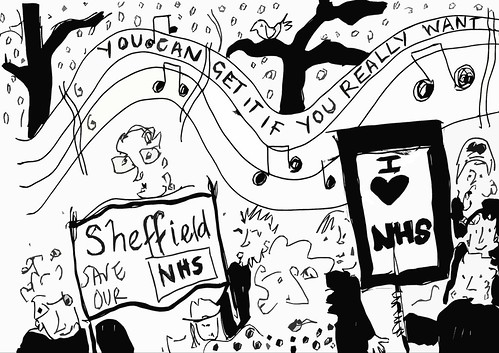
Cartoons by Samantha Galbraith @sgalbraith47
For more national information see Health Campaigns Together and Keep Our NHS Public
FUTURE EVENTS
April 14th 2018 11.45 Regional Demonstration to Save the NHS Leeds
April 25th Soviet Healthcare via Targets: Are Governments Bringing it into the NHS? Roco 2pm or 7pm
April 28th Sheffield Demonstration against proposed closure of the Minor Injuries and Walk-in Centres (see main website for details)
June 27th The NHS is 70 - but what is its life expectancy? Festival of Debate / SSONHS panel discussion and social. Roco 7pm - 11 pm.
June 30th Health Campaigns Together march for the NHS in London See main wesbite for details.
SSONHS planning and information meetings are generally on the first Monday of the month, except for bank holidays. They are usually at 6pm at the United Reform Church. Chapel Walk/Norfolk St S1
To contact us email teamssonhs@gmail.com
PREVIOUS EVENTS
In 2016 abnd 2017 we worked with Sheffield Festival of Debate and other colleagues to promote realistic discussion of the issues facing the NHS. On 4th May 2017 we had a lively meeting debating the future of hospitals and in 2016 we mounted an exhibition on NHS privatisation to coincide with a play, A DUTY OF CARE about Labour and the healthcare market. On 22nd November 2016 we held a panel-led debate on the future of the NHS with local NHS leaders, academics and campaigners. We also held a public meeting on 4th July 2016 to celebrate the NHS anniversary, discuss the STPs, the implications for privatisation in South Yorkshire and North Derbyshire and the consequences of the EU referendum result.
In March 2016 we held a successful workshop Taking Back Our NHS

For our questions to 2017 General Election candidates and canvassers about the NHS see our website campaign page
2016 8th-22nd November Exhibition on NHS privatisation How come we didn't know by London photographer Marion Macalpine
Theatre Delicatessen, The Moor
22nd November SSONHS Festival of Debate event Why is the NHS Under so much pressure? How can we save it for future generations?
Speakers included Dr Tim Moorhead, Chair, Sheffield CCG, Kevan Taylor (Sheffield Health and Social Care Trust) and Professor Sarah Salway (University of Sheffield, Public Health) + local campaigners
Taking Back Our NHS SSONHS workshop
Saturday 12th March 2016, 10am - 2pm
(2015)
Campaigning for GP practices at risk of closure
2nd July Successful SSONHS public meeting addressed by Ray Tallis and speakers from Devonshire Green and Unison.
2nd May SSONHS stall in city centre from 11.30 Come and see us.
The 38 degrees ambulance will also be in Surrey Street at 12pm and conveying the 38 degrees petitions to local Hallam candidates at Wesley Hall in Crookes for 3pm.25th April - March through Sheffield Hallam, with the People's NHS and 38 degrees
28th February 38 degrees petitioning around Sheffield http://www.thestar.co.uk/news/health/local-health/campaigners-take-to-sheffield-streets-in-fight-to-save-nhs-1-7132981
22nd November Leafleting in Sheffield City Centre from 12.00 pm in support of the NHS strikers. For A5 and A4 copies of the leaflet which has more information on it see the Campaigns Page at our website
24th November NHS picket lines from 7am to 11am. Rallies at the Hallamshire and Northern General (Herries Road) at 10 am.
We were proud to support the Jarrow to London march for the NHS, organised by Darlington Mums passing through Sheffield on August Bank Holiday Monday. http://999callfornhs.org.uk/ Thanks to everyone for helping and joining in.
Is our NHS really in crisis? Behind the headlines and soundbites
Panel discussion led by GPs and health experts from the NHS and universities.
For past activities see our website www.sheffieldsaveournhs.co.uk
Wednesday, 30 April 2014

Wednesday, 5 March 2014
Independent Review of Whole Person Care compiled for the Labour Party
Andy Burnham, Shadow Secretary of State for Health commissioned an independent review led by Sir John Oldham - a former high ranking NHS manager - to produce proposals relating to Whole Person Care - i.e. the integration of health and social care. The review was for the Labour Party but was not funded by them or indeed by anyone apparently. It has just been published as
One Person supported by people acting as One Team from organisations behaving as One System
and is available on the Labour policy website Your Britain
Most of the team are from an NHS background, including Professor Hilary Chapman, Director of Nursing at Sheffield Teaching Hospitals. Two are from local government (though one of these is a trained nurse) and one from the Alzheimer's society. At first glance the thrust of the review seems to move towards bringing social care into the NHS structure.
In the introduction the review comments " The emphasis of this report is recommendations for an incoming government in 2015. They are built on three themes: giving meaningful power to people using the health and care system; reorienting the whole system around the true needs of the population in the 21st century; and, addressing the biases in the established system that prevent necessary change happening. For too long health and social care have been considered separately. They are inextricably linked. However we do not believe the answer includes yet another major structural reform at this time. The scale of recent reforms so damaged the NHS and care system that we believe it would not survive intact from a further dose of structural change. We are not saying that the current structures are right, or that they won’t need to change in the future – they aren’t and they will. We reflect some of that in our recommendations on national organisations. However, relationships and culture trump structures. We should not focus now on what the structures are, but the relationships among them, the people who work in them, and what they do. This is the essence of care and what really matters. These changes may not be as tangible and headline grabbing as scrapping and creating organisations. Arguably they are, taken together, more radical."
The recommendations are significant, far reaching and controversial. They include the renaming of NHS England as Care England which would be the strategic lead behind which other NHS organisations including Monitor should aligned themselves. The report recommends that the S75 regulations (on competition) be abolished.
The report is 92 pages and needs careful reading but the issues it raises are probably worth openly debating in the city. Comments and more information are welcome.
One Person supported by people acting as One Team from organisations behaving as One System
and is available on the Labour policy website Your Britain
Most of the team are from an NHS background, including Professor Hilary Chapman, Director of Nursing at Sheffield Teaching Hospitals. Two are from local government (though one of these is a trained nurse) and one from the Alzheimer's society. At first glance the thrust of the review seems to move towards bringing social care into the NHS structure.
In the introduction the review comments " The emphasis of this report is recommendations for an incoming government in 2015. They are built on three themes: giving meaningful power to people using the health and care system; reorienting the whole system around the true needs of the population in the 21st century; and, addressing the biases in the established system that prevent necessary change happening. For too long health and social care have been considered separately. They are inextricably linked. However we do not believe the answer includes yet another major structural reform at this time. The scale of recent reforms so damaged the NHS and care system that we believe it would not survive intact from a further dose of structural change. We are not saying that the current structures are right, or that they won’t need to change in the future – they aren’t and they will. We reflect some of that in our recommendations on national organisations. However, relationships and culture trump structures. We should not focus now on what the structures are, but the relationships among them, the people who work in them, and what they do. This is the essence of care and what really matters. These changes may not be as tangible and headline grabbing as scrapping and creating organisations. Arguably they are, taken together, more radical."
The recommendations are significant, far reaching and controversial. They include the renaming of NHS England as Care England which would be the strategic lead behind which other NHS organisations including Monitor should aligned themselves. The report recommends that the S75 regulations (on competition) be abolished.
The report is 92 pages and needs careful reading but the issues it raises are probably worth openly debating in the city. Comments and more information are welcome.
Wednesday, 26 February 2014
Electronic Care Data - the saga continues
The Care Data protests have forced NHS England rather unapologetically to delay the collection of data from GPs until the autumn The NHS England website http://www.england.nhs.uk/2014/02/19/response-info-share/ states:
To ensure that the concerns of the BMA, RCGP, Healthwatch and other groups are met, NHS England will:
• Begin collecting data from GP surgeries in the Autumn, instead of April, to allow more time to build understanding of the benefits of using the information, what safeguards are in place, and how people can opt out if they choose to;
• Work with patients and professional groups – including the BMA, RCGP and Healthwatch – to develop additional practical steps to promote awareness with patients and the public, and ensure information is accessible and reaches all sections of the community, including people with disabilities;
• Look into further measures that could be taken to build public confidence, in particular steps relating to scrutiny of ways in which the information will be used to benefit NHS patients
The gathering protests also led to the current Health Select Committee inquiry which met yesterday (25thFeb) to get the background. It will get some written evidence and then hold at least one more session to look at proposals for improving the system.
There are several version of why the postponement took place, one being that if the policy was successfully challenged in the courts it would be GPs who would be held liable for permitting the data to be collected rather than NHS England.
GP reaction has varied from trying to opt out all their patients (resulting in threats - late withdrawn - to suspend the GP), some actively contacting patients to tell them about opting out, and others making it pretty difficult to opt out.
It's worth stating that this is a really important issue and the potential value for patient care of the database has led many of those involved to ignore some of the difficulties about setting it up. For a sensitive discussion by Ben Goldacre (and various comments)
There are two issues: one about care data; and one about the arrogance, evasion and apparent incompetence of some types of senior NHS management.
1) Care Data:
Stones are now being rolled back revealing a lot of thoughtless and possibly murky practice. This includes the failure of the new Health and Social Care Information Centre to start this process without having developed and consulted on a code of practice as required by the 2012 Act; the possibility until assurances given this week that even if people opted out, some data would have been extracted; the failure of NHS England to communicate with properly with GPs, let alone the public; and last year's decision of the NHS Information Centre which preceded the new organisation to give the contract for extracting data from GPs to ATOS. It is quite incredible that NHS information managers could have given ATOS the contract to extract data even before pseudonymisation, however fast they were going to transfer it to the 'safe haven' of the HSCIC. If, as was said yesterday, it is technically difficult to psuedonymise the data before or when extracted, then the contract should not have been given to an organisation which has a clear conflict of interest. No way is this in the interests of patients as required by law. The managers also appeared unable to give the Select Committee any firm assurances that the DWP would not be able to access this personal medical data. Both of these factors might well influence a decision to opt out unless further protection is built in.
At least with the Select Committee's involvement, revised plans for care data collection will be opened to public scrutiny and to direct challenge by organisations like Medical Confidential.
All this is a gift to the right wing press like the Telegraph and the Mail which can refer to the NHS thought police. The Telegraph secured an added scoop by revealing (under a misleading headline) that hospital care data for millions of patients was sold (at cost) to representatives of insurance companies who were able to match it up with credit rating information from Experian and use it to raise premiums. What's more the Tories are claiming first that patients were never given the chance by the previous government to opt out from the centralisation of this data (true but the significance of the data is different) and secondly that this was only possible under the previous regime and it cannot happen under the safeguards of the Health and Social Care Act 2012 (something challenged by Medical Confidential and not convincingly defended by the minister and NHS witnesses yesterday).
2) NHS England and the Secretary of State.
Although the Secretary of State remains formally accountable under the 2012, it was clear that it was NHS England on to which the ordure was being shovelled. As one Committee Member pointed out, the Ministerial witness, Dr Dan Poulter, was pretty silent and not able to answer matters of detail.
Evidence is emerging that some of the national organisations set up under the Act are not doing too well. For instance the staff survey of Public Health England reveals very low morale and its head has failed to demonstrate his independence from government. Meanwhile NHS England is affected first by the departure of many skilled staff because of Lansley's reorganisation and cuts, secondly by the pressures being put on those who remain and are in an entirely new structure, and thirdly by an increased tendency, when under pressure, not just to take short cuts but to preserve some of the dictatorial trends of previous centralised NHS regimes. We have already complained about the lack of transparency and accessibility of the local NHS England office. The implementation of the Friends and Family Test is also proving dubious.
The senior managers at HSCIC(some with past private sector involvement) seem to have let their obsession with getting hold of data and their lack of principle in determining end users, get in the way of any understanding of how the public might perceive it. They ostensibly agree that a person's health records are their property but don't take on the implications. They also hide behind the relatively recent creation of the HSCIC to deny any responsibility for or even access to the decisions of the previous NHS Information Centre. As one MP commented, their actions have threatened the doctor patient relationship and discredited the NHS.
They are not going to go, unfortunately, at least for the time being; so we have to hope that some of the damage can be repaired by the processes now being put in place to improve some of the technical aspects of data collection, to tell people more clearly about what is involved, and to make it much simpler to opt out if people wish. The campaign needs to go on in order to exert maximum pressure for an acceptable system. If it cannot be made acceptable, it should not happen.
To ensure that the concerns of the BMA, RCGP, Healthwatch and other groups are met, NHS England will:
• Begin collecting data from GP surgeries in the Autumn, instead of April, to allow more time to build understanding of the benefits of using the information, what safeguards are in place, and how people can opt out if they choose to;
• Work with patients and professional groups – including the BMA, RCGP and Healthwatch – to develop additional practical steps to promote awareness with patients and the public, and ensure information is accessible and reaches all sections of the community, including people with disabilities;
• Look into further measures that could be taken to build public confidence, in particular steps relating to scrutiny of ways in which the information will be used to benefit NHS patients
The gathering protests also led to the current Health Select Committee inquiry which met yesterday (25thFeb) to get the background. It will get some written evidence and then hold at least one more session to look at proposals for improving the system.
There are several version of why the postponement took place, one being that if the policy was successfully challenged in the courts it would be GPs who would be held liable for permitting the data to be collected rather than NHS England.
GP reaction has varied from trying to opt out all their patients (resulting in threats - late withdrawn - to suspend the GP), some actively contacting patients to tell them about opting out, and others making it pretty difficult to opt out.
It's worth stating that this is a really important issue and the potential value for patient care of the database has led many of those involved to ignore some of the difficulties about setting it up. For a sensitive discussion by Ben Goldacre (and various comments)
There are two issues: one about care data; and one about the arrogance, evasion and apparent incompetence of some types of senior NHS management.
1) Care Data:
Stones are now being rolled back revealing a lot of thoughtless and possibly murky practice. This includes the failure of the new Health and Social Care Information Centre to start this process without having developed and consulted on a code of practice as required by the 2012 Act; the possibility until assurances given this week that even if people opted out, some data would have been extracted; the failure of NHS England to communicate with properly with GPs, let alone the public; and last year's decision of the NHS Information Centre which preceded the new organisation to give the contract for extracting data from GPs to ATOS. It is quite incredible that NHS information managers could have given ATOS the contract to extract data even before pseudonymisation, however fast they were going to transfer it to the 'safe haven' of the HSCIC. If, as was said yesterday, it is technically difficult to psuedonymise the data before or when extracted, then the contract should not have been given to an organisation which has a clear conflict of interest. No way is this in the interests of patients as required by law. The managers also appeared unable to give the Select Committee any firm assurances that the DWP would not be able to access this personal medical data. Both of these factors might well influence a decision to opt out unless further protection is built in.
At least with the Select Committee's involvement, revised plans for care data collection will be opened to public scrutiny and to direct challenge by organisations like Medical Confidential.
All this is a gift to the right wing press like the Telegraph and the Mail which can refer to the NHS thought police. The Telegraph secured an added scoop by revealing (under a misleading headline) that hospital care data for millions of patients was sold (at cost) to representatives of insurance companies who were able to match it up with credit rating information from Experian and use it to raise premiums. What's more the Tories are claiming first that patients were never given the chance by the previous government to opt out from the centralisation of this data (true but the significance of the data is different) and secondly that this was only possible under the previous regime and it cannot happen under the safeguards of the Health and Social Care Act 2012 (something challenged by Medical Confidential and not convincingly defended by the minister and NHS witnesses yesterday).
2) NHS England and the Secretary of State.
Although the Secretary of State remains formally accountable under the 2012, it was clear that it was NHS England on to which the ordure was being shovelled. As one Committee Member pointed out, the Ministerial witness, Dr Dan Poulter, was pretty silent and not able to answer matters of detail.
Evidence is emerging that some of the national organisations set up under the Act are not doing too well. For instance the staff survey of Public Health England reveals very low morale and its head has failed to demonstrate his independence from government. Meanwhile NHS England is affected first by the departure of many skilled staff because of Lansley's reorganisation and cuts, secondly by the pressures being put on those who remain and are in an entirely new structure, and thirdly by an increased tendency, when under pressure, not just to take short cuts but to preserve some of the dictatorial trends of previous centralised NHS regimes. We have already complained about the lack of transparency and accessibility of the local NHS England office. The implementation of the Friends and Family Test is also proving dubious.
The senior managers at HSCIC(some with past private sector involvement) seem to have let their obsession with getting hold of data and their lack of principle in determining end users, get in the way of any understanding of how the public might perceive it. They ostensibly agree that a person's health records are their property but don't take on the implications. They also hide behind the relatively recent creation of the HSCIC to deny any responsibility for or even access to the decisions of the previous NHS Information Centre. As one MP commented, their actions have threatened the doctor patient relationship and discredited the NHS.
They are not going to go, unfortunately, at least for the time being; so we have to hope that some of the damage can be repaired by the processes now being put in place to improve some of the technical aspects of data collection, to tell people more clearly about what is involved, and to make it much simpler to opt out if people wish. The campaign needs to go on in order to exert maximum pressure for an acceptable system. If it cannot be made acceptable, it should not happen.
Monday, 3 February 2014
Electronic Centralisation of your NHS medical records. Should you opt out?
Did you realise that in March your GP records will be loaded into a centralised data bank unless you opt out and that this data may be sold on? What is this about and why does it matter? What has happened to medical confidentiality?
During January households in England should have received a leaflet from NHS England outlining its expansion of centralised care data records by uploading everyone’s GP records into a centralised data bank. Of course if you have opted out of receiving junk mail, you won’t have got it? Or it may have got included in a bundle of commercial junk mail which you immediately recycled. Maybe you looked at it and thought what has this got to do with me and ignored it? Maybe you read it but didn’t fully understand what it was about? Or maybe you are part of a small minority of the population who read it and took a conscious decision either to permit your data to be used in this way or to opt out by contacting your GP surgery.
Details about how to opt out including a link to a form are at the end of this post.
There are good arguments for both decisions and it is one for individuals to take. The well known academic and campaigner Alyson Pollock illustrates the difficulty when she calls for opting in to data centralisation but out of data being sold. So why is it a matter for organisations which seek to defend the NHS? Why are organisations like Keep Our NHS Public calling for mass opt outs? After all, this initiative comes from the NHS.
The reason is firstly that the way this scheme has come about is a direct result of the 2012 Health and Social Care Act; secondly that the way it is being implemented (including the dreadful information campaign) is partly because of the NHS structure imposed by the Act; thirdly that it ignores the principle of explicit consent, and fourthly that the fragmentation of the NHS means that data is far more accessible to outsiders including companies which want to use it for profit. Even if the data cannot be shared for the purposes of calculating insurance, the more data which is available in any form to private sector companies with or without NHS contracts, the greater the possibility that it will be used for purposes (including marketing) which help companies to make profits for their shareholders and not for the improvement of your care in the NHS.
This post is based on emails circulated to the Sheffield SSONHS mailing list. NB So far the GPs we know of seem happy to provide further information and answer questions at their Patient Participation Groups (and possibly by other means as well). Those with websites may well have their own opt out forms which can be downloaded.
What’s the issue?
If we want our NHS to work well and for treatment to be based on the best possible evidence, then we need performance reporting and research: both of these have to be based on data. However the collection of data is normally based on a series of protocols which generally include explicit consent of the subjects, especially if the data is both confidential and identifiable.
The NHS has collected a lot of centralised data including hospital care for some time. Since 2010 it has also centralised Summary Care Records for over 32 million people. These enable remote access for NHS staff to important information about patients, namely any medicines you are taking, allergies you suffer from and any bad reactions to medicines that you have had. These are currently being viewed at a rate of 12000 per week, mainly by acute hospital pharmacy staff, but also in emergency care centres and prisons. In 2010 patients were offered the chance to opt out of having Summary Care Records created and about half a million people did opt out. If you did not opt out then, you cannot opt out now – your SCR is in the system.
Now the NHS wants to go further and put most of your GP record into its centralised system. The data will be handled by the Health and Social Care Information Centre (HSCIC) which has enhanced responsibilities under the Health and Social Care Act 2012 to reduce the burden on frontline services by acting as a 'gateway' to bodies seeking to collect data.
'Sensitive’ codes such as sexual health records, pregnancy termination, IVF, marital status, complaints, convictions, and abuse, will not be extracted as part of the care data process, but all other codes, including diagnostic codes, investigation results and information about prescriptions, will be. This could include prescription items that reveal sensitive data, such as medication for HIV or chlamydia, or hormonal treatment for infertility.
The problem is that this data will not be fully anonymised. First of all the records are uploaded from your GP's system in identifiable form before key identifiers are removed to pseudonymise the data so that it remains as an integral record but without an immediately obvious real identity. This is the data which will be most widely shared across the NHS system. However in special circumstances researchers may want access to personal confidential data. This has to be for work in the interest of NHS patients and requires special permission but not from the individual concerned who is already presumed to have consented if their care data has been uploaded. There were 31 permissions granted for the release of identifiable data between April and December 2013 according to Pulse magazine for GPs.
Civil liberty campaigners have for a long time been concerned that as public service databases develop in scope and sophistication, the temptation to join them together for the purposes of government 'efficiency' becomes ever greater, the more so when certain failures of care turn out to be partly due to the right information not having been passed between agencies. On the other hand the unification of databases hugely increases the number of people of different sorts who may have access to personal information about citizens. We already know from the Snowden revelations how much electronic information and traffic is collected by the security services. Now personal medical records can potentially be included.
The possibility of your records being identifiable are first of all if they are intercepted or misrouted before pseudonymisation takes place; secondly after pseudonymisation as it has to be possible for people with administrative access to the system to trace back to the original dataset; and finally if your fully confidential details are passed on to researchers who may be within the NHS, academia, the charity sector, or even in the private sector (see below).
Why does the NHS want to do this?
Some of the reasons are explained in the leaflet and you can get more information from the official website. Some people (including a lot of medical research charities) argue the formation of this databank is a good thing because it will aid NHS planning, auditing and research into health needs.
What's the objection?
The main objection is that it is a betrayal of the confidentiality which patients expect from their doctors, using information which has in the past been given confidentially but will now be much more widely accessible without full anonymisation. See for example Medical Confidentiality and Why I have opted out. For an informed discussion of the dilemma see the Dianthus medical blog.
What will the data be used for?
The Health Care Information System explains its data use and linkage system here. This is where it gives examples of how data is used and who by (including the private sector), and outlines some of the protections. The NHS has promised that the data cannot be used for the purposes of assessing insurance.
How has the NHS handled the proposal?
The NHS has done a pretty poor job and has basically hoped that people would consent by default. WE have to opt out, not to opt in. There has been little or no attempt to engage patient organisations that we are aware of. First of all it tried to put all the burden of informing public and patients onto GPs (as if they were not busy enough already) even threatening them with prosecution if they failed to do so. Then it finally agreed to the national leaflet. And all along it has basically tried to use the formula 'We are your beloved NHS, Trust Us', without realising that what the government has done to the NHS renders it anything but trustworthy.
What should I do?
Well you could have objections in principle - either about the wider dissemination of your data itself or about it being passed in some form or another through myriad hands, including those seeking to profit from involvement with health care. Or you might feel that your data could be used against you in some way. Or you might just feel more insecure about talking to your GP at all. You might want to take a general stance against the creeping data-richness of the state. If so Opt Out before March. Probably the only way to move towards fuller anonymisation will be if sufficient people opt out and this is the action recommended by Keep Our NHS Public (see their leaflet and briefing paper.
On the other hand you could feel that all these risks are pretty hypothetical/negligible, or that you don't have anything to hide, or that having a wider pool of medical histories will be of public benefit in terms of developing treatments and that it in the long run this will help the NHS to plan its facilities more effectively. (One argument in favour of the data centralisation is that it will help improve clinical performance, whereas there is little or no available information about clinical performance in relation to sexual health because confidentiality is much tighter.)
How do I opt out?
To get an opt out form, contact your GP, look on their website or use a form designed by Dr Neil Bhatia who has an informative website http://www.care-data.info/. There is also a slightly briefer version.
Please note that there are apparently 2 levels of opt out each with a code. These are mentioned in the letter section of the form.
9Nu4 is an opt out which is a dissent from any disclosure of personal confidential information.
9Nu0 is the complete opt out from having your data passed on.
You might decide only to opt out from having your identifiable personal records passed on, and if so, ask for code 9Nu4 to be entered in your records. If you want to opt out completely then ask for both codes to be included as it says on the form.
If you go to your practice to opt out, make sure that you don't get given a form for opting out of the Summary Care Record which gives details of prescriptions, allergies etc. This will have no effect. On the other hand, if you opt out of care data centralisation now, you can always opt in at a later date. The uploading will be a continuous process, probably on a monthly basis. If you decide to opt out only at a later stage, future data won't be uploaded but the initial uploads will remain on the system.
During January households in England should have received a leaflet from NHS England outlining its expansion of centralised care data records by uploading everyone’s GP records into a centralised data bank. Of course if you have opted out of receiving junk mail, you won’t have got it? Or it may have got included in a bundle of commercial junk mail which you immediately recycled. Maybe you looked at it and thought what has this got to do with me and ignored it? Maybe you read it but didn’t fully understand what it was about? Or maybe you are part of a small minority of the population who read it and took a conscious decision either to permit your data to be used in this way or to opt out by contacting your GP surgery.
Details about how to opt out including a link to a form are at the end of this post.
There are good arguments for both decisions and it is one for individuals to take. The well known academic and campaigner Alyson Pollock illustrates the difficulty when she calls for opting in to data centralisation but out of data being sold. So why is it a matter for organisations which seek to defend the NHS? Why are organisations like Keep Our NHS Public calling for mass opt outs? After all, this initiative comes from the NHS.
The reason is firstly that the way this scheme has come about is a direct result of the 2012 Health and Social Care Act; secondly that the way it is being implemented (including the dreadful information campaign) is partly because of the NHS structure imposed by the Act; thirdly that it ignores the principle of explicit consent, and fourthly that the fragmentation of the NHS means that data is far more accessible to outsiders including companies which want to use it for profit. Even if the data cannot be shared for the purposes of calculating insurance, the more data which is available in any form to private sector companies with or without NHS contracts, the greater the possibility that it will be used for purposes (including marketing) which help companies to make profits for their shareholders and not for the improvement of your care in the NHS.
This post is based on emails circulated to the Sheffield SSONHS mailing list. NB So far the GPs we know of seem happy to provide further information and answer questions at their Patient Participation Groups (and possibly by other means as well). Those with websites may well have their own opt out forms which can be downloaded.
What’s the issue?
If we want our NHS to work well and for treatment to be based on the best possible evidence, then we need performance reporting and research: both of these have to be based on data. However the collection of data is normally based on a series of protocols which generally include explicit consent of the subjects, especially if the data is both confidential and identifiable.
The NHS has collected a lot of centralised data including hospital care for some time. Since 2010 it has also centralised Summary Care Records for over 32 million people. These enable remote access for NHS staff to important information about patients, namely any medicines you are taking, allergies you suffer from and any bad reactions to medicines that you have had. These are currently being viewed at a rate of 12000 per week, mainly by acute hospital pharmacy staff, but also in emergency care centres and prisons. In 2010 patients were offered the chance to opt out of having Summary Care Records created and about half a million people did opt out. If you did not opt out then, you cannot opt out now – your SCR is in the system.
Now the NHS wants to go further and put most of your GP record into its centralised system. The data will be handled by the Health and Social Care Information Centre (HSCIC) which has enhanced responsibilities under the Health and Social Care Act 2012 to reduce the burden on frontline services by acting as a 'gateway' to bodies seeking to collect data.
'Sensitive’ codes such as sexual health records, pregnancy termination, IVF, marital status, complaints, convictions, and abuse, will not be extracted as part of the care data process, but all other codes, including diagnostic codes, investigation results and information about prescriptions, will be. This could include prescription items that reveal sensitive data, such as medication for HIV or chlamydia, or hormonal treatment for infertility.
The problem is that this data will not be fully anonymised. First of all the records are uploaded from your GP's system in identifiable form before key identifiers are removed to pseudonymise the data so that it remains as an integral record but without an immediately obvious real identity. This is the data which will be most widely shared across the NHS system. However in special circumstances researchers may want access to personal confidential data. This has to be for work in the interest of NHS patients and requires special permission but not from the individual concerned who is already presumed to have consented if their care data has been uploaded. There were 31 permissions granted for the release of identifiable data between April and December 2013 according to Pulse magazine for GPs.
Civil liberty campaigners have for a long time been concerned that as public service databases develop in scope and sophistication, the temptation to join them together for the purposes of government 'efficiency' becomes ever greater, the more so when certain failures of care turn out to be partly due to the right information not having been passed between agencies. On the other hand the unification of databases hugely increases the number of people of different sorts who may have access to personal information about citizens. We already know from the Snowden revelations how much electronic information and traffic is collected by the security services. Now personal medical records can potentially be included.
The possibility of your records being identifiable are first of all if they are intercepted or misrouted before pseudonymisation takes place; secondly after pseudonymisation as it has to be possible for people with administrative access to the system to trace back to the original dataset; and finally if your fully confidential details are passed on to researchers who may be within the NHS, academia, the charity sector, or even in the private sector (see below).
Why does the NHS want to do this?
Some of the reasons are explained in the leaflet and you can get more information from the official website. Some people (including a lot of medical research charities) argue the formation of this databank is a good thing because it will aid NHS planning, auditing and research into health needs.
What's the objection?
The main objection is that it is a betrayal of the confidentiality which patients expect from their doctors, using information which has in the past been given confidentially but will now be much more widely accessible without full anonymisation. See for example Medical Confidentiality and Why I have opted out. For an informed discussion of the dilemma see the Dianthus medical blog.
What will the data be used for?
The Health Care Information System explains its data use and linkage system here. This is where it gives examples of how data is used and who by (including the private sector), and outlines some of the protections. The NHS has promised that the data cannot be used for the purposes of assessing insurance.
How has the NHS handled the proposal?
The NHS has done a pretty poor job and has basically hoped that people would consent by default. WE have to opt out, not to opt in. There has been little or no attempt to engage patient organisations that we are aware of. First of all it tried to put all the burden of informing public and patients onto GPs (as if they were not busy enough already) even threatening them with prosecution if they failed to do so. Then it finally agreed to the national leaflet. And all along it has basically tried to use the formula 'We are your beloved NHS, Trust Us', without realising that what the government has done to the NHS renders it anything but trustworthy.
What should I do?
Well you could have objections in principle - either about the wider dissemination of your data itself or about it being passed in some form or another through myriad hands, including those seeking to profit from involvement with health care. Or you might feel that your data could be used against you in some way. Or you might just feel more insecure about talking to your GP at all. You might want to take a general stance against the creeping data-richness of the state. If so Opt Out before March. Probably the only way to move towards fuller anonymisation will be if sufficient people opt out and this is the action recommended by Keep Our NHS Public (see their leaflet and briefing paper.
On the other hand you could feel that all these risks are pretty hypothetical/negligible, or that you don't have anything to hide, or that having a wider pool of medical histories will be of public benefit in terms of developing treatments and that it in the long run this will help the NHS to plan its facilities more effectively. (One argument in favour of the data centralisation is that it will help improve clinical performance, whereas there is little or no available information about clinical performance in relation to sexual health because confidentiality is much tighter.)
How do I opt out?
To get an opt out form, contact your GP, look on their website or use a form designed by Dr Neil Bhatia who has an informative website http://www.care-data.info/. There is also a slightly briefer version.
Please note that there are apparently 2 levels of opt out each with a code. These are mentioned in the letter section of the form.
9Nu4 is an opt out which is a dissent from any disclosure of personal confidential information.
9Nu0 is the complete opt out from having your data passed on.
You might decide only to opt out from having your identifiable personal records passed on, and if so, ask for code 9Nu4 to be entered in your records. If you want to opt out completely then ask for both codes to be included as it says on the form.
If you go to your practice to opt out, make sure that you don't get given a form for opting out of the Summary Care Record which gives details of prescriptions, allergies etc. This will have no effect. On the other hand, if you opt out of care data centralisation now, you can always opt in at a later date. The uploading will be a continuous process, probably on a monthly basis. If you decide to opt out only at a later stage, future data won't be uploaded but the initial uploads will remain on the system.
Wednesday, 1 January 2014
Minimum financial allocations to CCGs match official inflation forecasts but will still be a cut
NHS England has published the new CCG financial allocations. As expected, the threat of actual cash cuts contained in the consultation paper which most people in the North objected to, was lifted. Sheffield and the majority of CCGs will receive an inflation equivalent increase of 2.14%. This represents a recognition from NHS England that a complete change to age-related population funding would be both destabilising and unacceptable in many areas. Although NHS and Council officials in Sheffield will breathe a mighty sigh of relief this is not quite the victory which a press release from Sheffield City Council appears to suggest. The inflation increase is based on the 4 year low of 2.1% recorded in November. The total budget uplift for the NHS next year is 3.1% but there are several reasons for expecting inflation to rise again, and NHS inflation when there are normal wage rises tends to be around 1% higher than the general rate. So it's unlikely that CCGs receiving 2.14% will have the same purchasing power as this year. However Cambridgeshire (Lansley's constituency) gets 2.9% and Oxfordshire (including Cameron's constituency) gets 3.32%. London averages a 3.07% increase and the Thames Valley 3.48%.
Both the inflation forecast and the minimum allocation increases for CCGs for 2015-5 are 1.7% (2.3% for the NHS as a whole).
NHS England bases the reallocations on a new formula which includes factors for age, population, and deprivation, as well as differing regional costs (the Market Forces Factor). Applying the formula produces target allocations for each CCG which may differ significantly from their current allocations (partly because of the way in which populations are estimated). The actual allocations are intended to move slightly towards the targets partly in order to deal with CCG deficits. 16 of the 37 CCGs forecasting a deficit this year are on average 5% below the proposed formula target and 31 of the 37 are under target. However despite an adjustment for inequality, some of the most disadvantaged areas are probably not getting what they need (e.g.for liver disease) http://www.theguardian.com/society/2013/dec/30/liver-disease-deaths-starved-nhs-funds
Note also that the Better Care Fund (BCF) (promoting integrated services for older and vulnerable people) will become operational in 2015-6 with expected funding of £3.8bn pooled from existing core committed funding within the Department of Health, the Department for Communities, Local Government, and CCGs. Over time this fund, to be overseen by local Health and Wellbeing Boards is intended to shift the balance of resources from the acute sector into primary, community and social care. However according to Sir David Nicholson "the fund does not in itself address the financial pressures faced by local authorities and CCGs in 2015/16, which remain very challenging" and "the requirements of the fund are likely to significantly exceed existing pooled budget arrangements. Councils and CCGs will, therefore, have to redirect funds from these activities to shared programmes that deliver better outcomes for individuals." Plans are supposed to be in place from February.
Saturday, 14 December 2013
What's going on in the NHS?
It’s quite difficult for people to get a grip on what is happening in the NHS at the moment. Even the trade unions seem to have gone quiet despite the success of the march on 29th September.
At national level the government is slowly realising some of the consequences of the distortions it has created through the Health and Social Care Act and looks like being caught in a trap as the NHS tries to move forward (e.g. by introducing more service availability at weekends etc) but finds itself tangled up in competition law and continuing financial and resource issues.
The Conservatives are probably not too displeased at the drip drip exposure of actual or alleged poor practice in parts of the NHS since it softens services up for tendering out once the time is right. This process will be eased by new measures being slipped through such as making it easier for administrators of failing hospitals to insist on changes in neighbouring services (Clause 118 of the Care Bill to be debated in the Commons on Monday 16th Dec), and the looming negotiation on the EU/USA free trade pact.
However privatisation is itself in trouble. Serco is abandoning contracts for GP services in Cornwall and hospital services in Braintree and admits that its operations in Suffolk are not producing the profits it had hoped for. Serco now says these services are no longer core to its healthcare strategy. So once again the promises of the private sector have no more value than tinsel. When problems start they just walk away, leaving the public sector and the taxpayer to clear up the mess.
Desperate for the NHS not to be too much of an election issue, the Coalition is applying financial sticking plaster over issues such as winter pressures. Meanwhile the rising profile of patient safety has forced some government induced practices (including trying to save money by reducing nursing staff) into reverse. At local level things appear on the surface to be on fairly even keel in Sheffield, though there are major threats to the current configuration of services in Rotherham. There is concern across South Yorkshire that there may be quite a lot of outsourcing going on for smaller services which only people working in the NHS may realise is happening.
Also, as hospitals come under pressure to increase the ratio of qualified nursing staff on wards, they may try and compensate by substituting qualified staff in community services by different types of health ‘assistant’ with lower level training. There is real concern about the quality of service such assistants may be able to deliver, not least because their knowledge may not be wide enough to deal with the different issues they may face.
Late December and early January will see a series of national and local policy announcements which are likely to spark off further campaigning. The principles for calculating CCG financial allocations from 2015 are expected to be agreed at the NHS England Board meeting next Tuesday, when we will know if the age of local populations will be used as the main weighting for allocation adjustments, rather than measures of deprivation. This will lead to major cuts, especially in the north of England. Sheffield Health and Wellbeing Board have made what they say are vigorous representations and briefed MPs for recent publicity. Allocations for 2014-15 will probably be announced just before Christmas. In January the CCG will consider the future commissioning of musculoskeletal care. Meanwhile local partnership organisations are concentrating on finding ways to improve primary care.
Thursday, 31 October 2013
Blog update October 31 2013
Apologies for the delays in updating this blog - technical problems on site which we hope are now resolved.
New posts will appear from the beginning of November.
New posts will appear from the beginning of November.
Tuesday, 25 June 2013
Defending the NHS as it reaches 65
Remember the BBC2 series on the NHS last month, filmed over one day in October. What a fantastically complex organisation, whirring away in so many forms and dimensions. Is it any wonder that it goes wrong sometimes, however hard we all try. But patients have generally been forgiving if they feel that the service was doing as much as it could - the local population has marched in support of Mid-Staffordshire Hospital for example and it is moving, especially in these days of compensation culture, to here people who have suffered injury or loss emphasising that their priority is to make sure that bad events are not repeated.
That is what is so discouraging about the alleged cover up at the CQC - and the embarrassed and embarrassing wriggles by both Lansley and Andy Burnham who were responsible ministers at different times. The Francis Report on Mid-Staffs exonerated the Department of Health from being a bullying culture (just about) but there can be little doubt that there was a culture of fear - at senior as well as at middle management levels. However much the NHS might try to encourage a 'no blame' culture to help people own up to clinical mistakes (they probably ought to go back to the old name of a learning culture now) politicians and the media search for others on whom to lay blame, creating their own victims. Alternatively if issues look like causing problems directly, they look for the nearest carpet whose corner to lift. The banality that is Jeremy Hunt thinks the answer is more and better regulation, but regulation carries its own costs and inefficiencies (cf Ofsted). A fragmented NHS would have to spend even more on regulation to try and secure standards in the services commissioned from different sectors. How much better it would be to have more emphasis (and spending) on a shared and genuine commitment to quality and safety at the front line - something difficult if not impossible to achieve within a competitive market. (See background to the CQC issue at http://www.guardian.co.uk/commentisfree/2013/jun/24/nhs-cqc-cover-up-market-failure
Now, more than a year since the Act was passed, and a few months since it came into operation, the forces who want to break up the NHS are pushing harder and harder. GPs are now beginning to realise how much the NHS reforms have put them in the firing line, something we warned about time and time again. David Nicholson, for all his centralism etc, has at least been a staunch defender of the basic ideal. But the people being mooted to succeed him are of a different ilk. Of those being mooted as favourites, two ex NHS managers are prominent advocates of outsourcing (Mark Britnell, head of global healthcare for KPMG) who told US providers what great opportunities awaited them) and Simon Stevens, Tony Blair's advisor, and vice president of the United Health Group. And of course Nick Seddon, an advocate of private healthcare, has just been appointed as Cameron's advisor. (Several internal candidates have blots on their copybooks: Mike Farrar was Chair of North West SHA until fairly recently and Ian Dalton recently left for BT Global Healthcare.) Issues like Serco's falsification of figures in the West Country, Harmoni's failures in NHS 111, Circle's financial difficulties, and the fiasco of the NHS 111 commissioning won't halt these people.
Charges have raised their head again, including among BMA members, though it is to be hoped that their annual conference will firmly push this down. The overwhelming passing of a motion of no confidence in Jeremy Hunt was a good start (and see the article by Jacky Davis at http://www.guardian.co.uk/commentisfree/2013/jun/23/betrayals-nhs-doctors-fight-back-bma?INTCMP=SRCH. Apart from undermining basic principles, creating its own costs, and worsening equality issues, it will change the nature of the patient-doctor relationship - staff will find patients becoming more not less demanding if there is any element of payment (cf students and university lecturers).
We will need to debate these issues and more over the coming months as well as marshalling the defence of local services.
Subscribe to:
Posts (Atom)