Apologies that there have been no new updates for a while. Most information is now on our revamped website - with further improvements planned for later this year and updates here will be only occasional. If you want to be on our email list which contains various posts with updates and information please contact teamssonhs@gmail.com.
There have been two main focuses of activity in Sheffield during the last six months - active participation in the Clinical Commissioning Group's consultation on Urgent Care - involving the closure of the Minor Injuries Unit at the Hallamshire and the Walk-In Centre at Broad Lane, plus the regrading of the Eye Clinic to Emergency only. The proposal was to replace these with an Urgent Care Centre at Northern General Hospital and to improve access to GP appointments and non-emergency eye care in localities. We helped mount a significant campaign which persuaded the CCG to extend the consultation deadline from December to the end of January, generated several petitions totalling over 10000 signatures, particularly to save the Minor Injuries Unit and pushed the CCG in to reevaluating its proposals in the light of suggestion made by campaigners (and other NHS organisations) across the city.
The CCG Primary Care Commissioning Committee will be considering the results of this work on May 17th. Pressure will need to be kept up if it is not to revert to a reiteration of the original proposals.
The other focus has been the development of local NHS organisations into South Yorkshire and Bassetlaw STP footprints (Sustainability and Transformation Plans, then Partnerships) followed by Accountable Care Systems (then Organisations) and then Integrated Care Systems (or Partnerships). South Yorks is one of 8 Vanguard organisations for this in the country and has got some extra resources but the whole process has been very murky despite the SYB ICS adopting the hashtag Honest and Open. Anxiety about the future of local services has been mounting in Barnsley, Bassetlaw, Doncaster and Rotherham. Banrsley have instituted a judicial review application of the consultation so far carried out about stroke services and Doncaster have initiated a formal S Yorks Save Our NHS Party which will be standing National Health Action Party Treasurer Naveen Judah from Rotherham in the Sheffield City Region Elections.
In Sheffield the Accountable Care Partnership Board which has been meeting privately for a year will begin public meetings in June. The Council is part of this Board in shadow format and has undertaken to consult further if the Board becomes formalised with local powers before fully signing up.
There will be a debate about accountable care and decision making at a Festival of Debate event on 26th June and SSONHS will hold its FoD panel debate on 27th June at Roco.
We are a grassroots movement comprising people from all walks of life who are, or will be affected by the government’s austerity measures and spending cuts to NHS Services across England. We also strongly oppose the creeping privatisation of the NHS by successive governments. Privatisation = Profit not Good Patient Care
RESIST THE BREAKUP OF THE NHS THROUGH PRIVATISATION AND CUTS!
BRIEF UPDATE April 2018
(N.B. This site is not currently being regularly updated. )
FOR COMING EVENTS, MEETINGS AND OTHER INFORMATION
SEE BELOW AND THE MAIN SSONHS WEBSITE
To be put on the SSONHS mailing list or for any other queries please email teamssonhs@gmail.com
The government's increasingly desperate attempts to defend their record on the NHS have become less and less credible over the last year. This is partly due to increasingly effective local and national campaigns and partly to the crisis in hospitals, primary care and social care has forced more and more of those involved to speak out against the damage being caused by austerity. But many of those who are being damaged have no voice. Poor people, disabled people and the chronically ill have fewer opportunities to make their case as their benefit and treatment rights become eroded. NHS staff are generally gagged in one way or another. Exit can be the only escape leaving the NHS still weaker and now less and less able to recruit staff from overseas.
Large national demonstrations and industrial action by junior doctors, nurses and others have made the strength of feeling around the country quite clear, to the extent that even the Conservatives have got worried enough to promise the outlines of a new financial deal this summer. But will it be too late? Certainly it will be insufficient to undo the damage inflicted since 2010. Meanwhile the stress on services which affect the need for healthcare becomes more and more acute. The unspupported costs of Social Care (which is subject to means tested charges) is driving local authorities to bankruptcy.
Another threat is the developing reorganisation into Integrated Care Systems (previously known as Accountable Care Systems) which threaten to become Accountable Care Organisations. In our local area the Integrated Care System covers Barnsley, Rotherham, Doncaster and Bassetlaw as well as Sheffield. (See posts below.) Increasing pressure from campaigners and within the Labour Party is deterring local councils to sign up to these in case they become vehicles for further cuts and privatisation.
Across South Yorkshire resistance is building to the threatened implications of the ICS for local services and South Yorkshire Save Our NHS have formed a political party to stand in the Sheffield City Region Mayoral election on May 3rd 2018. See also Barnsley Save Our NHS.
THE NHS IS
 NOT KILLED OFF YET. Campaigning does work whether on the streets, in the press or, increasingly in the lawcourts. The government's high-handed tactics are being subjected to an increasing number of judicial reviews. At national level these have forced a public consultation on Accountable Care Organisations starting in May 2018.
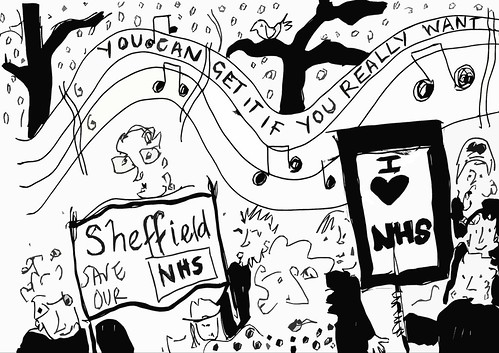
Cartoons by Samantha Galbraith @sgalbraith47
For more national information see Health Campaigns Together and Keep Our NHS Public
FUTURE EVENTS
April 14th 2018 11.45 Regional Demonstration to Save the NHS Leeds
April 25th Soviet Healthcare via Targets: Are Governments Bringing it into the NHS? Roco 2pm or 7pm
April 28th Sheffield Demonstration against proposed closure of the Minor Injuries and Walk-in Centres (see main website for details)
June 27th The NHS is 70 - but what is its life expectancy? Festival of Debate / SSONHS panel discussion and social. Roco 7pm - 11 pm.
June 30th Health Campaigns Together march for the NHS in London See main wesbite for details.
SSONHS planning and information meetings are generally on the first Monday of the month, except for bank holidays. They are usually at 6pm at the United Reform Church. Chapel Walk/Norfolk St S1
To contact us email teamssonhs@gmail.com
PREVIOUS EVENTS
In 2016 abnd 2017 we worked with Sheffield Festival of Debate and other colleagues to promote realistic discussion of the issues facing the NHS. On 4th May 2017 we had a lively meeting debating the future of hospitals and in 2016 we mounted an exhibition on NHS privatisation to coincide with a play, A DUTY OF CARE about Labour and the healthcare market. On 22nd November 2016 we held a panel-led debate on the future of the NHS with local NHS leaders, academics and campaigners. We also held a public meeting on 4th July 2016 to celebrate the NHS anniversary, discuss the STPs, the implications for privatisation in South Yorkshire and North Derbyshire and the consequences of the EU referendum result.
In March 2016 we held a successful workshop Taking Back Our NHS

For our questions to 2017 General Election candidates and canvassers about the NHS see our website campaign page
2016 8th-22nd November Exhibition on NHS privatisation How come we didn't know by London photographer Marion Macalpine
Theatre Delicatessen, The Moor
22nd November SSONHS Festival of Debate event Why is the NHS Under so much pressure? How can we save it for future generations?
Speakers included Dr Tim Moorhead, Chair, Sheffield CCG, Kevan Taylor (Sheffield Health and Social Care Trust) and Professor Sarah Salway (University of Sheffield, Public Health) + local campaigners
Taking Back Our NHS SSONHS workshop
Saturday 12th March 2016, 10am - 2pm
(2015)
Campaigning for GP practices at risk of closure
2nd July Successful SSONHS public meeting addressed by Ray Tallis and speakers from Devonshire Green and Unison.
2nd May SSONHS stall in city centre from 11.30 Come and see us.
The 38 degrees ambulance will also be in Surrey Street at 12pm and conveying the 38 degrees petitions to local Hallam candidates at Wesley Hall in Crookes for 3pm.25th April - March through Sheffield Hallam, with the People's NHS and 38 degrees
28th February 38 degrees petitioning around Sheffield http://www.thestar.co.uk/news/health/local-health/campaigners-take-to-sheffield-streets-in-fight-to-save-nhs-1-7132981
22nd November Leafleting in Sheffield City Centre from 12.00 pm in support of the NHS strikers. For A5 and A4 copies of the leaflet which has more information on it see the Campaigns Page at our website
24th November NHS picket lines from 7am to 11am. Rallies at the Hallamshire and Northern General (Herries Road) at 10 am.
We were proud to support the Jarrow to London march for the NHS, organised by Darlington Mums passing through Sheffield on August Bank Holiday Monday. http://999callfornhs.org.uk/ Thanks to everyone for helping and joining in.
Is our NHS really in crisis? Behind the headlines and soundbites
Panel discussion led by GPs and health experts from the NHS and universities.
For past activities see our website www.sheffieldsaveournhs.co.uk
Wednesday, 11 April 2018

Friday, 2 June 2017
Could support for the NHS block May's attempt at a landslide election victory?
Theresa May's Easter meditations let her to thoughts of a triumphant Tory Ascension to a landslide election victory. But things haven't quite worked out like this. Corbyn's defiance and gathering support, reinforced by the way that other parties have plugged not just the plight of the NHS but of all public services, have forced May into Fortress Brexit.
It is vital to keep public attention on to the financial and staffing crises facing the NHS. Make no mistake, if the Conservatives achieve a substantial majority they will tell Simon Stevens to get on with his Forward View, devised at Davos with the help of his previous employers United Healthcare, and deliver a reduced but supposedly more efficient NHS which will meet his financial targets. Rationing and closures will increase apace as the unaccountable Sustainability and Transformation Plans take hold, imposed by Boards to which local CCGs have ceded power, even though they are the organisations which are currently statutorily responsible for ensuring our health care.
Allthough none of the parties are promising resource to the level which NHS providers are asking for, the Conservatives offer the least and their u-turns on social care betray the fact that few of them have any actual idea about public services and those who use them. Jeremy Hunt told Sky News that more funding for the NHS depended on a good Brexit deal. So where is his commitment? There may not be an NHS by that time on Tory levels of resourcing. Labour offers the most, but only if it can raise the money not just for the NHS but for its other promises as it seeks to undo some of the misery imposed by the Conservatives and their Coalition predecessors. The Greens offer principled opposition and go further than Labour in seeking to undo current 'directions of travel' such as the Sustainability and Transformation Plans but are short on practical proposals.
SSONHS supporters include members of electorally competing parties as well as those who are non-aligned or support other groups. We don't therefore have a specific electoral line but we urge supporters, young and old, to vote for the NHS. Remember also that if you are in what seems like a safe seat, your vote is still important in terms of turnout. The fact that Trump lost the popular vote to Clinton, despite winning in the electoral college, is still something which gives encouragement to all those who want to see him reined in.
It is vital to keep public attention on to the financial and staffing crises facing the NHS. Make no mistake, if the Conservatives achieve a substantial majority they will tell Simon Stevens to get on with his Forward View, devised at Davos with the help of his previous employers United Healthcare, and deliver a reduced but supposedly more efficient NHS which will meet his financial targets. Rationing and closures will increase apace as the unaccountable Sustainability and Transformation Plans take hold, imposed by Boards to which local CCGs have ceded power, even though they are the organisations which are currently statutorily responsible for ensuring our health care.
Allthough none of the parties are promising resource to the level which NHS providers are asking for, the Conservatives offer the least and their u-turns on social care betray the fact that few of them have any actual idea about public services and those who use them. Jeremy Hunt told Sky News that more funding for the NHS depended on a good Brexit deal. So where is his commitment? There may not be an NHS by that time on Tory levels of resourcing. Labour offers the most, but only if it can raise the money not just for the NHS but for its other promises as it seeks to undo some of the misery imposed by the Conservatives and their Coalition predecessors. The Greens offer principled opposition and go further than Labour in seeking to undo current 'directions of travel' such as the Sustainability and Transformation Plans but are short on practical proposals.
SSONHS supporters include members of electorally competing parties as well as those who are non-aligned or support other groups. We don't therefore have a specific electoral line but we urge supporters, young and old, to vote for the NHS. Remember also that if you are in what seems like a safe seat, your vote is still important in terms of turnout. The fact that Trump lost the popular vote to Clinton, despite winning in the electoral college, is still something which gives encouragement to all those who want to see him reined in.
Thursday, 27 October 2016
Sustainability and Transformation Plan update
The STPs look like being neither sustainable nor transforming, except for introducing cuts. They're more like castles in the air. At the time of writing the STPs are still mostly secret despite having been submitted on 21st October. Some details of the Sheffield Place Plan were published at the Sheffield CCG meeting on 6th October here. NHS England have instructed that all local communication about the STPs must be processed through their central communications team.
Some call the STPs the least bad option (Chris Ham here) but campaigners like John Lister of London Health Emergency and Keep Our NHS Public are more scathing. Campaigners are pushing local Councils not to sign up to the STPs if they involve cuts. Two London Councils decided to publish the STPs anyway in order to bring them into the public domain and, because they involve disputed hospital closures, to seek a judicial review.
Opposing STPs does put cash-strapped councillors in a dilemma because the STPs are a potential source of funds for social care. But to accept this is just making matters worse. The plans need to be part of a proper public debate which must surely but back pressure on Hunt and May to recognise they can't go on pretending that the NHS is managing. Cracks are appearing all over. The Chancellor's neglect of the NHS and social care in his Autumn Statement was quite shocking.
Update 28th November
The South Yorkshire and Bassetlaw STP has been published on the website of South and Mid Yorkshire Commissioners Working Together, the group which is providing administrative support for the STP. Here you can also find consultation proposals about the reconfiguration of Hyper acute stroke services and children's surgery. (Scroll down for the link to the STP page).
The STP does not involve any immediate cuts in Sheffield but significant changes are hinted at. The financial strategy is not yet written or agreed.
We have attended a number of local events to challenge assumptions in the STP process but both the STP and the Sheffield Plan are up for approval at Sheffield CCG on 1st December.
Update 10th December
Sheffield Clinical Commissioning Group agreed the Direction of Travel of the STP and also approved the outline of the Sheffield Plan. However at the full meeting of Sheffield Council on 7th December Cllr Cate Macdonald, Cabinet Member for Health and Social Care, said that it was not currently the intention of the Council to approve the STP because of the implications of agreeing the cuts which it implies, both at local and national level. Hostility has also been expressed within Barnsley Council. Other Councils up and down the country (including Tory controlled Devon) have also refused to agree their STPs. The NHS leadership is showing signs that it recognises the process is in trouble, but for the moment it remains the only game in town. There is likely to be more consultation and wooing of Councils and other organisations but the press seems clear that Theresa May is adamant in her refusal of more money for the NHS despite its increasing desperation. Expect more trouble and confrontation from many quarters, not excluding staff groups as things become more and more stretched.
The Shaping Sheffield event held on 8th December was notable for avoiding the phrase STP wherever possible (though it was raised by the SSONHS speaker) and it seems likely that the Sheffield Plan (which predates the STP though is based on similar principles) will carry on edging forward under its own branding.
Some call the STPs the least bad option (Chris Ham here) but campaigners like John Lister of London Health Emergency and Keep Our NHS Public are more scathing. Campaigners are pushing local Councils not to sign up to the STPs if they involve cuts. Two London Councils decided to publish the STPs anyway in order to bring them into the public domain and, because they involve disputed hospital closures, to seek a judicial review.
Opposing STPs does put cash-strapped councillors in a dilemma because the STPs are a potential source of funds for social care. But to accept this is just making matters worse. The plans need to be part of a proper public debate which must surely but back pressure on Hunt and May to recognise they can't go on pretending that the NHS is managing. Cracks are appearing all over. The Chancellor's neglect of the NHS and social care in his Autumn Statement was quite shocking.
Update 28th November
The South Yorkshire and Bassetlaw STP has been published on the website of South and Mid Yorkshire Commissioners Working Together, the group which is providing administrative support for the STP. Here you can also find consultation proposals about the reconfiguration of Hyper acute stroke services and children's surgery. (Scroll down for the link to the STP page).
The STP does not involve any immediate cuts in Sheffield but significant changes are hinted at. The financial strategy is not yet written or agreed.
We have attended a number of local events to challenge assumptions in the STP process but both the STP and the Sheffield Plan are up for approval at Sheffield CCG on 1st December.
Update 10th December
Sheffield Clinical Commissioning Group agreed the Direction of Travel of the STP and also approved the outline of the Sheffield Plan. However at the full meeting of Sheffield Council on 7th December Cllr Cate Macdonald, Cabinet Member for Health and Social Care, said that it was not currently the intention of the Council to approve the STP because of the implications of agreeing the cuts which it implies, both at local and national level. Hostility has also been expressed within Barnsley Council. Other Councils up and down the country (including Tory controlled Devon) have also refused to agree their STPs. The NHS leadership is showing signs that it recognises the process is in trouble, but for the moment it remains the only game in town. There is likely to be more consultation and wooing of Councils and other organisations but the press seems clear that Theresa May is adamant in her refusal of more money for the NHS despite its increasing desperation. Expect more trouble and confrontation from many quarters, not excluding staff groups as things become more and more stretched.
The Shaping Sheffield event held on 8th December was notable for avoiding the phrase STP wherever possible (though it was raised by the SSONHS speaker) and it seems likely that the Sheffield Plan (which predates the STP though is based on similar principles) will carry on edging forward under its own branding.
Sunday, 25 September 2016
Sheffield's "Place Plan" - part of the South Yorkshire and Bassetlaw STP
The NHS was instructed early this year to prepare Sustainability and Transformation Plans for 44 NHS Footprint areas. Ours is South Yorkshire and Bassetlaw and it is founded on so-called Place Plans for each of the CCG areas involved. The foundation for Sheffield's Place Plan is the Out of Hospital Strategy previously adopted by the CCG.
The STPs are unequivocally about getting the NHS to make local decisions about how to manage within the very tight and effectively reducing Government budget for the NHS. Nervous about this, NHS England placed a ban on public involvement during the preparation of the plans. In many areas (including West Yorkshire) they involve hospital closures. Some London Councils have refused to sign up to STPs where they involve the closure of popular facilities and the organisation Health Campaigns Together is calling on all Councils to refuse to sign up to STPs where they involve significant closures.
Some details of the Sheffield Plan will be made available on 29th Sept but local statements suggest that the process is currently more fluid than the early proclamations from NHS England anticipated. Although the plans are scheduled for implementation from April 2017 there will have to be formal public consultation from October. In Sheffield this will include sub-regional consultation on new proposals for hyper-acute stroke and paediatric surgery services - separate from but linked to the STP - and any changes deemed 'significant' by Sheffield CCG on Urgent and Emergency Care. the changes to stroke and paediatric services will involve some services ceasing in some centres (e.g. Barnsley and Rotherham) in order to reinforce/improve the regional services from the centres regarded as stronger (including Sheffield. This will have implications for income, viability and capacity in all local hospitals and the consultation will need to be vigorously addressed.
The Sheffield Plan is due to be approved by the Clinical Commissioning Group on 1st December and will be the subject of a citywide workshop on 8th December, hosted by Sheffield Health and Wellbeing Board and Sheffield Healthwatch.
The STPs are unequivocally about getting the NHS to make local decisions about how to manage within the very tight and effectively reducing Government budget for the NHS. Nervous about this, NHS England placed a ban on public involvement during the preparation of the plans. In many areas (including West Yorkshire) they involve hospital closures. Some London Councils have refused to sign up to STPs where they involve the closure of popular facilities and the organisation Health Campaigns Together is calling on all Councils to refuse to sign up to STPs where they involve significant closures.
Some details of the Sheffield Plan will be made available on 29th Sept but local statements suggest that the process is currently more fluid than the early proclamations from NHS England anticipated. Although the plans are scheduled for implementation from April 2017 there will have to be formal public consultation from October. In Sheffield this will include sub-regional consultation on new proposals for hyper-acute stroke and paediatric surgery services - separate from but linked to the STP - and any changes deemed 'significant' by Sheffield CCG on Urgent and Emergency Care. the changes to stroke and paediatric services will involve some services ceasing in some centres (e.g. Barnsley and Rotherham) in order to reinforce/improve the regional services from the centres regarded as stronger (including Sheffield. This will have implications for income, viability and capacity in all local hospitals and the consultation will need to be vigorously addressed.
The Sheffield Plan is due to be approved by the Clinical Commissioning Group on 1st December and will be the subject of a citywide workshop on 8th December, hosted by Sheffield Health and Wellbeing Board and Sheffield Healthwatch.
Wednesday, 29 June 2016
So after the Brexit vote, what next?
Whatever you make of the Brexit vote, the ensuing chaos must be laid firmly at the door of the Conservative Party which forced the idea of the referendum, organised it (if that's the right word), failed to be honest about the issues (on either side), alienated the public and failed also to plan for an unexpected result.
The EU Leave campaign made a deliberate point of promising extra money for the NHS. The extent of the pledge was quickly revealed to be a lie and, indeed, post referendum, has already been retreated from by the likes of Nigel Farage. Nevertheless comments from the public both before and after referendum day suggested that it stuck in the memory and influenced people’s votes.
Whatever happens to the UK’s relationship with the EU after the vote in favour of Leave, the current government's austerity programme has placed the NHS in dire trouble and it is now issuing new threats to public spending. Goerge Osborne warned that even his so-called protection for the NHS budget was unlikely to be guaranteed. Starved of resources, haemorrhaging clinical staff, and facing continually rising expectations, the NHS faces new threats of further cuts because of growing economic weakness, rising inflation as a result of currency fluctuation and the likely diminution of the 52000 EU immigrant staff who help to keep services meeting patient need. As budgets get tighter national and local NHS leaders are being forced into ever more contortions to keep the service going - the latest being so-called Sustainability and Transformation Plans, in our case covering the whole of South Yorkshire and Bassetlaw. In many parts of the country these plans introduce cuts and closures and are already subject to challenge.
In the General Election our area voted overwhelmingly for pro-NHS candidates but in the referendum it voted narrowly for Leave. Few in Sheffield want to see the NHS collapse so we have a collective responsibility to ensure that what we value about our system lives on. We, the public, NHS patients and NHS staff, whether we are Remainers or Brexiters, need to care for the NHS both in the demands we must make of decision makers in all parts of the political spectrum and in the way in which we use it. Otherwise. before very long, we will find ourselves faced with an increasing spread of charges and the collapse of many parts of the system into private hands with no sense of responsibility to society at large. We've already seen the mess which has been left in places like Nottingham, Cambridgeshire and Cornwall when that happens. Sheffield Save Our NHS will be continuing to campaign both locally and in partnership with others in Yorkshire and the rest of the country to keep the NHS as a public provider of quality universal health care.
Come to our meeting on 4th July at the United Reform Church (6.30 for 7pm) to celebrate the 68th anniversary of the NHS, to hear about developments across Yorkshire, and to plan how best to campaign for the NHS in the future.
The EU Leave campaign made a deliberate point of promising extra money for the NHS. The extent of the pledge was quickly revealed to be a lie and, indeed, post referendum, has already been retreated from by the likes of Nigel Farage. Nevertheless comments from the public both before and after referendum day suggested that it stuck in the memory and influenced people’s votes.
Whatever happens to the UK’s relationship with the EU after the vote in favour of Leave, the current government's austerity programme has placed the NHS in dire trouble and it is now issuing new threats to public spending. Goerge Osborne warned that even his so-called protection for the NHS budget was unlikely to be guaranteed. Starved of resources, haemorrhaging clinical staff, and facing continually rising expectations, the NHS faces new threats of further cuts because of growing economic weakness, rising inflation as a result of currency fluctuation and the likely diminution of the 52000 EU immigrant staff who help to keep services meeting patient need. As budgets get tighter national and local NHS leaders are being forced into ever more contortions to keep the service going - the latest being so-called Sustainability and Transformation Plans, in our case covering the whole of South Yorkshire and Bassetlaw. In many parts of the country these plans introduce cuts and closures and are already subject to challenge.
In the General Election our area voted overwhelmingly for pro-NHS candidates but in the referendum it voted narrowly for Leave. Few in Sheffield want to see the NHS collapse so we have a collective responsibility to ensure that what we value about our system lives on. We, the public, NHS patients and NHS staff, whether we are Remainers or Brexiters, need to care for the NHS both in the demands we must make of decision makers in all parts of the political spectrum and in the way in which we use it. Otherwise. before very long, we will find ourselves faced with an increasing spread of charges and the collapse of many parts of the system into private hands with no sense of responsibility to society at large. We've already seen the mess which has been left in places like Nottingham, Cambridgeshire and Cornwall when that happens. Sheffield Save Our NHS will be continuing to campaign both locally and in partnership with others in Yorkshire and the rest of the country to keep the NHS as a public provider of quality universal health care.
Come to our meeting on 4th July at the United Reform Church (6.30 for 7pm) to celebrate the 68th anniversary of the NHS, to hear about developments across Yorkshire, and to plan how best to campaign for the NHS in the future.
Sunday, 19 June 2016
The EU Leave campaign has no right to claim the NHS logo
SSONHS isn't taking a stance on whether the UK should or shouldn't remain in the EU. However we decided to circulate a comment to our email list on the unjustified use of the NHS logo on Leave publicity material including bus advertising. We thought that NHS England had not challenged this but a reply told us that apparently government lawyers did request them to stop in March but the Leave campaign refused accusing the government of 'bully-boy tactics' and no further action was taken. It says a lot about the debasement of the logo through its regular licensing to private firms that NHS England went no further than a threat and that the Leave campaign was so shameless.
Whatever side you are on in the referendum debate the NHS should not in itself be a crunch issue although broader health considerations may be. The NHS is not directly relevant to the basic arguments for or against EU membership especially as the debate becomes increasingly polarised between those who consider they have a lot to lose and those voters who feel they have very little left to lose.
The basic trope of the Leave campaign in relation to the NHS is that more money will be available for the NHS if we leave and that pressure on services will be reduced because there will be less immigration. Two Tories have commented on the finance issue: Dr Sarah Wollaston the GP who was part of the Leave campaign, has changed sides because she could not justify the claim that £350billion is paid to the EU, let alone that a significant part of this would be available for the NHS. Also speaking about the NHS last week, John Major, ex Tory PM, told Andrew Marr on the BBC that "Michael Gove wanted to privatise it, Boris wanted to charge people for using it and Iain Duncan Smith wanted a social insurance system. The NHS is about as safe with them as a pet hamster would be with a hungry python". As for immigration, yes there are pressures on the NHS just as there are pressures on the Spanish health service because of elderly Brit expatriates. These might change slightly if Brexit secured some change in migration rules but would not necessarily be hugely different especially if we remained in the single market. The threat to the many non UK nationals working in the NHS would be significantly undermining and an extension to the threats faced by non-UK NHS staff earning under £18000 under the current Tory system. We have also been told about the importance of EU membership for collaboration on medical and public health research.
The Remain campaign claim that the Brexit would lead to economic difficulties and confusion for the economy as a whole and this, as Simon Stevens (head of NHS England) has warned, could seriously affect the NHS both short and long term. The NHS is highly vulnerable right now and the head of NHS Improvement has already said that the NHS will be unable to meet its national undertaking to break even this financial year. However the dire general warnings being uttered by lead Remain campaigners and European leaders seem much too catastrophic. Faced with Brexit more bilateral or alternative agreements could and would be drawn up to cover such issues as EHIC although some of the arrangements for elective treatment in EU countries currently available for NHS patients are likely to become unavailable and this would create more demand on UK services. Nevertheless Brexit supporters who are concerned for the NHS have to weigh up whether the longish period of serious economic and political uncertainty which will follow any vote, together with the consequent high level of threat to public sector spending and an NHS which is already over-stretched, is worth the risk against whatever they think will be gained. It is quite possible that the administrative strain of leaving the EU could be at least as stressful for the NHS as Lansley's Act.
Broader health issues and the consequent effects on the NHS are also relevant. We already have austerity and further economic uncertainty will, in the short term at any rate, affect jobs and the national income. Some of the issues are listed in a BMJ article but the links are behind a pay wall. Some medical opinion is summarised by The Independent here. Most medical opinion is in the Remain camp. The EU has taken significant public health initiatives although these are constrained by the lumbering nature of the way in which decisions are taken. Would the sort of UK government or regime which might follow a Brexit vote be likely to give equal support to public health issues, environmental considerations or even human rights given that a prime argument for leaving is deregulation?
Against this it is perfectly possible to argue that taking back responsibility for decision making into UK hands would mean that credit or blame for outcomes, for instance on the NHS, could be squarely put where it belongs instead of using the EU as scapegoat or smokescreen. Some financiers fear that Brexit could give space for 'madcap left ideas' if EU restrictions on state aid to industries are withdrawn (although other EU countries seem to have found ways to provide state support where necessary/desired). One positive outcome of the referendum arguments is the present government's agreement to formally exclude the NHS from TTIP - though the real worth of this assurance is still be tested. Brexit may of course eventually exempt the UK from EU competition laws (though these might still apply, at least partially, in a single market) but what would be the likelihood of a UK government taking an even more pro-competition stance? Business leaders who favour Brexit are overwhelmingly taking a neoliberal free market line.
If this piece is read as being pro-Remain, it is largely because of the misleading claims about the NHS being made by the Leave campaign and the distrust this generates. Campaigners report doorstep opinion that the Brexit campaign is more pro NHS which, as the quotes above suggest, is absolutely untrue.
If we remain in the EU, we know what the general climate is. If we leave then we will have to fight even harder to try and retain the public services we value. For some this may in the long term be a more attractive scenario because it can be argued to favour self-organisation. For others it can only create serious alarm.
Whatever side you are on in the referendum debate the NHS should not in itself be a crunch issue although broader health considerations may be. The NHS is not directly relevant to the basic arguments for or against EU membership especially as the debate becomes increasingly polarised between those who consider they have a lot to lose and those voters who feel they have very little left to lose.
The basic trope of the Leave campaign in relation to the NHS is that more money will be available for the NHS if we leave and that pressure on services will be reduced because there will be less immigration. Two Tories have commented on the finance issue: Dr Sarah Wollaston the GP who was part of the Leave campaign, has changed sides because she could not justify the claim that £350billion is paid to the EU, let alone that a significant part of this would be available for the NHS. Also speaking about the NHS last week, John Major, ex Tory PM, told Andrew Marr on the BBC that "Michael Gove wanted to privatise it, Boris wanted to charge people for using it and Iain Duncan Smith wanted a social insurance system. The NHS is about as safe with them as a pet hamster would be with a hungry python". As for immigration, yes there are pressures on the NHS just as there are pressures on the Spanish health service because of elderly Brit expatriates. These might change slightly if Brexit secured some change in migration rules but would not necessarily be hugely different especially if we remained in the single market. The threat to the many non UK nationals working in the NHS would be significantly undermining and an extension to the threats faced by non-UK NHS staff earning under £18000 under the current Tory system. We have also been told about the importance of EU membership for collaboration on medical and public health research.
The Remain campaign claim that the Brexit would lead to economic difficulties and confusion for the economy as a whole and this, as Simon Stevens (head of NHS England) has warned, could seriously affect the NHS both short and long term. The NHS is highly vulnerable right now and the head of NHS Improvement has already said that the NHS will be unable to meet its national undertaking to break even this financial year. However the dire general warnings being uttered by lead Remain campaigners and European leaders seem much too catastrophic. Faced with Brexit more bilateral or alternative agreements could and would be drawn up to cover such issues as EHIC although some of the arrangements for elective treatment in EU countries currently available for NHS patients are likely to become unavailable and this would create more demand on UK services. Nevertheless Brexit supporters who are concerned for the NHS have to weigh up whether the longish period of serious economic and political uncertainty which will follow any vote, together with the consequent high level of threat to public sector spending and an NHS which is already over-stretched, is worth the risk against whatever they think will be gained. It is quite possible that the administrative strain of leaving the EU could be at least as stressful for the NHS as Lansley's Act.
Broader health issues and the consequent effects on the NHS are also relevant. We already have austerity and further economic uncertainty will, in the short term at any rate, affect jobs and the national income. Some of the issues are listed in a BMJ article but the links are behind a pay wall. Some medical opinion is summarised by The Independent here. Most medical opinion is in the Remain camp. The EU has taken significant public health initiatives although these are constrained by the lumbering nature of the way in which decisions are taken. Would the sort of UK government or regime which might follow a Brexit vote be likely to give equal support to public health issues, environmental considerations or even human rights given that a prime argument for leaving is deregulation?
Against this it is perfectly possible to argue that taking back responsibility for decision making into UK hands would mean that credit or blame for outcomes, for instance on the NHS, could be squarely put where it belongs instead of using the EU as scapegoat or smokescreen. Some financiers fear that Brexit could give space for 'madcap left ideas' if EU restrictions on state aid to industries are withdrawn (although other EU countries seem to have found ways to provide state support where necessary/desired). One positive outcome of the referendum arguments is the present government's agreement to formally exclude the NHS from TTIP - though the real worth of this assurance is still be tested. Brexit may of course eventually exempt the UK from EU competition laws (though these might still apply, at least partially, in a single market) but what would be the likelihood of a UK government taking an even more pro-competition stance? Business leaders who favour Brexit are overwhelmingly taking a neoliberal free market line.
If this piece is read as being pro-Remain, it is largely because of the misleading claims about the NHS being made by the Leave campaign and the distrust this generates. Campaigners report doorstep opinion that the Brexit campaign is more pro NHS which, as the quotes above suggest, is absolutely untrue.
If we remain in the EU, we know what the general climate is. If we leave then we will have to fight even harder to try and retain the public services we value. For some this may in the long term be a more attractive scenario because it can be argued to favour self-organisation. For others it can only create serious alarm.
Sunday, 24 April 2016
Treat our doctors fairly Mr Hunt, so that they can treat us safely
Update 18th June
As the Junior Doctors begin to vote on the contract offer, opinion remains split. There are plenty of reasons for rejecting the offer but many doctors feel they have gone as far as they can and want to get on with their training/careers. Another result for Hunt - divide the opposition. Most are agreed that the current offer is a massive improvement on the original proposals and also on the March offer. There are some significant concessions by the junior doctors (for example the loss of increments) and other technical worries remain partly because of Hunt's insistence on the 7 day concept and his neutral cost envelope. But the main concern is the effect on staffing and recruitment as well as the loss of momentum in the huge wave of public support to preserve the NHS. The rejecters say "The contract on offer will not fix the recruitment and retention crisis. It is not going to help trainees on rotas with less than 50% fill rates such as GP and Core Medical Training. It is not going to help with the cost of living crisis as inflation continues to outstrip pay. It is not going to attract trainees back from abroad and encourage people to stay as a doctor in the NHS. It will drive LTFT [doctors in less than full-time training] out of medical and surgical specialties and possibly out of medicine as a career, despite the best efforts of our negotiators to prevent that. It will require a constant fight with management in order to be paid for the work we do, with no independent oversight, without concrete safeguards that a hospital has any legal duty to honour." See here
******************************************
We were asked by the Sheffield Star to submit a short article for possible publication in a feature on the strikes on 26th April. This is what we wrote.
"Talk to almost any junior doctor and you’ll immediately sense their anxiety not just about their own future but about the whole NHS. Jeremy Hunt’s insistence on trying to stretch the NHS while cutting its funding is squeezing staff at all levels beyond endurance. As numbers fall, junior doctors find themselves rostered to provide more and more extra cover with less help, often in unfamiliar surroundings and knowing that any mistake will be jumped on. In the 2015 NHS Staff Survey only 31% of staff agreed that there are enough staff for them to do their job properly.
We already have fewer doctors per head than most other European countries. 80% of junior doctors work unpaid overtime, often 11 hours a week. In 2008, 22% of doctors using the official ‘sick doctor service’ were aged under 35 but by 2015 that number was 54%. In 5 years newly qualified doctors joining NHS training schemes have reduced from 71% to 52%. Many trainees are planning gap years from this August because the proposed contract is the last straw. It also discriminates against women doctors.
Hunt’s 7 day service plan is based on misleading statistics and an ill-thought-out manifesto commitment totally derailed by his government’s austerity programme. The NHS will be less safe and possibly not even sustainable. Despite considerable progress in negotiations, the disagreement about Saturday working is less about pay than about clinical staff being able to retain enough control over their working lives to ensure they can make decisions and carry out treatments safely. If the doctors lose, nurses and other clinical staff will be next. We call on Sir Andrew Cash at STHFT not to implement the contract locally.
Without junior doctors our health service will collapse. Nobody wants these strikes but any short term safety risks are outweighed by the longer term danger of system collapse. Not all doctors’ strikes have been for the NHS but this one definitely is. They need our support."
Although several of us are away during the week, we shall be supporting the pickets at the major hospitals and the rally in Barkers Pool at 1pm on 27th April.
As the Junior Doctors begin to vote on the contract offer, opinion remains split. There are plenty of reasons for rejecting the offer but many doctors feel they have gone as far as they can and want to get on with their training/careers. Another result for Hunt - divide the opposition. Most are agreed that the current offer is a massive improvement on the original proposals and also on the March offer. There are some significant concessions by the junior doctors (for example the loss of increments) and other technical worries remain partly because of Hunt's insistence on the 7 day concept and his neutral cost envelope. But the main concern is the effect on staffing and recruitment as well as the loss of momentum in the huge wave of public support to preserve the NHS. The rejecters say "The contract on offer will not fix the recruitment and retention crisis. It is not going to help trainees on rotas with less than 50% fill rates such as GP and Core Medical Training. It is not going to help with the cost of living crisis as inflation continues to outstrip pay. It is not going to attract trainees back from abroad and encourage people to stay as a doctor in the NHS. It will drive LTFT [doctors in less than full-time training] out of medical and surgical specialties and possibly out of medicine as a career, despite the best efforts of our negotiators to prevent that. It will require a constant fight with management in order to be paid for the work we do, with no independent oversight, without concrete safeguards that a hospital has any legal duty to honour." See here
******************************************
We were asked by the Sheffield Star to submit a short article for possible publication in a feature on the strikes on 26th April. This is what we wrote.
"Talk to almost any junior doctor and you’ll immediately sense their anxiety not just about their own future but about the whole NHS. Jeremy Hunt’s insistence on trying to stretch the NHS while cutting its funding is squeezing staff at all levels beyond endurance. As numbers fall, junior doctors find themselves rostered to provide more and more extra cover with less help, often in unfamiliar surroundings and knowing that any mistake will be jumped on. In the 2015 NHS Staff Survey only 31% of staff agreed that there are enough staff for them to do their job properly.
We already have fewer doctors per head than most other European countries. 80% of junior doctors work unpaid overtime, often 11 hours a week. In 2008, 22% of doctors using the official ‘sick doctor service’ were aged under 35 but by 2015 that number was 54%. In 5 years newly qualified doctors joining NHS training schemes have reduced from 71% to 52%. Many trainees are planning gap years from this August because the proposed contract is the last straw. It also discriminates against women doctors.
Hunt’s 7 day service plan is based on misleading statistics and an ill-thought-out manifesto commitment totally derailed by his government’s austerity programme. The NHS will be less safe and possibly not even sustainable. Despite considerable progress in negotiations, the disagreement about Saturday working is less about pay than about clinical staff being able to retain enough control over their working lives to ensure they can make decisions and carry out treatments safely. If the doctors lose, nurses and other clinical staff will be next. We call on Sir Andrew Cash at STHFT not to implement the contract locally.
Without junior doctors our health service will collapse. Nobody wants these strikes but any short term safety risks are outweighed by the longer term danger of system collapse. Not all doctors’ strikes have been for the NHS but this one definitely is. They need our support."
Although several of us are away during the week, we shall be supporting the pickets at the major hospitals and the rally in Barkers Pool at 1pm on 27th April.
Thursday, 18 February 2016
Taking Back Our NHS SSONHS Saturday Workshop 12th March
Update 21 March. The workshop went well and generated a lot of information sharing, comment and suggestions. We will be discussing future plans, together with updates on local and national issues at our monthly meeting on 4th April.
*************************************************************************************
Sheffield Save Our NHS will be hosting a half day event of information, discussion and campaign planning.
Taking Back Our NHS
Saturday 12th March 2016, 10am - 2pm
The Roco, 342 Glossop Road, Sheffield. S10 2HW
Keynote speaker Dr David Wrigley, Carnforth GP, Member of BMA Council and GP Committee and longstanding KONP activist. Plus regional and local speakers, who will cover the situation in Sheffield, the parliamentary NHS Bill to reinstate the NHS, and the Junior Doctors' dispute; followed by guided discussion and action planning.
The NHS is reeling under the pressure of the new market structures and the financial restrictions introduced by the 2010-15 Coalition government and reinforced by the current Conservative government. What is the impact in Sheffield and what can we do about it?
The Junior Doctors dispute has shone a light on the discontent felt about the government's agenda by many NHS staff and provided a focus for showing support for the NHS. Find out the latest in the dispute and what can be done to build solidarity.
This event is part of national action called by Keep our NHS Public to mark the second Parliamentary reading on March 11th of the National Health Service Bill, introduced by Caroline Lucas MP (Green Party) and co-sponsored by the Labour leader Jeremy Corbyn MP.
All welcome to come along and contribute Refreshments and low cost lunch available.
Accessible venue.
Register for the event at Eventbrite.co.uk,
or email team@sheffieldsaveournhs.co.uk
Pre-registration would be helpful to us but you can just turn up on the day
*************************************************************************************
Sheffield Save Our NHS will be hosting a half day event of information, discussion and campaign planning.
Taking Back Our NHS
Saturday 12th March 2016, 10am - 2pm
The Roco, 342 Glossop Road, Sheffield. S10 2HW
Keynote speaker Dr David Wrigley, Carnforth GP, Member of BMA Council and GP Committee and longstanding KONP activist. Plus regional and local speakers, who will cover the situation in Sheffield, the parliamentary NHS Bill to reinstate the NHS, and the Junior Doctors' dispute; followed by guided discussion and action planning.
The NHS is reeling under the pressure of the new market structures and the financial restrictions introduced by the 2010-15 Coalition government and reinforced by the current Conservative government. What is the impact in Sheffield and what can we do about it?
The Junior Doctors dispute has shone a light on the discontent felt about the government's agenda by many NHS staff and provided a focus for showing support for the NHS. Find out the latest in the dispute and what can be done to build solidarity.
This event is part of national action called by Keep our NHS Public to mark the second Parliamentary reading on March 11th of the National Health Service Bill, introduced by Caroline Lucas MP (Green Party) and co-sponsored by the Labour leader Jeremy Corbyn MP.
All welcome to come along and contribute Refreshments and low cost lunch available.
Accessible venue.
Register for the event at Eventbrite.co.uk,
or email team@sheffieldsaveournhs.co.uk
Pre-registration would be helpful to us but you can just turn up on the day
Wednesday, 10 February 2016
Junior Doctors strike - Hunt must take the blame
Update Sept 2016
After many false hopes of potential settlement (including Hunt's potential departure following the Brexit vote)the junior doctors voted not to accept the new deal and eventually decided that escalating the dispute would be the only way forward. Reluctantly they posted notice of a rolling programme of 5 day strikes (daytime only) starting in September, but feedback from members and senior doctors soon revealed that the NHS would be too fragile to cope and patient safety might well be compromised. The first strike was called off and on 24th Sept a newly elected junior doctors leadership (including several radical names) decided to suspend the proposed actions entirely while not accepting imposition of the document. This will cause difficulties for junior doctors as new rotas are introduced next month and the JD leadership is likely to propose a different series of actions. A High Court judgement on the junior doctor's challenge to the new contract as the result of Hunt acting beyond his remit and irrationally is expected on the 28th Sept. The Junior Doctors' statement is on the BMA website.
Update 18/02/16 Following the strike on 10th February Hunt announced that he would be imposing the contract. In a typical NHS management muddle a number of leading NHS Trust executives including Sir Andrew Cash from Sheffield Teaching Hospitals were cited as supporting Hunt. However many of them, including Sir Andrew, notified that while they regarded the revised contract as fair and reasonable they did not support its imposition. Following reports that the imposition was not binding on Trusts, Health Education England which is now in charge of national training schemes announced that Trusts which did not impose the contract could be fined. Junior doctors are considering their positions while senior doctors have rallied to their support. This is a huge crisis for the NHS.
10/02/16 Both the Independent and the Guardian have reported that a provisional agreement between NHS Employers and the BMA has been personally vetoed by Jeremy Hunt. The crux seems to be around the description of Saturdays. Jeremy Hunt did not turn up to Parliament on Monday to answer an urgent health question, leaving it to his sidekick Ben Gummer. The interesting parliamentary exchanges can be read here.
The new chief negotiator's letters to junior doctors and to Jeremy Hunt can be accessed here. Note David Dalton's references to the crisis in morale among junior doctors (not to mention other NHS staff groups) and figures published today suggesting that fewer and fewer doctors finishing training will stay in the NHS.
This is clearly a strike which did not need to happen and the fault appears to lie firmly with the Government. As well as failing with this particular contract negotiation, they continue to undermine the NHS as a whole.
Finally a report just out from the National Audit Office, the independent spending watchdog, firmly criticises NHS workforce planning and says it is often driven by the need to make cash savings rather than clinical need. It says:
there is a 5.9% reported staffing shortfall in 2014, equating to some 50,000 clinical staff.
Across the health system as a whole, there are shortcomings in how the supply of clinical staff is managed, in terms of both planning the future workforce and meeting the current demand for staff.
"Trusts’ workforce plans appear to be influenced as much by meeting efficiency targets as by staffing need. Our evidence indicates that trusts’ workforce plans are often driven by the financial plans that they prepare for the NHS Trust Development Authority or Monitor. These plans envisage significant recurrent pay savings. Between 2012-13 and 2015-16, trusts planned to make recurrent pay savings of around £1 billion each year, although actual savings consistently fell well short of this amount. By focusing on efficiency targets when balancing financial sustainability and service requirements, trusts risk understating their true staff needs. This in turn could result in Health Education England commissioning too few places to train new staff. At trust level, it may also lead to gaps in staffing or additional costs from using more expensive temporary staff to address shortfalls.
All key health policies and guidance should explicitly consider the workforce implications. Past developments have not fully assessed how the necessary staff will be made available and funded. When major changes to services are proposed, such as the ‘7-day NHS’, the various national oversight bodies – including the Department, NHS England, NHS Improvement, the Care Quality Commission and the National Institute for Health and Care Excellence – need to work together to understand the staffing implications and financial impact.
The Department and Health Education England should review the funding arrangements for training clinical staff. The review should involve evaluating the effect of current and planned funding arrangements for higher education institutions, clinical placements and students. Specifically, they should ensure that the right incentives, including financial reimbursements, are in place to supply sufficient staff with the right skills in the right locations."
In these circumstances - more and more responsibility, stretched out over more and more time, and with less and less help - is it any wonder that Junior Doctors feel that they are being "hung out to dry"?
After many false hopes of potential settlement (including Hunt's potential departure following the Brexit vote)the junior doctors voted not to accept the new deal and eventually decided that escalating the dispute would be the only way forward. Reluctantly they posted notice of a rolling programme of 5 day strikes (daytime only) starting in September, but feedback from members and senior doctors soon revealed that the NHS would be too fragile to cope and patient safety might well be compromised. The first strike was called off and on 24th Sept a newly elected junior doctors leadership (including several radical names) decided to suspend the proposed actions entirely while not accepting imposition of the document. This will cause difficulties for junior doctors as new rotas are introduced next month and the JD leadership is likely to propose a different series of actions. A High Court judgement on the junior doctor's challenge to the new contract as the result of Hunt acting beyond his remit and irrationally is expected on the 28th Sept. The Junior Doctors' statement is on the BMA website.
Update 18/02/16 Following the strike on 10th February Hunt announced that he would be imposing the contract. In a typical NHS management muddle a number of leading NHS Trust executives including Sir Andrew Cash from Sheffield Teaching Hospitals were cited as supporting Hunt. However many of them, including Sir Andrew, notified that while they regarded the revised contract as fair and reasonable they did not support its imposition. Following reports that the imposition was not binding on Trusts, Health Education England which is now in charge of national training schemes announced that Trusts which did not impose the contract could be fined. Junior doctors are considering their positions while senior doctors have rallied to their support. This is a huge crisis for the NHS.
10/02/16 Both the Independent and the Guardian have reported that a provisional agreement between NHS Employers and the BMA has been personally vetoed by Jeremy Hunt. The crux seems to be around the description of Saturdays. Jeremy Hunt did not turn up to Parliament on Monday to answer an urgent health question, leaving it to his sidekick Ben Gummer. The interesting parliamentary exchanges can be read here.
The new chief negotiator's letters to junior doctors and to Jeremy Hunt can be accessed here. Note David Dalton's references to the crisis in morale among junior doctors (not to mention other NHS staff groups) and figures published today suggesting that fewer and fewer doctors finishing training will stay in the NHS.
This is clearly a strike which did not need to happen and the fault appears to lie firmly with the Government. As well as failing with this particular contract negotiation, they continue to undermine the NHS as a whole.
Finally a report just out from the National Audit Office, the independent spending watchdog, firmly criticises NHS workforce planning and says it is often driven by the need to make cash savings rather than clinical need. It says:
there is a 5.9% reported staffing shortfall in 2014, equating to some 50,000 clinical staff.
Across the health system as a whole, there are shortcomings in how the supply of clinical staff is managed, in terms of both planning the future workforce and meeting the current demand for staff.
"Trusts’ workforce plans appear to be influenced as much by meeting efficiency targets as by staffing need. Our evidence indicates that trusts’ workforce plans are often driven by the financial plans that they prepare for the NHS Trust Development Authority or Monitor. These plans envisage significant recurrent pay savings. Between 2012-13 and 2015-16, trusts planned to make recurrent pay savings of around £1 billion each year, although actual savings consistently fell well short of this amount. By focusing on efficiency targets when balancing financial sustainability and service requirements, trusts risk understating their true staff needs. This in turn could result in Health Education England commissioning too few places to train new staff. At trust level, it may also lead to gaps in staffing or additional costs from using more expensive temporary staff to address shortfalls.
All key health policies and guidance should explicitly consider the workforce implications. Past developments have not fully assessed how the necessary staff will be made available and funded. When major changes to services are proposed, such as the ‘7-day NHS’, the various national oversight bodies – including the Department, NHS England, NHS Improvement, the Care Quality Commission and the National Institute for Health and Care Excellence – need to work together to understand the staffing implications and financial impact.
The Department and Health Education England should review the funding arrangements for training clinical staff. The review should involve evaluating the effect of current and planned funding arrangements for higher education institutions, clinical placements and students. Specifically, they should ensure that the right incentives, including financial reimbursements, are in place to supply sufficient staff with the right skills in the right locations."
In these circumstances - more and more responsibility, stretched out over more and more time, and with less and less help - is it any wonder that Junior Doctors feel that they are being "hung out to dry"?
Monday, 11 January 2016
Junior Doctors forced to strike by Hunt's intransigence
Junior doctors will face their new assignments on the picket line with strong resolve but with heavy hearts. They did not want this strike but the NHS Employers, dancing to the tune of Jeremy Hunt and the Conservative Cabinet, have failed to recognise that this is a protest against the persistent and continuous squeeze on the NHS, the brunt of which is borne by front line staff, including junior doctors as they try to maintain a good service to patients. Already over 80% of doctors work unpaid overtime as they try to complete their rostered tasks and deal with emergencies. 30% report workplace stress and the main organisation providing counselling support for doctors says that their clientele is getting younger and younger. Doctors, both in hospital and in general practice, are getting driven away from the NHS - and it can't exist without them. The leakage of nursing and medical staff into agency and locum work is a warning symptom of how further privatisation could happen.
Hunt is trying to introduce a 7 day NHS on the basis of ropey evidence and within a tight financial envelope which will not bear the strain. The 7 day NHS may be a manifesto pledge but even manifestos have to be treated with realism. The public does want proper safeguarding of their health, both within hospital and outside, but there are few signs that it wants or expects the NHS as a whole to function fully for 7 days, especially if this eventually means a dilution of services during the week.
Hunt wants to put doctors working conditions firmly in the grasp of the management of hospital Trusts, many of which are either in desperate financial straits or retain control only by squeezing their staff till they have no energy left. Doctors want to retain some control over their own conditions and not find that they are being used as elastoplast to cover up management inadequacies, shortages of staff, and financial crises. While it is reasonable to ask staff help organisations adapt to new conditions, it is not reasonable to force staff on whose decisions lives depend, to become overstretched and undervalued. Doctors are striking against what for many would be a cut in pay and a worsening in conditions. They are also striking because the government position on safety both for patients and practitioners lacks both detail and conviction.
Any inconvenience to patients is outweighed by the overall consequences for the NHS if the doctors lose their action and Hunt imposes a new contract. It is vital that the public speaks out in favour of the doctors and rejects the smears and insinuations being peddled by the government and much of the right wing press.
Hunt is trying to introduce a 7 day NHS on the basis of ropey evidence and within a tight financial envelope which will not bear the strain. The 7 day NHS may be a manifesto pledge but even manifestos have to be treated with realism. The public does want proper safeguarding of their health, both within hospital and outside, but there are few signs that it wants or expects the NHS as a whole to function fully for 7 days, especially if this eventually means a dilution of services during the week.
Hunt wants to put doctors working conditions firmly in the grasp of the management of hospital Trusts, many of which are either in desperate financial straits or retain control only by squeezing their staff till they have no energy left. Doctors want to retain some control over their own conditions and not find that they are being used as elastoplast to cover up management inadequacies, shortages of staff, and financial crises. While it is reasonable to ask staff help organisations adapt to new conditions, it is not reasonable to force staff on whose decisions lives depend, to become overstretched and undervalued. Doctors are striking against what for many would be a cut in pay and a worsening in conditions. They are also striking because the government position on safety both for patients and practitioners lacks both detail and conviction.
Any inconvenience to patients is outweighed by the overall consequences for the NHS if the doctors lose their action and Hunt imposes a new contract. It is vital that the public speaks out in favour of the doctors and rejects the smears and insinuations being peddled by the government and much of the right wing press.
Tuesday, 24 November 2015
Osborne's £3.8 billion sleight of hand
So Chancellor Osborne is claiming to be rescuing the NHS by frontloading (significant increases beginning this year) the £8billion+ it promised over 5 years, rather than backloading as originally intended.
The Government is still claiming that this will pay for a 7 day NHS (which hardly anyone wants - e.g. 2/3 of patients just surveyed by the Royal College of GPs say the government should improve existing services before stretching them) and might even allow Hunt some margin to settle with the Junior Doctors. However a good chunk of the funding will be swallowed up by the deficits already run up this year throughout the NHS. Nearly everyone outside the government agrees that the £22 billion efficiency savings which Simon Stevens imagined as balancing the books cannot be achieved so the deficit will still keep on growing.
Except that there are some private sector suppliers rubbing their hands, not in healthcare but in IT. Articles from Computer Weekly and digitalhealth.net unearthed by Our NHS state that the Department of Health, advised of course by the notorious McKinsey consultants (whose 2010 Labour commissioned report provided part of the motor for the Health and Social Care Bill), has asked the Treasury for £3.5 billion for IT investment (including electronic records) in order to save up to £8billion. I think we've heard this one before and the problems associated with the implementation of STHFT's new Lorenzo system (palmed off by the government to desperate Trusts despite its being generally regarded as unfit) hardly help the credibility of IT led solutions. But rest assured - the Department is spending money on developing a digital maturity index to be applied to CCGs and health economies by the Care Quality Commission!
So there is going to have to be a lot of pressure to try and ensure that any additional funding does actually do some good. There is an additional problem in that the budget for the following 2 to 3 years is pretty flat. Real terms investment will drop to just £500m in the third year, before rising again to £1.7bn in 2020-21. And beware of percentages - different estimates of the total Department of Health budget are being used; also details of the overall budget under tomorrow's full spending review announcement are still not clear.
And where is the money coming from? Well, partly from the non ring-fenced parts of healthcare, including nurse training, public health and the Care Quality Commission, while the cuts in social care are being allowed only a smidgeon of necessary relief by allowing councils to raise an extra 2% in council tax - for which of course they will get the resentment. And then of course from all the other services (and service users, benefit recipients, tax credit claimants etc). Announcing the NHS budget separately from all the others shows that the Treasury still has not made the connections.
It's not exactly a recipe for national health - and incidentally the government yesterday closed a short and less than token consultation on its mandate to NHS England which was not publicised and barely noticed until Keep Our NHS Public people kicked up a stink because the website would not even accept responses to the consultation! In it they claimed that improving the nation's health was one of their overarching objectives. So why cut public health expenditure? And why put out an 8 page mandate which mentions staff only once?
The Government is still claiming that this will pay for a 7 day NHS (which hardly anyone wants - e.g. 2/3 of patients just surveyed by the Royal College of GPs say the government should improve existing services before stretching them) and might even allow Hunt some margin to settle with the Junior Doctors. However a good chunk of the funding will be swallowed up by the deficits already run up this year throughout the NHS. Nearly everyone outside the government agrees that the £22 billion efficiency savings which Simon Stevens imagined as balancing the books cannot be achieved so the deficit will still keep on growing.
Except that there are some private sector suppliers rubbing their hands, not in healthcare but in IT. Articles from Computer Weekly and digitalhealth.net unearthed by Our NHS state that the Department of Health, advised of course by the notorious McKinsey consultants (whose 2010 Labour commissioned report provided part of the motor for the Health and Social Care Bill), has asked the Treasury for £3.5 billion for IT investment (including electronic records) in order to save up to £8billion. I think we've heard this one before and the problems associated with the implementation of STHFT's new Lorenzo system (palmed off by the government to desperate Trusts despite its being generally regarded as unfit) hardly help the credibility of IT led solutions. But rest assured - the Department is spending money on developing a digital maturity index to be applied to CCGs and health economies by the Care Quality Commission!
So there is going to have to be a lot of pressure to try and ensure that any additional funding does actually do some good. There is an additional problem in that the budget for the following 2 to 3 years is pretty flat. Real terms investment will drop to just £500m in the third year, before rising again to £1.7bn in 2020-21. And beware of percentages - different estimates of the total Department of Health budget are being used; also details of the overall budget under tomorrow's full spending review announcement are still not clear.
And where is the money coming from? Well, partly from the non ring-fenced parts of healthcare, including nurse training, public health and the Care Quality Commission, while the cuts in social care are being allowed only a smidgeon of necessary relief by allowing councils to raise an extra 2% in council tax - for which of course they will get the resentment. And then of course from all the other services (and service users, benefit recipients, tax credit claimants etc). Announcing the NHS budget separately from all the others shows that the Treasury still has not made the connections.
It's not exactly a recipe for national health - and incidentally the government yesterday closed a short and less than token consultation on its mandate to NHS England which was not publicised and barely noticed until Keep Our NHS Public people kicked up a stink because the website would not even accept responses to the consultation! In it they claimed that improving the nation's health was one of their overarching objectives. So why cut public health expenditure? And why put out an 8 page mandate which mentions staff only once?
The Attack On Junior Doctors Is An Attack On Us All
SSONHS was represented at the Junior Doctors October protest in Leeds. This update is by SSONHS supporter Rachel Hallam and written for the Sheffield Student Union paper Forge Press November 22, 2015
On 28 October, around 250 Sheffield students travelled up to Leeds to join a 2,000-strong protest against the new junior doctors’ contracts. This protest mirrors protests and marches taking place up and down the country (including a march of 20,000 in London) in the past two months and support has been building to oppose contracts which are unsafe for patients and unfair to doctors.
The “non-negotiable” terms of the new contract are an extension of the existing standard working time of junior doctors from 60 to 90 hours per week, changing ‘social hours’ to 7am-10pm Monday to Saturday. This means that Junior Doctors will be paid the same for working 9am on a Monday morning as they will for working 9pm on a Saturday.
The new contracts put an end to banding payments, which have built-in safeguards to prevent excessive hours and to ensure sufficient breaks. This means there will be no way of preventing unsafe hours from being worked or to guarantee junior doctors are paid when shifts overrun.
Changes to pay progression will impact heavily on part-time workers and will put junior doctors off undertaking specialist training, in addition to disadvantaging those wishing to take maternity leave.
These changes will affect the quality of life for those giving care, overall exacerbating the health inequalities already rife within the UK. Get the 83a in Sheffield from Fulwood to Ecclesfield and the life expectancy of the people around you drops by a year for every three minutes you travel. GPs who are tired and demoralised will not be able to treat their patients to the high standards NHS patients deserve.
The British Medical Association (BMA) balloted its junior members in England for industrial action, with an almost unbelievable 98% voting in favour. If strike action takes place, the BMA require the following concrete assurances before re-entering into the negotiations with NHS employers:
• Proper recognition of unsocial hours as premium time
• No disadvantage for those working unsocial hours compared to the current system
• No disadvantage for those working less than full time and taking parental leave compared to the current system pay for all work done.
• Proper hours safeguards protecting patients and their doctors
Industrial action for junior doctors poses some serious questions to medical students: do they leave their placements to support their colleagues and defend their future careers?
The General Medical Council say that a medical student is “unfit to practice” if their attendance is less than 80 per cent, so medical schools are currently unable to explicitly support their students in strike action. It will come down to the individual’s decision if they want to join the junior doctors on the picket line.
If medical students do attend placement on the days of the strike, they risk the pressure of doing more procedures unsupervised, on understaffed wards, putting themselves and patients at risk. If they don’t, they risk penalisation for their absence. Caught between a rock and a hard place, they now need as much support as possible from their peers and lecturers.
How does this fit into the NHS as a whole? Since Health Secretary Jeremy Hunt refuses to back down on the most contentious issues of the Junior Doctors contract, health workers and patients must unite to defend their NHS. If the BMA (the union Aneurin Bevan had to pay off in order to found the welfare state) isn’t safe, then nobody is.
On 28 October, around 250 Sheffield students travelled up to Leeds to join a 2,000-strong protest against the new junior doctors’ contracts. This protest mirrors protests and marches taking place up and down the country (including a march of 20,000 in London) in the past two months and support has been building to oppose contracts which are unsafe for patients and unfair to doctors.
The “non-negotiable” terms of the new contract are an extension of the existing standard working time of junior doctors from 60 to 90 hours per week, changing ‘social hours’ to 7am-10pm Monday to Saturday. This means that Junior Doctors will be paid the same for working 9am on a Monday morning as they will for working 9pm on a Saturday.
The new contracts put an end to banding payments, which have built-in safeguards to prevent excessive hours and to ensure sufficient breaks. This means there will be no way of preventing unsafe hours from being worked or to guarantee junior doctors are paid when shifts overrun.
Changes to pay progression will impact heavily on part-time workers and will put junior doctors off undertaking specialist training, in addition to disadvantaging those wishing to take maternity leave.
These changes will affect the quality of life for those giving care, overall exacerbating the health inequalities already rife within the UK. Get the 83a in Sheffield from Fulwood to Ecclesfield and the life expectancy of the people around you drops by a year for every three minutes you travel. GPs who are tired and demoralised will not be able to treat their patients to the high standards NHS patients deserve.
The British Medical Association (BMA) balloted its junior members in England for industrial action, with an almost unbelievable 98% voting in favour. If strike action takes place, the BMA require the following concrete assurances before re-entering into the negotiations with NHS employers:
• Proper recognition of unsocial hours as premium time
• No disadvantage for those working unsocial hours compared to the current system
• No disadvantage for those working less than full time and taking parental leave compared to the current system pay for all work done.
• Proper hours safeguards protecting patients and their doctors
Industrial action for junior doctors poses some serious questions to medical students: do they leave their placements to support their colleagues and defend their future careers?
The General Medical Council say that a medical student is “unfit to practice” if their attendance is less than 80 per cent, so medical schools are currently unable to explicitly support their students in strike action. It will come down to the individual’s decision if they want to join the junior doctors on the picket line.
If medical students do attend placement on the days of the strike, they risk the pressure of doing more procedures unsupervised, on understaffed wards, putting themselves and patients at risk. If they don’t, they risk penalisation for their absence. Caught between a rock and a hard place, they now need as much support as possible from their peers and lecturers.
How does this fit into the NHS as a whole? Since Health Secretary Jeremy Hunt refuses to back down on the most contentious issues of the Junior Doctors contract, health workers and patients must unite to defend their NHS. If the BMA (the union Aneurin Bevan had to pay off in order to found the welfare state) isn’t safe, then nobody is.
Monday, 7 September 2015
This is the month in which NHS bodies hold their annual meetings which are supposed to be a key part of their accountability to the public. Annual Reports are presented, together sometimes with presentations highlighting a particular piece of the Trust's work. Then there is opportunity for public questions to the Trust Board. The STHFT and SHSCT meetings are usually well attended. Whereas the CCG presents a Commissioning point of view, this is a chance to hear from the Chair and Finance Directors of providers. Expect gloomy predictions about finance. (This is the only chance to question the STHFT Board as it is the only local Trust not to allow questions at the monthly Board meetings.).
Thursday 10th Sept CCG Annual Meeting 1.30 for 2pm at the Source. Details here.
Tuesday 15 September 2015 Sheffield Children's Hospital Annual Members' Meeting 5.30pm refreshments / 6.00pm start
Helena Davies Lecture Theatre, Sheffield Children's Hospital. "The Annual Members' Meeting is a great opportunity to find out about what has been happening at the Trust during the last year and hear about our plans for the future. This year's meeting will also have a special feature on the development of the Trust's Respiratory Team. If you would like to attend please contact madeleine.parry@sch.nhs.uk."
(TUESDAY 22nd September 7pm SSONHS screening of Sell Off + guest speaker and performance. Theatre Delicatessen The Moor, S1(where the old Woolworth's used to be)
Wednesday 23 Sept 12.30-3.30 pm Sheffield Teaching Hospitals Annual Members Meeting Meeting 12.30 prompt followed by stalls highlighting research in SAHTFT. Sandwiches provided. Lecture Theatre 2, Medical Education Centre Northern General Hospital. It's usually quite full so reserve your place by emailing jane.pellegrina@sth.nhs.uk.
Thursday 24th Sept. 2pm - 4pm Sheffield Health and Wellbeing Board 2pm - 4 pm Sheffield Town Hall. Papers will be available on line from 18th Sept here . If devolution of health has featured in the local proposals submitted to government this week, this is as good a place as any to ask questions about it.
Tuesday 29 September 2015 Sheffield Health and Social Care Trust Annual Members Meeting. 12.45pm to 4pm Executive Suites, 2nd Floor, Sheffield United Football Club, John Street, Sheffield. Information about the meeting will be available on the website in the next few days. To book a place email karen.jones@shsc.nhs.uk
Tuesday 29 September 2015 Yorkshire Ambulance Service Trust Annual General Meeting (AGM) 10.45am Presentation on NHS 111 Service. 11.15am - 12.30 pm AGM. Trust Board Meeting held in public between 1.00pm and 3.30pm Doncaster Racecourse, The Grandstand, Leger Way, Doncaster, South Yorkshire, DN2 6BB. If you would like to attend the meeting and lunch, please email foundationtrust@yas.nhs.uk or telephone 01924 584416.
Thursday 1st October Sheffield CCG Governing Body meeting in public 4pm Darnall.
Thursday 10th Sept CCG Annual Meeting 1.30 for 2pm at the Source. Details here.
Tuesday 15 September 2015 Sheffield Children's Hospital Annual Members' Meeting 5.30pm refreshments / 6.00pm start
Helena Davies Lecture Theatre, Sheffield Children's Hospital. "The Annual Members' Meeting is a great opportunity to find out about what has been happening at the Trust during the last year and hear about our plans for the future. This year's meeting will also have a special feature on the development of the Trust's Respiratory Team. If you would like to attend please contact madeleine.parry@sch.nhs.uk."
(TUESDAY 22nd September 7pm SSONHS screening of Sell Off + guest speaker and performance. Theatre Delicatessen The Moor, S1(where the old Woolworth's used to be)
Wednesday 23 Sept 12.30-3.30 pm Sheffield Teaching Hospitals Annual Members Meeting Meeting 12.30 prompt followed by stalls highlighting research in SAHTFT. Sandwiches provided. Lecture Theatre 2, Medical Education Centre Northern General Hospital. It's usually quite full so reserve your place by emailing jane.pellegrina@sth.nhs.uk.
Thursday 24th Sept. 2pm - 4pm Sheffield Health and Wellbeing Board 2pm - 4 pm Sheffield Town Hall. Papers will be available on line from 18th Sept here . If devolution of health has featured in the local proposals submitted to government this week, this is as good a place as any to ask questions about it.
Tuesday 29 September 2015 Sheffield Health and Social Care Trust Annual Members Meeting. 12.45pm to 4pm Executive Suites, 2nd Floor, Sheffield United Football Club, John Street, Sheffield. Information about the meeting will be available on the website in the next few days. To book a place email karen.jones@shsc.nhs.uk
Tuesday 29 September 2015 Yorkshire Ambulance Service Trust Annual General Meeting (AGM) 10.45am Presentation on NHS 111 Service. 11.15am - 12.30 pm AGM. Trust Board Meeting held in public between 1.00pm and 3.30pm Doncaster Racecourse, The Grandstand, Leger Way, Doncaster, South Yorkshire, DN2 6BB. If you would like to attend the meeting and lunch, please email foundationtrust@yas.nhs.uk or telephone 01924 584416.
Thursday 1st October Sheffield CCG Governing Body meeting in public 4pm Darnall.
Tuesday, 28 July 2015
The future shape of NHS services in Sheffield
Sheffield CCG has been running a series of workshops in Sheffield entitled Changing the Balance - A 2020 Vision of Health and Social Care in Sheffield.
Changing the Balance - A 2020 Vision of Health and Social Care in Sheffield; (Health and Wellbeing Board) The notes of the first 2020 vision meeting in May are here. There are further similar events coming up on 12th August and in early September. See here. The introduction highlighted an expected £65m funding gap for the NHS in Sheffield by 2020 and set increasing demand caused by an ageing society, more long-term conditions and increasing expectations against supply issues: increasing costs of provision; limits to productivity gains; and reducing public expenditure. On an electronic poll most participants agreed that the NHS had to change but the changes were all discussed in terms of improving services within the current context of public provision and increased VCF participation.
This is certainly not the case in most areas outside Sheffield especially for those CCGs and parts of NHS England for whom only the private sector can deliver more cheaply and for those who continue to drive moves to an insurance based system (which the forms of Simon Stevens' Five Year Forward View' fit nicely). Sheffield may be one of the few places where there is still sufficient expertise, resource and collective commitment to make a realistic stab at delivering on its joint strategies but the history of attempts to make savings through integration, moving services into the community, increasing productivity, seven day working etc is pretty grim. See this Morning Star article by John Lister of London Health Emergency.
None of Sheffield's current rush of consultations touches the overall shape of services, decision making and accountability. The position of the biggest provider, the Sheffield Teaching Hospitals Trust, which also runs many community services, is difficult to assess and, for the first time, it expects to report a deficit this year because of the national tariff reforms. The Health and Social Care Trust is so concerned at the erosion of what others think of as its 'non-core' care services that it is considering setting up a company to bid more cheaply.
but things must shortly come to a head as the city-region faces up to George Osborne's challenges about devolution and his demand for a local decision before his autumn financial statement. Both the CCG and the Trusts are joining wider groups of similar bodies to make more regional decisions. Could 'local' (i.e. sub-regional as opposed to national) decision making (let's leave the mayor question for the moment) help Sheffield become safer in trying to pursue a continuation of publicly provided services or will the region be cast off with limited budgets, internal squabbling about financial allocations, unaccountable local processes and the final condition that the Secretary of State can prevent any action which he or she dislikes? And does devolution of NHS services itself mean the fragmentation of the NHS as a national service? The issue of localism in the NHS has tended to surface only in terms of the postcode lottery. The Medical Practitioners Union is one group arguing that moves to localism only make sense in the context of restoring the Secretary of State's duty to provide a comprehensive health service, but that won't happen for at least five years now. There is also widespread concern that this will mean local government and local politicians controlling NHS spending See John Lister again.
Locally Sheffield for Democracy has over the last year been raising significant questions about the format of the city region and its decision making, and is now taking these concerns into the devolution debate. SSONHS will also be tackling these issues in the coming weeks and raising questions for the CCG, the Council and other relevant bodies.
Changing the Balance - A 2020 Vision of Health and Social Care in Sheffield; (Health and Wellbeing Board) The notes of the first 2020 vision meeting in May are here. There are further similar events coming up on 12th August and in early September. See here. The introduction highlighted an expected £65m funding gap for the NHS in Sheffield by 2020 and set increasing demand caused by an ageing society, more long-term conditions and increasing expectations against supply issues: increasing costs of provision; limits to productivity gains; and reducing public expenditure. On an electronic poll most participants agreed that the NHS had to change but the changes were all discussed in terms of improving services within the current context of public provision and increased VCF participation.
This is certainly not the case in most areas outside Sheffield especially for those CCGs and parts of NHS England for whom only the private sector can deliver more cheaply and for those who continue to drive moves to an insurance based system (which the forms of Simon Stevens' Five Year Forward View' fit nicely). Sheffield may be one of the few places where there is still sufficient expertise, resource and collective commitment to make a realistic stab at delivering on its joint strategies but the history of attempts to make savings through integration, moving services into the community, increasing productivity, seven day working etc is pretty grim. See this Morning Star article by John Lister of London Health Emergency.
None of Sheffield's current rush of consultations touches the overall shape of services, decision making and accountability. The position of the biggest provider, the Sheffield Teaching Hospitals Trust, which also runs many community services, is difficult to assess and, for the first time, it expects to report a deficit this year because of the national tariff reforms. The Health and Social Care Trust is so concerned at the erosion of what others think of as its 'non-core' care services that it is considering setting up a company to bid more cheaply.
but things must shortly come to a head as the city-region faces up to George Osborne's challenges about devolution and his demand for a local decision before his autumn financial statement. Both the CCG and the Trusts are joining wider groups of similar bodies to make more regional decisions. Could 'local' (i.e. sub-regional as opposed to national) decision making (let's leave the mayor question for the moment) help Sheffield become safer in trying to pursue a continuation of publicly provided services or will the region be cast off with limited budgets, internal squabbling about financial allocations, unaccountable local processes and the final condition that the Secretary of State can prevent any action which he or she dislikes? And does devolution of NHS services itself mean the fragmentation of the NHS as a national service? The issue of localism in the NHS has tended to surface only in terms of the postcode lottery. The Medical Practitioners Union is one group arguing that moves to localism only make sense in the context of restoring the Secretary of State's duty to provide a comprehensive health service, but that won't happen for at least five years now. There is also widespread concern that this will mean local government and local politicians controlling NHS spending See John Lister again.
Locally Sheffield for Democracy has over the last year been raising significant questions about the format of the city region and its decision making, and is now taking these concerns into the devolution debate. SSONHS will also be tackling these issues in the coming weeks and raising questions for the CCG, the Council and other relevant bodies.
GP funding crisis update
Update 7th October. Practices are now having their special case applications considered by the CCG. Some practices with income loss have chosen to explore other solutions like mergers. The CCG is to become a Level 3 co-commissioner of primary care with NHS England which means that once again (as in the Sheffield Primary Care Trust abolished by the Coalition) commissioning decisions for Sheffield will be taken in Sheffield - though GPs are excluded from the actual decision making.
July 2015 A packed public meeting of the CCG goverening body on 16th July heard almost an hour of representations from the public, a presentation from the CCG and statements from NHS England, the Local Medical Committee and GP representatives of the four Sheffield localities. The CCG stated that the 11 practices most at risk were from different and differing areas of the city, not just disadvantaged areas but support for Devonshire Green and Page Hall was explicit, including from other GPS who supported the general principle of equalisation. In the end Members of the Board eligible to vote agreed the original proposal but with an apparently enhanced safety net (in terms of criteria rather than money)giving more weight to health inequalities, a commitment that no practice would be left unviable and an agreement to report back in public during September.
The CCG's relief was understandable. They took the risk of holding a complicated decision making meeting in public, they gave space to the public to voice their feelings, they gained a lot of useful feedback and they got their original recommendation through. Campaigners (especially the two practices most at risk) were also successful in getting very strong shows of patient support particularly from migrant communities which are not often heard, let alone seen at public meetings.
However for the most vulnerable practices the relief must have been more double edged. They could feel both pleased and relieved at some of the assurances given, but were also alarmed that little or no additional resources were being made available and that they would have to spend a considerable amount more time and effort to make very strong cases to prevent actual cuts in practice income and therefore services. The only disadvantage weighting used for the equalisation proposal has been the inadequate modified Carr-Hill formula from 2004 which does not include ethnicity or language and the new safety net measure have to recognise that this will not do and the CCG must be pushed to recognise the particular problems of serving transient populations where the list/per capita model of financing does not reflect patient demand. Development of these arguments, particularly from Devonshire Green, has been going on for a long time; NHS England and the CCG have no excuse for not producing appropriate, effective, fair and acceptable solutions. Some services will probably have to be shared with / co-delivered by neighbouring practices and as with most NHS reconfigurations, however justified, these changes may affect jobs, earnings and livelihoods as well as services.
Overall and not surprisingly GPs were overwhelmingly in favour of the equalisation policy especially now that collaboration and integration are being given a bit more emphasis than competition. All practices feel stretched and from a business point of view equalisation now makes more sense. This probably reflects the uneven development of PMS contracts where nationally some practices working with disadvantaged populations have sought to maximise the resources they can bring to meeting their health needs, but others have involved GPs finding ways of increasing their practice income without increasing services. The historical anomalies surrounding contracts have resulted in situations where neighbouring surgeries serving similar populations (including disadvantaged ones or communities with special needs) receive considerable different incomes. Interestingly the promotion of PMS income opportunities by Labour in the 2000s could be seen as reflecting Labour's belief at that time in competition and choice: unequal resources mattered less because they promoted competition between GPs which therefore increased patient choice. This is yet another of the ways in which Blairite Labour laid the foundations for Andrew Lansley.
SSONHS has actively offered support to the surgeries under threat and has received formal thanks from them. If progress on the safety net for practices is not clearly being made by September the next Business Meeting of the CCG on September 3rd and the CCG AGM on September 10th will have to be lobbied even more strongly.
July 2015 A packed public meeting of the CCG goverening body on 16th July heard almost an hour of representations from the public, a presentation from the CCG and statements from NHS England, the Local Medical Committee and GP representatives of the four Sheffield localities. The CCG stated that the 11 practices most at risk were from different and differing areas of the city, not just disadvantaged areas but support for Devonshire Green and Page Hall was explicit, including from other GPS who supported the general principle of equalisation. In the end Members of the Board eligible to vote agreed the original proposal but with an apparently enhanced safety net (in terms of criteria rather than money)giving more weight to health inequalities, a commitment that no practice would be left unviable and an agreement to report back in public during September.
The CCG's relief was understandable. They took the risk of holding a complicated decision making meeting in public, they gave space to the public to voice their feelings, they gained a lot of useful feedback and they got their original recommendation through. Campaigners (especially the two practices most at risk) were also successful in getting very strong shows of patient support particularly from migrant communities which are not often heard, let alone seen at public meetings.
However for the most vulnerable practices the relief must have been more double edged. They could feel both pleased and relieved at some of the assurances given, but were also alarmed that little or no additional resources were being made available and that they would have to spend a considerable amount more time and effort to make very strong cases to prevent actual cuts in practice income and therefore services. The only disadvantage weighting used for the equalisation proposal has been the inadequate modified Carr-Hill formula from 2004 which does not include ethnicity or language and the new safety net measure have to recognise that this will not do and the CCG must be pushed to recognise the particular problems of serving transient populations where the list/per capita model of financing does not reflect patient demand. Development of these arguments, particularly from Devonshire Green, has been going on for a long time; NHS England and the CCG have no excuse for not producing appropriate, effective, fair and acceptable solutions. Some services will probably have to be shared with / co-delivered by neighbouring practices and as with most NHS reconfigurations, however justified, these changes may affect jobs, earnings and livelihoods as well as services.
Overall and not surprisingly GPs were overwhelmingly in favour of the equalisation policy especially now that collaboration and integration are being given a bit more emphasis than competition. All practices feel stretched and from a business point of view equalisation now makes more sense. This probably reflects the uneven development of PMS contracts where nationally some practices working with disadvantaged populations have sought to maximise the resources they can bring to meeting their health needs, but others have involved GPs finding ways of increasing their practice income without increasing services. The historical anomalies surrounding contracts have resulted in situations where neighbouring surgeries serving similar populations (including disadvantaged ones or communities with special needs) receive considerable different incomes. Interestingly the promotion of PMS income opportunities by Labour in the 2000s could be seen as reflecting Labour's belief at that time in competition and choice: unequal resources mattered less because they promoted competition between GPs which therefore increased patient choice. This is yet another of the ways in which Blairite Labour laid the foundations for Andrew Lansley.
SSONHS has actively offered support to the surgeries under threat and has received formal thanks from them. If progress on the safety net for practices is not clearly being made by September the next Business Meeting of the CCG on September 3rd and the CCG AGM on September 10th will have to be lobbied even more strongly.
Tuesday, 7 July 2015
Crisis and possibly closure for some of our best GP practices
NHS England has ordered that some of the ways in which GPs are funded has to be changed. Over the last few months we have seen practices all over the country, including Devonshire Green Surgery in Sheffield fighting the abolition of the Minimum Practice Income Guarantee. Now NHS England has ordained that another form of funding, PMS, should be phased out over a much shorter time putting 11 practices at risk in Sheffield.
Since the foundation of the NHS GPs have been independent practitioners working for the NHS on a contract basis. Following the abolition of Primary Care Trusts in 2012, contracts have been overseen by NHS England, although CCGs have recently been encouraged to get involved in co-commissioning. Traditionally these contracts have been for GPs to provide General Medical Services (GMS). The terms of the contract are set nationally and have undergone significant revisions at different times, most recently in 2004. However since about 1997 and more so since 2004 many practices have been on a more flexible contract called PMS (Personal Medical Services) which was intended to allow practices to tailor their services more specifically to local needs and priorities and which made it easier to employ salaried GPs. Also in 2004 there were changes to the basis on which GP core practice income was calculated; these were intended to make the income more sensitive to practice needs (including deprivation) but when the calculations were delivered to practices there was a huge outcry because nearly every practice would lose money and many would be made financially unviable. As a result the formula was revised during a heavy week of negotiations and an emergency correction factor was introduced, the Minimum Practice Income Guarantee (MPIG) to save practices, especially those most at risk. The NHS is full of such measures which are introduced because some other decision has had unintended consequences, which is partly why NHS funding is so complicated - and often unfair.
Over the last 10 years there have been significant changes in the expectations of and demands on General Practice, especially the services they provide within surgeries and NHS England has been looking for savings or reallocations. A study they commissioned suggested that these days there is far less practical difference between GMS and PMS surgeries and that PMS practices are actually receiving a premium (i.e. extra money which is not reflected in extra services) put nationally at £260m. Whether this is correct or not is open to argument. In addition NHS England decided that the MPIG was having less and less effect overall and that it should be phased out, although it admitted that this would seriously affect the practices which MPIG was originally introduced to help, among them Devonshire Green Surgery. MPIG is already being phased out over 7 years and this is what Devonshire Green has been protesting about. Other surgeries which have been vigorously campaigning include the Limehouse Practice in Tower Hamlets. See this facebook page
NHS England has now also instructed that the PMS system should be abolished but within a much shorter period. Local CCGs have been told to distribute the savings around local GPs in whatever they determine to be an equitable manner. A report to the CCG Governing Body meeting of 2nd July recommended that this surplus ( the estimated local premium totalling around £2.9m) should be redistributed equally around local practices, subject to certain adjustments for deprivation weighting and the possibility that practices at risk could apply to the CCG for special consideration because of the services they provide.
The report said that 62 out of the 87 practices in Sheffield would lose out, with 11 practices losing more than £20 per weighted patient – a potential loss of more than £200,000 per year. Without special help, these practices may not be able to survive so that thousands of Sheffield patients, including many from vulnerable groups, face the possible closure of their General Practice during the next 18 months. The full list has not been made public because of confidentiality issues but it includes Devonshire Green Surgery and Page Hall Medical Centre. Doctors from both these surgeries attended the successful SSONHS meeting last Thursday.
The CCG had to deal with this in an extraordinary way. GPs were excluded from the decision making (because of their financial interest) leaving the CCG inquorate, so it had been decided in advance to run a contiguous sub committee of non-executive directors, CCG officers and the co-option of regular participant observers. They were told that the decision had to be taken fairly quickly or more problems would arise.
In the public questions part of the meeting the paper had been challenged by Dr Graham Pettinger from Devonshire Green Surgery and by a representative of Sheffield Save Our NHS on the basis that it contained no Equality Impact Assessment and that the criteria for special help seemed far too rigid.
Also in the preliminary discussion Dr Mark Durling from the Local Medical Committee representing all GPs said that general practice faced a catastrophe. Demand, stress, financial pressures and bureaucracy were causing many middle aged doctors to leave. The historical system of GP funding does not work properly but the current proposals, as they stood, would severely affect practices with dedicated doctors and staff who were putting all their resources into the care of their patients. The implication of Dr Durling's remarks is that these are practices which really are using their PMS money for extra services, and now risk being put out of action because of this. The notion that these practices are receiving an undeserved premium is quite wrong.
In the formal discussion on the paper the CCG officers apologised for not including an EIA and said that some of the criteria for special help could be adjusted as could the sum set aside from CCG funds. However they said that a decision was needed urgently as further uncertainty might lead doctors in some of the non PMS practices to start withdrawing services such as phlebotomy which they are having to meet out of their own core funding and sending patients to hospital instead. Board members seemed to accept during the meeting that there was not an agreed interpretation of word 'equitable' which is required by NHS England as a criterion for this redistribution. In this case we are talking both about effects on health inequalities and equity as fairness for practices. They were also troubled by the lack of information especially the EIA and decided to defer the decision for a fortnight.
SSONHS members have been supporting Devonshire Green from the start of their campaign; we alerted practices about the impending decision; and since the meeting we have been liaising with some of the GPs from the practices at risk. We want to see doctors working together to find the best way of supporting the varied need of patients across Sheffield. We do not want to see those doctors who have made huge efforts to connect with their local communities and meet their needs being hung out to dry.
There is also a further risk to practices consisting of salaried GPs and run by the Sheffield Health and Social Care Trust. These contracts are due to expire soon meaning that the practices may be put out to competitive tender and fall under the control of private companies such as Virgin. Independent research has shown that GP services run by private companies are less effective than NHS GPs on 14 out of 17 measures.
The doctors have been discussing the best way to campaign; it's not easy because the interests, needs and finances of all the practices are different making common ground more difficult to establish in detail. What's more they are forced to compete with each other for survival - which would not be happening if the overall funding to GPs was not being reduced by the Government. It is also obvious that any practice closures or service reductions will put far more financial pressure on other parts of the system.
Devonshire Green has had its own campaigning site for some months, and this will be regularly updated. See here Other practices may set up their own Save Our Surgery campaigns but will, we hope, also link up to provide a more concerted public presence.
SSONHS supporters who are patients of the practices at risk are urged to offer direct support when they identify themselves and to support any more centralised protests - see our website for updates. Things may develop quite rapidly unless the practices receive adequate assurances from the CCG. Already in the last 6 months NHS England has been forced to abandon threats of practice closure in both Sheffield and Goldthorpe when local patients have organised to protest.
Since the foundation of the NHS GPs have been independent practitioners working for the NHS on a contract basis. Following the abolition of Primary Care Trusts in 2012, contracts have been overseen by NHS England, although CCGs have recently been encouraged to get involved in co-commissioning. Traditionally these contracts have been for GPs to provide General Medical Services (GMS). The terms of the contract are set nationally and have undergone significant revisions at different times, most recently in 2004. However since about 1997 and more so since 2004 many practices have been on a more flexible contract called PMS (Personal Medical Services) which was intended to allow practices to tailor their services more specifically to local needs and priorities and which made it easier to employ salaried GPs. Also in 2004 there were changes to the basis on which GP core practice income was calculated; these were intended to make the income more sensitive to practice needs (including deprivation) but when the calculations were delivered to practices there was a huge outcry because nearly every practice would lose money and many would be made financially unviable. As a result the formula was revised during a heavy week of negotiations and an emergency correction factor was introduced, the Minimum Practice Income Guarantee (MPIG) to save practices, especially those most at risk. The NHS is full of such measures which are introduced because some other decision has had unintended consequences, which is partly why NHS funding is so complicated - and often unfair.
Over the last 10 years there have been significant changes in the expectations of and demands on General Practice, especially the services they provide within surgeries and NHS England has been looking for savings or reallocations. A study they commissioned suggested that these days there is far less practical difference between GMS and PMS surgeries and that PMS practices are actually receiving a premium (i.e. extra money which is not reflected in extra services) put nationally at £260m. Whether this is correct or not is open to argument. In addition NHS England decided that the MPIG was having less and less effect overall and that it should be phased out, although it admitted that this would seriously affect the practices which MPIG was originally introduced to help, among them Devonshire Green Surgery. MPIG is already being phased out over 7 years and this is what Devonshire Green has been protesting about. Other surgeries which have been vigorously campaigning include the Limehouse Practice in Tower Hamlets. See this facebook page
NHS England has now also instructed that the PMS system should be abolished but within a much shorter period. Local CCGs have been told to distribute the savings around local GPs in whatever they determine to be an equitable manner. A report to the CCG Governing Body meeting of 2nd July recommended that this surplus ( the estimated local premium totalling around £2.9m) should be redistributed equally around local practices, subject to certain adjustments for deprivation weighting and the possibility that practices at risk could apply to the CCG for special consideration because of the services they provide.
The report said that 62 out of the 87 practices in Sheffield would lose out, with 11 practices losing more than £20 per weighted patient – a potential loss of more than £200,000 per year. Without special help, these practices may not be able to survive so that thousands of Sheffield patients, including many from vulnerable groups, face the possible closure of their General Practice during the next 18 months. The full list has not been made public because of confidentiality issues but it includes Devonshire Green Surgery and Page Hall Medical Centre. Doctors from both these surgeries attended the successful SSONHS meeting last Thursday.
The CCG had to deal with this in an extraordinary way. GPs were excluded from the decision making (because of their financial interest) leaving the CCG inquorate, so it had been decided in advance to run a contiguous sub committee of non-executive directors, CCG officers and the co-option of regular participant observers. They were told that the decision had to be taken fairly quickly or more problems would arise.
In the public questions part of the meeting the paper had been challenged by Dr Graham Pettinger from Devonshire Green Surgery and by a representative of Sheffield Save Our NHS on the basis that it contained no Equality Impact Assessment and that the criteria for special help seemed far too rigid.
Also in the preliminary discussion Dr Mark Durling from the Local Medical Committee representing all GPs said that general practice faced a catastrophe. Demand, stress, financial pressures and bureaucracy were causing many middle aged doctors to leave. The historical system of GP funding does not work properly but the current proposals, as they stood, would severely affect practices with dedicated doctors and staff who were putting all their resources into the care of their patients. The implication of Dr Durling's remarks is that these are practices which really are using their PMS money for extra services, and now risk being put out of action because of this. The notion that these practices are receiving an undeserved premium is quite wrong.
In the formal discussion on the paper the CCG officers apologised for not including an EIA and said that some of the criteria for special help could be adjusted as could the sum set aside from CCG funds. However they said that a decision was needed urgently as further uncertainty might lead doctors in some of the non PMS practices to start withdrawing services such as phlebotomy which they are having to meet out of their own core funding and sending patients to hospital instead. Board members seemed to accept during the meeting that there was not an agreed interpretation of word 'equitable' which is required by NHS England as a criterion for this redistribution. In this case we are talking both about effects on health inequalities and equity as fairness for practices. They were also troubled by the lack of information especially the EIA and decided to defer the decision for a fortnight.
SSONHS members have been supporting Devonshire Green from the start of their campaign; we alerted practices about the impending decision; and since the meeting we have been liaising with some of the GPs from the practices at risk. We want to see doctors working together to find the best way of supporting the varied need of patients across Sheffield. We do not want to see those doctors who have made huge efforts to connect with their local communities and meet their needs being hung out to dry.
There is also a further risk to practices consisting of salaried GPs and run by the Sheffield Health and Social Care Trust. These contracts are due to expire soon meaning that the practices may be put out to competitive tender and fall under the control of private companies such as Virgin. Independent research has shown that GP services run by private companies are less effective than NHS GPs on 14 out of 17 measures.
The doctors have been discussing the best way to campaign; it's not easy because the interests, needs and finances of all the practices are different making common ground more difficult to establish in detail. What's more they are forced to compete with each other for survival - which would not be happening if the overall funding to GPs was not being reduced by the Government. It is also obvious that any practice closures or service reductions will put far more financial pressure on other parts of the system.
Devonshire Green has had its own campaigning site for some months, and this will be regularly updated. See here Other practices may set up their own Save Our Surgery campaigns but will, we hope, also link up to provide a more concerted public presence.
SSONHS supporters who are patients of the practices at risk are urged to offer direct support when they identify themselves and to support any more centralised protests - see our website for updates. Things may develop quite rapidly unless the practices receive adequate assurances from the CCG. Already in the last 6 months NHS England has been forced to abandon threats of practice closure in both Sheffield and Goldthorpe when local patients have organised to protest.
Friday, 8 May 2015
So the Conservatives won the election ....
Update 3rd June. We're pleased to report a big surge in interest since the election as people want to know how they can resist the threat of a 5 year Tory government both to the NHS and to health in general. Come to our public meeting on 2nd July (7pm Quaker Meeting House) to find out more.
Original Post Well it wasn't because of their policies on the NHS. More a matter of a heavily funded press-backed fear campaign based partly on xenophobia against an opposition which at a national level lacked presence, profile, conviction, narrative and personality. To the myth that Labour were mostly responsible for the banking crisis is now being added the myth that Labour went too far to the left. As if. It made mild moves about taxation, refused - for business reasons - to back an EU referendum and offered little in the way of redistribution - buying into the shirkers smears. Now it will have to regenerate.
What does this mean for the NHS? Well the first thing to recognise is that the national and local campaigns for the NHS have not been wasted. They placed the NHS high (though not high enough)among voter priorities and held at least some of the worst intentions of Lansley's reforms in check. They also forced Cameron to pledge continued funding for the NHS. Now we can expect to see the further reconfigurations of the 5 year Forward View being rolled out along with attempts (which will include cuts) to deal with the immediate funding crisis. One of the most crucial tests will be seeing how the government deals with the likely vast increase in hospital financial 'failures'. Will offers to the private sector be their first solution and is so will the private sector bite? There will need to be significant and prolonged campaigning as has recently begun in Staffordshire, backed by national liaison through organisations such as Keep Our NHS Public (to which SSONHS is at present affiliated). Trades Unions will need to improve the ways they informing the public and canvas support.
At the same time campaigning will have to be well informed. Resisting all changes to hospitals and other services, including transfers of services to community bases, will neither be helpful nor successful. We will have to disentangle all the projected winners and losers from each proposal.
There will also be the question of devolution and whether it will, as in Manchester, include health spending. Local politicians, especially Labour, will need persuading not to accept chalices which contain the poisons of limited funding and limited accountability (national or local) as well as others to be identified.
Health treatment for migrants will also be an issue, with the Tories likely to use this as a pilot for further charges.
Neither Cameron (nor Hunt if he continues) will embark on policies which can be easily branded as the breakdown of the NHS. They will be more subtle building on the the quite widely voiced feeling (including among doctors) that the conditions of a service matter more than who provides it (without seeing how the two are related).
But most importantly of all, the NHS cannot be viewed in isolation. Cameron refused to say where his promised funding of the NHS would come from - and remember it was on top of the £12billion welfare cuts. If he works to a fixed budget, backed by his promised tax lock, all other public services, especially those for the poorest, will suffer worst - thus causing even more of a burden on the NHS. This cannot be allowed to happen - it will not have been this for which people voted - rather that they felt safer under Cameron. Instead they have voted to live on a cliff edge which is being eroded from below. Disasters will undoubtedly follow.
To continue campaigning SSONHS will need more support from all those dismayed at the scale of the Tory triumph and who are rightly fearful of what it will mean for all our services, especially the NHS.
If you are not already a SSONHS supporter and want to be more involved, let us know by emailing team@sheffieldsaveournhs.co.uk. We will need people who are willing to get involved all sorts of different ways of trying to protect the NHS, from making sure that the public are aware of what will be planned to getting involved in some of the detailed consultations and engagement we can expect from our local NHS.
Original Post Well it wasn't because of their policies on the NHS. More a matter of a heavily funded press-backed fear campaign based partly on xenophobia against an opposition which at a national level lacked presence, profile, conviction, narrative and personality. To the myth that Labour were mostly responsible for the banking crisis is now being added the myth that Labour went too far to the left. As if. It made mild moves about taxation, refused - for business reasons - to back an EU referendum and offered little in the way of redistribution - buying into the shirkers smears. Now it will have to regenerate.
What does this mean for the NHS? Well the first thing to recognise is that the national and local campaigns for the NHS have not been wasted. They placed the NHS high (though not high enough)among voter priorities and held at least some of the worst intentions of Lansley's reforms in check. They also forced Cameron to pledge continued funding for the NHS. Now we can expect to see the further reconfigurations of the 5 year Forward View being rolled out along with attempts (which will include cuts) to deal with the immediate funding crisis. One of the most crucial tests will be seeing how the government deals with the likely vast increase in hospital financial 'failures'. Will offers to the private sector be their first solution and is so will the private sector bite? There will need to be significant and prolonged campaigning as has recently begun in Staffordshire, backed by national liaison through organisations such as Keep Our NHS Public (to which SSONHS is at present affiliated). Trades Unions will need to improve the ways they informing the public and canvas support.
At the same time campaigning will have to be well informed. Resisting all changes to hospitals and other services, including transfers of services to community bases, will neither be helpful nor successful. We will have to disentangle all the projected winners and losers from each proposal.
There will also be the question of devolution and whether it will, as in Manchester, include health spending. Local politicians, especially Labour, will need persuading not to accept chalices which contain the poisons of limited funding and limited accountability (national or local) as well as others to be identified.
Health treatment for migrants will also be an issue, with the Tories likely to use this as a pilot for further charges.
Neither Cameron (nor Hunt if he continues) will embark on policies which can be easily branded as the breakdown of the NHS. They will be more subtle building on the the quite widely voiced feeling (including among doctors) that the conditions of a service matter more than who provides it (without seeing how the two are related).
But most importantly of all, the NHS cannot be viewed in isolation. Cameron refused to say where his promised funding of the NHS would come from - and remember it was on top of the £12billion welfare cuts. If he works to a fixed budget, backed by his promised tax lock, all other public services, especially those for the poorest, will suffer worst - thus causing even more of a burden on the NHS. This cannot be allowed to happen - it will not have been this for which people voted - rather that they felt safer under Cameron. Instead they have voted to live on a cliff edge which is being eroded from below. Disasters will undoubtedly follow.
To continue campaigning SSONHS will need more support from all those dismayed at the scale of the Tory triumph and who are rightly fearful of what it will mean for all our services, especially the NHS.
If you are not already a SSONHS supporter and want to be more involved, let us know by emailing team@sheffieldsaveournhs.co.uk. We will need people who are willing to get involved all sorts of different ways of trying to protect the NHS, from making sure that the public are aware of what will be planned to getting involved in some of the detailed consultations and engagement we can expect from our local NHS.
Wednesday, 29 April 2015
Privatisation of the NHS
There was a dire health debate on the Daily Politics show this afternoon, which proved to be another example of how to engender despair at our self aggrandising macho political system. The only woman, Jillian Creasy from the Greens, fought her corner but was allowed no chance to try and change the terms of the debate. What a contrast from some of the local discussions in Sheffield which have brought people together in a genuine effort to bring about service improvement as a partnership.
During the discussion (or rather during the series of interruptions)it became clear that mainstream journalists are willing to take on defenders of the NHS as a public service by arguing that the NHS is not being privatised because no shares are being sold. This has been going on since 2011.
Let's be clear. Shares are not being sold because at the moment there are no shares to be sold but that doesn't mean that they couldn't be. On the provider side Trusts were created by the Tories for the internal market, then made into more independent financial entities by Labour (Foundation Trusts)- which could easily become more independent still (those that are not bogged down in bankrupting PFI agreements at least); while the proposals in the Five Year Forward View can easily lead to the creation of local health corporations.
But shareholding isn't the point. Creeping privatisation is the normalisation of commercial and market relationships in the NHS by enforcing competitive tendering and allowing the private sector 'a level playing field'. This changes the value base of the NHS and also leads to its resources being fed into the pockets of private providers and shareholders. (That's the theory - though in practice private contracts are proving more loss making than profitable at the moment.) For a patient it means that her or his service is dependent on decisions made by commercial providers for commercial reasons which do not have the patient's interest as their prime objective. If there are issues or gaps, resolution will depend not on what is best for the patient but what is in the contract. And of course there is no security because a private provider can simply walk away from provision leaving the NHS to pick up the pieces.
Both Andrew Neill and Jeremy Hunt argued that the increase in contracts to the private sector was relatively small compared to what Labour had started but Andy Burnham was right to reply that it is not so much the value of the contracts being given that needs to be taken into account (a few are huge but the most expensive NHS services remain in house) but their number - leading to a huge increase in the number of occasions that a patient will encounter private providers with no accountability to her or him, and also to the fragmentation of services.
The overall scenario is best put by James Meek in his book Private Island (Verso 2014.)The NHS 'hasn't been privatised and the political parties vie with each other to show that it's safest in their hands. Yet it has been commercialised and repeatedly reorganised, with competition introduced, in such a way as to create a kind of shadowing of an as-yet-unrealised private health insurance system.' (p19) and 'The more closely you look at what has happened over the last twenty-five years, the more clearly you can see a consistent programme of commercialising the NHS which is independent of party political platforms.'(p163). See also his recent articles .
There is little evidence that private contracting is working. Apart from the well-known failure of Circle in the acute sector at Hinchingbrooke and the chaos engendered by some of the contracts elsewhere ( Muscoloskeletal services in Bedfor, Dermatology in Nottingham) a study just published in the Journal of the Royal Society of Medicine has found that alternative providers of primary care, including private companies (such as Virgin) and voluntary organisations, do not perform as well as traditional GP practices. Among the differences between types of practices, alternative providers had worse results for patients’ diabetes control, higher hospital admission rates for chronic conditions, and lower overall patient satisfaction. See also various press reports including this one
We may be able to guess the stance of the next government by its decision about the almost completed privatisation of primary care support services (the backroom services for GPs, dentists etc). This is the one for which Lockheed Martin was not shortlisted but the three leading bidders are all private sector. NHS England has already announced the impending closure of more than 9 offices with something like 348 redundancies (about half voluntary). The result of the tendering process is not due to be announced until after the election but will need to be one of the first operational decisions permitted or refused by the new Secretary of State.
There is also the impending privatisation of cancer care at Stafford. Protestors will be marching across Staffordshire during the May Day weekend. Join them if you can.
Register on their Website:
and have a look at their Facebook:
During the discussion (or rather during the series of interruptions)it became clear that mainstream journalists are willing to take on defenders of the NHS as a public service by arguing that the NHS is not being privatised because no shares are being sold. This has been going on since 2011.
Let's be clear. Shares are not being sold because at the moment there are no shares to be sold but that doesn't mean that they couldn't be. On the provider side Trusts were created by the Tories for the internal market, then made into more independent financial entities by Labour (Foundation Trusts)- which could easily become more independent still (those that are not bogged down in bankrupting PFI agreements at least); while the proposals in the Five Year Forward View can easily lead to the creation of local health corporations.
But shareholding isn't the point. Creeping privatisation is the normalisation of commercial and market relationships in the NHS by enforcing competitive tendering and allowing the private sector 'a level playing field'. This changes the value base of the NHS and also leads to its resources being fed into the pockets of private providers and shareholders. (That's the theory - though in practice private contracts are proving more loss making than profitable at the moment.) For a patient it means that her or his service is dependent on decisions made by commercial providers for commercial reasons which do not have the patient's interest as their prime objective. If there are issues or gaps, resolution will depend not on what is best for the patient but what is in the contract. And of course there is no security because a private provider can simply walk away from provision leaving the NHS to pick up the pieces.
Both Andrew Neill and Jeremy Hunt argued that the increase in contracts to the private sector was relatively small compared to what Labour had started but Andy Burnham was right to reply that it is not so much the value of the contracts being given that needs to be taken into account (a few are huge but the most expensive NHS services remain in house) but their number - leading to a huge increase in the number of occasions that a patient will encounter private providers with no accountability to her or him, and also to the fragmentation of services.
The overall scenario is best put by James Meek in his book Private Island (Verso 2014.)The NHS 'hasn't been privatised and the political parties vie with each other to show that it's safest in their hands. Yet it has been commercialised and repeatedly reorganised, with competition introduced, in such a way as to create a kind of shadowing of an as-yet-unrealised private health insurance system.' (p19) and 'The more closely you look at what has happened over the last twenty-five years, the more clearly you can see a consistent programme of commercialising the NHS which is independent of party political platforms.'(p163). See also his recent articles .
There is little evidence that private contracting is working. Apart from the well-known failure of Circle in the acute sector at Hinchingbrooke and the chaos engendered by some of the contracts elsewhere ( Muscoloskeletal services in Bedfor, Dermatology in Nottingham) a study just published in the Journal of the Royal Society of Medicine has found that alternative providers of primary care, including private companies (such as Virgin) and voluntary organisations, do not perform as well as traditional GP practices. Among the differences between types of practices, alternative providers had worse results for patients’ diabetes control, higher hospital admission rates for chronic conditions, and lower overall patient satisfaction. See also various press reports including this one
We may be able to guess the stance of the next government by its decision about the almost completed privatisation of primary care support services (the backroom services for GPs, dentists etc). This is the one for which Lockheed Martin was not shortlisted but the three leading bidders are all private sector. NHS England has already announced the impending closure of more than 9 offices with something like 348 redundancies (about half voluntary). The result of the tendering process is not due to be announced until after the election but will need to be one of the first operational decisions permitted or refused by the new Secretary of State.
There is also the impending privatisation of cancer care at Stafford. Protestors will be marching across Staffordshire during the May Day weekend. Join them if you can.
Register on their Website:
and have a look at their Facebook:
Tuesday, 28 April 2015
Is the NHS in crisis? 3) staffing
This is the third in a series of comments on key issues in the NHS. They don't represent an agreed or formal position of SSONHS but are a collection of thoughts broadly consistent with views across the group's point of view.
Earlier in April the Daily Mail ran a campaign to show how badly the NHS is working - designed of course to soften up the argument for privatisation - choosing their examples carefully - like the lead off story about the £25 million which Trust bosses have apparently awarded themselves in pay rises over the last year. (In Sheffield, Sir Andrew Cash, (the second most highly rated Trust boss in England) has remained in the same pay band between 2011/12 and 2013/14 (but this is £215-£220,000 plus increasing pension and other benefits). However the Director of Finance saw his payband increase in 2012/13 from £150-155000 to £170-£175000 whilst the Director of Service Development saw her pay move from £125-130000 when first appointed in 2011 to 140-145000 last year.)
The party leaders have been proclaiming figures for extra recruitment of doctors, nurses and other front line staff, most of which make little sense, either in terms of where they would come from or where they would go. We've heard about the number of GPs likely to retire in the next few years, we know about the shortages of nurses on wards and in the community, and we know about the lack of staff willing to maintain A&E and ambulance services. Promises about recruitment make no sense if new staff pick up training and experience and then leave for the private sector or abroad - while Trusts are spending huge amounts on recruiting from abroad. (The same is happening with teachers.)
Meanwhile the Tories are playing confusing number games with staffing changes since 2010 (made all the more difficult by the number of staff they have fired and then rehired). Tory leaflets claim that 'Under David Cameron we've got 9,500 more doctors, 7,000 more nurses, and 2,200 more midwives caring for us, (since 2010).' Obviously with the ringfencing of the budget you would expect that overall numbers would not have declined - even with the redundancies in 2010-11. (Health minister Dan Poulter said last year that an estimated 3,950 NHS staff were made redundant between May 2010 and November 2013 and subsequently rehired, 2,570 of them having been employed on a permanent basis and 1,380 on fixed-term contracts.) Many of the 'efficiency' savings have come through reallocations or pushing people harder rather than staff reductions but, in the words of one Sheffield Trust Finance Director last year, there is nowhere to go other than squeezing staff still more.
However all the figures mean different things, and, for instance, depend on whether they refer to the actual number of employees (headcount) or Whole Time Equivalents. There may be more staff but working fewer hours so the WTE figure will vary accordingly. Figures are also affected by downbanding and outsourcing (when staff TUPEd over to a private contractor no longer count as part of the NHS workforce).
According to the NHS Information Centre the total number of medical and dental staff in 2010 was 97,636 (WTE) in 2010 and 104,501 in 2014. In general there have been increases in all specialties and in General Practice. (Incidentally among hospital and community health medical staff, 66% qualified in the UK, 8% in Europe and 26% elsewhere.) However among GPs, since 2004, there has been a 46% increase in the number of female GPs (headcount) and a decline of 4.7% in male GPs (headcount).
The employment count figures are rather different for nurses. In 2010 there were 323,783 total qualified nursing staff (WTE) but this number declined to 319,755 in 2012 before going up again (post mid-Staffs) to 322,635 (WTE) in 2013. The most significant and persistent decline is in mental health nursing (including community psychiatric nurses) and learning disabilities (where changes towards more community settings may have had an effect). A decrease in the number of nursing assistants was matched by an increase in the number of healthcare assistants. The number of midwives increased from 20,126 in 2010 to 21,670 in 2014 (WTE).
And of course the NHS spends a fortune on (around £2.5bn per year) on agency staff and locums - with a big proportion of that going to the agencies.
But the numbers game is probably not as important as the conditions. Although the NHS staff survey reports some increases in job satisfaction etc over recent years, it is astonishing that 24% of NHS staff said they had been bullied or harassed by managers or colleagues last year. A Unison survey of 5,000 nursing staff reported that half who responded (49 per cent) thought that staffing levels had got worse since May 2010. Nearly two-thirds (65 per cent) reported that patients missed out on care due to understaffing, while around half (49 per cent) reported not having enough time with each patient. 45 per cent felt there were not adequate staff numbers to deliver safe and dignified care; 70 per cent were unable to take all or some of their breaks that day; 65 per cent reported care was left undone due to understaffing; 75 per cent worked up to an hour of additional time, but only 8 per cent were paid for working overtime. One staff member surveyed said: “I could not offer adequate food or fluids due to workload. Another said: “I was unable to give pain relief immediately as it is a controlled drug and two nurses are rarely available to check drugs for long periods of time.”
Meanwhile 'fear stalks the corridors' as the relentless push from patients on the one hand and managers on the other squeezes the frontline workers in the middle. Clare Gerada wrote recently about the toxic effects of fear of annihilation, loss of jobs, loss of service, and humiliation (on doctors as well as nurses and other workers). Recently the huge London Trust Barts Health was put into special measures (with the subsequent resignation of senior management) and particular reference was made to the appalling and bullying working conditions at Whipps Cross. An occupational therapist, Charlotte Munro, who was a long standing trade unionist, had spoken out against conditions and against cuts to the stroke service in 2013 and was dismissed that November. However the better news is that a huge local campaign and a vigorous defence from Unison finally resulted in her reinstatement following a tribunal decision last month.
The lesson from all of this is that numbers, while important, are not the whole answer. Politicians need to recognise that the success of the NHS needs to be measured not just by numbers, nor even just by outcomes but also by the health of the organisation. And the health of the organisation is not just about wellbeing, it is about enabling staff to change practice to improve services or meet changing needs. When politicans can find ways of boasting not just about improvements for patients but about how they have made the NHS really worth working in, rather than staff being taken for granted, we will know they are getting somewhere.
Earlier in April the Daily Mail ran a campaign to show how badly the NHS is working - designed of course to soften up the argument for privatisation - choosing their examples carefully - like the lead off story about the £25 million which Trust bosses have apparently awarded themselves in pay rises over the last year. (In Sheffield, Sir Andrew Cash, (the second most highly rated Trust boss in England) has remained in the same pay band between 2011/12 and 2013/14 (but this is £215-£220,000 plus increasing pension and other benefits). However the Director of Finance saw his payband increase in 2012/13 from £150-155000 to £170-£175000 whilst the Director of Service Development saw her pay move from £125-130000 when first appointed in 2011 to 140-145000 last year.)
The party leaders have been proclaiming figures for extra recruitment of doctors, nurses and other front line staff, most of which make little sense, either in terms of where they would come from or where they would go. We've heard about the number of GPs likely to retire in the next few years, we know about the shortages of nurses on wards and in the community, and we know about the lack of staff willing to maintain A&E and ambulance services. Promises about recruitment make no sense if new staff pick up training and experience and then leave for the private sector or abroad - while Trusts are spending huge amounts on recruiting from abroad. (The same is happening with teachers.)
Meanwhile the Tories are playing confusing number games with staffing changes since 2010 (made all the more difficult by the number of staff they have fired and then rehired). Tory leaflets claim that 'Under David Cameron we've got 9,500 more doctors, 7,000 more nurses, and 2,200 more midwives caring for us, (since 2010).' Obviously with the ringfencing of the budget you would expect that overall numbers would not have declined - even with the redundancies in 2010-11. (Health minister Dan Poulter said last year that an estimated 3,950 NHS staff were made redundant between May 2010 and November 2013 and subsequently rehired, 2,570 of them having been employed on a permanent basis and 1,380 on fixed-term contracts.) Many of the 'efficiency' savings have come through reallocations or pushing people harder rather than staff reductions but, in the words of one Sheffield Trust Finance Director last year, there is nowhere to go other than squeezing staff still more.
However all the figures mean different things, and, for instance, depend on whether they refer to the actual number of employees (headcount) or Whole Time Equivalents. There may be more staff but working fewer hours so the WTE figure will vary accordingly. Figures are also affected by downbanding and outsourcing (when staff TUPEd over to a private contractor no longer count as part of the NHS workforce).
According to the NHS Information Centre the total number of medical and dental staff in 2010 was 97,636 (WTE) in 2010 and 104,501 in 2014. In general there have been increases in all specialties and in General Practice. (Incidentally among hospital and community health medical staff, 66% qualified in the UK, 8% in Europe and 26% elsewhere.) However among GPs, since 2004, there has been a 46% increase in the number of female GPs (headcount) and a decline of 4.7% in male GPs (headcount).
The employment count figures are rather different for nurses. In 2010 there were 323,783 total qualified nursing staff (WTE) but this number declined to 319,755 in 2012 before going up again (post mid-Staffs) to 322,635 (WTE) in 2013. The most significant and persistent decline is in mental health nursing (including community psychiatric nurses) and learning disabilities (where changes towards more community settings may have had an effect). A decrease in the number of nursing assistants was matched by an increase in the number of healthcare assistants. The number of midwives increased from 20,126 in 2010 to 21,670 in 2014 (WTE).
And of course the NHS spends a fortune on (around £2.5bn per year) on agency staff and locums - with a big proportion of that going to the agencies.
But the numbers game is probably not as important as the conditions. Although the NHS staff survey reports some increases in job satisfaction etc over recent years, it is astonishing that 24% of NHS staff said they had been bullied or harassed by managers or colleagues last year. A Unison survey of 5,000 nursing staff reported that half who responded (49 per cent) thought that staffing levels had got worse since May 2010. Nearly two-thirds (65 per cent) reported that patients missed out on care due to understaffing, while around half (49 per cent) reported not having enough time with each patient. 45 per cent felt there were not adequate staff numbers to deliver safe and dignified care; 70 per cent were unable to take all or some of their breaks that day; 65 per cent reported care was left undone due to understaffing; 75 per cent worked up to an hour of additional time, but only 8 per cent were paid for working overtime. One staff member surveyed said: “I could not offer adequate food or fluids due to workload. Another said: “I was unable to give pain relief immediately as it is a controlled drug and two nurses are rarely available to check drugs for long periods of time.”
Meanwhile 'fear stalks the corridors' as the relentless push from patients on the one hand and managers on the other squeezes the frontline workers in the middle. Clare Gerada wrote recently about the toxic effects of fear of annihilation, loss of jobs, loss of service, and humiliation (on doctors as well as nurses and other workers). Recently the huge London Trust Barts Health was put into special measures (with the subsequent resignation of senior management) and particular reference was made to the appalling and bullying working conditions at Whipps Cross. An occupational therapist, Charlotte Munro, who was a long standing trade unionist, had spoken out against conditions and against cuts to the stroke service in 2013 and was dismissed that November. However the better news is that a huge local campaign and a vigorous defence from Unison finally resulted in her reinstatement following a tribunal decision last month.
The lesson from all of this is that numbers, while important, are not the whole answer. Politicians need to recognise that the success of the NHS needs to be measured not just by numbers, nor even just by outcomes but also by the health of the organisation. And the health of the organisation is not just about wellbeing, it is about enabling staff to change practice to improve services or meet changing needs. When politicans can find ways of boasting not just about improvements for patients but about how they have made the NHS really worth working in, rather than staff being taken for granted, we will know they are getting somewhere.
Is the NHS in crisis? 2) Demand, rationing and charges
This is the second in a series of comments on key issues in the NHS. They don't represent an agreed or formal position of SSONHS but are a collection of thoughts broadly consistent with views across the group's point of view.
We hear a lot about the rising demand on the NHS - to do with demographic changes, more advanced diagnostics, more technological treatment, rising expectations etc. We also hear from people on the front line increasing resentment at what they perceive as abuse - something which leads some NHS workers in the most vulnerable areas such as GP surgeries and emergency medicine openly to canvas the idea of charges (either generic or linked to causal factors such as alcohol). Even more punitively the call to exclude people such as smokers or who are obese from treatment until they change their lifestyle is gathering more adherents.
As with funding crises, fears about demand have a long history. On the first day of the NHS one group of doctors and healthworkers in Birmingham barricaded themselves into their clinic, only to find, when they peeped out, an orderly queue of mothers and babies. But demand was much greater than expected, not just for medicines, but for aids like cottonwool (rationing was still in force). People place their hopes in medicines. There are also the abusers, the careless, the thoughtless and those who think they are entitled to get something back for their taxes, just like people who bump up their insurance claim if they have been paying premiums for years.
Austerity has its own answer to the demographic change. Life expectancies for women aged 65, 75, 85 and 95 all fell in 2012 compared with a year earlier, the first slip in all age groups in nearly two decades. There was also a small drop in life expectancy for men at ages 85 and 95, while longevity for men in the two younger age groups stagnated, according to a Guardian report referring to Public Health England. Although the figures for 2013 did not show any further falls, the life expectancies for men and women aged 85 and 95 failed to recover to 2011 levels, which were the highest to date. This looks like one gift of the Coalition's austerity programme - to manage demand by killing people off earlier especially if they are no longer in the workforce. If the Conservatives are elected they promise to make things worse. Apart from the cuts they also threaten in their manifesto impose benefit sanctions on people who won't accept recommended medical treatment.
Debates over priority for treatment are complex but nearly all the electoral talk has a victim-blaming edge to it. Rationing by severity of condition and predisposing behaviour are one tack - already introduced by some CCGs. But lifestyle issues are not just down to individual decision. Apart from restrictions on budget (so that the poor always have the poorest choices) health-affecting lifestyle choices are driven by commercial interests - especially the tobacco and alcohol industries, soft drinks manufacturers and the purveyors of fast food. At one stage it looked as if the Tories were actually going to stand up to the brewers, distillers and supermarkets by introducing minimum pricing. But then the public health researchers (principally from the University of Sheffield) who had shown the positive effects of this were frozen out of the Department of Health which set up meeting after meeting with the manufacturers. We also know that poverty and austerity ensure that the proportion of junk food consumed is much greater. One million people are using food banks but the only food available there is prepacked or processed with healthy options restricted.
We've heard over the last few years that fewer young people are taking addictive drugs and (until vaping got going) smoking. It is very likely that some of this was due to the Healthy Schools movement (eventually partially funded by the Labour government) which grew rapidly from 2006 but was then largely sabotaged by the Coalition's drive towards Academies. There is a huge amount of potential work to be done here but it threatens significant sectors of economic activity with access to powerful lobbyists.
So what about patient charges? Dr Mark Porter from the BMA (an opponent of the Health and Social Care Act and of charging) recently raised the spectre of extended charges (which currently raise about 1% of NHS income). The Coalition has already strengthened hospital charging mechanisms for overseas visitors and migrants (e.g. the new pre-entry charge for temporary migrants) which it was considering extending to primary care. This move was 'deprioritised' before the election. There is apparently intention to undertake an independent Major Projects Authority review into the impacts of charges on vulnerable groups - which could be a foundation for extending charges more widely. If current coalition policies continue, it is quite likely that the issue of potential primary and A & E charges will be put out to further public consultation in the autumn and this could include all NHS services inside and outside hospital as well as those commissioned from outside providers.
There is no doubt that charges totally undermine the basic concept of the NHS as a universal service. All of us will know people who have not taken up prescriptions, particularly for longer periods of treatment, because they cannot afford them, or people on low incomes who have had to cancel even dental checkups because there is no money that week for family food. It was shocking to read recently of the increase in DIY dental kits, including tooth extractors. Would everyone be charged (the £10 per GP visit for example) or would there be a vast range of exemptions? If only selected groups were charged (e.g. people with alcohol problems) who decides whether a charge is appropriate. And what is the difference between an alcohol-related injury and a sports one? How much would it cost to administer a charging system. And how much would it cost in terms of delaying diagnosis and treatment? There is no evidence to suggest that charging would not cause and cost much more than it might save.
Demand needs to be managed but in other ways - and it is possible to rethink the whole way in which people access the NHS. Technology may be part of the answer but making basic advice more available is also important. Meanwhile people are being blamed both for worrying too much about their health and for neglecting worrying symptoms - something for which they could get penalised.
The development of more community based health services is probably one part of the answer. Charges and sanctions are definitely not - another reason to try and ensure the Tories don't get back into power.
We hear a lot about the rising demand on the NHS - to do with demographic changes, more advanced diagnostics, more technological treatment, rising expectations etc. We also hear from people on the front line increasing resentment at what they perceive as abuse - something which leads some NHS workers in the most vulnerable areas such as GP surgeries and emergency medicine openly to canvas the idea of charges (either generic or linked to causal factors such as alcohol). Even more punitively the call to exclude people such as smokers or who are obese from treatment until they change their lifestyle is gathering more adherents.
As with funding crises, fears about demand have a long history. On the first day of the NHS one group of doctors and healthworkers in Birmingham barricaded themselves into their clinic, only to find, when they peeped out, an orderly queue of mothers and babies. But demand was much greater than expected, not just for medicines, but for aids like cottonwool (rationing was still in force). People place their hopes in medicines. There are also the abusers, the careless, the thoughtless and those who think they are entitled to get something back for their taxes, just like people who bump up their insurance claim if they have been paying premiums for years.
Austerity has its own answer to the demographic change. Life expectancies for women aged 65, 75, 85 and 95 all fell in 2012 compared with a year earlier, the first slip in all age groups in nearly two decades. There was also a small drop in life expectancy for men at ages 85 and 95, while longevity for men in the two younger age groups stagnated, according to a Guardian report referring to Public Health England. Although the figures for 2013 did not show any further falls, the life expectancies for men and women aged 85 and 95 failed to recover to 2011 levels, which were the highest to date. This looks like one gift of the Coalition's austerity programme - to manage demand by killing people off earlier especially if they are no longer in the workforce. If the Conservatives are elected they promise to make things worse. Apart from the cuts they also threaten in their manifesto impose benefit sanctions on people who won't accept recommended medical treatment.
Debates over priority for treatment are complex but nearly all the electoral talk has a victim-blaming edge to it. Rationing by severity of condition and predisposing behaviour are one tack - already introduced by some CCGs. But lifestyle issues are not just down to individual decision. Apart from restrictions on budget (so that the poor always have the poorest choices) health-affecting lifestyle choices are driven by commercial interests - especially the tobacco and alcohol industries, soft drinks manufacturers and the purveyors of fast food. At one stage it looked as if the Tories were actually going to stand up to the brewers, distillers and supermarkets by introducing minimum pricing. But then the public health researchers (principally from the University of Sheffield) who had shown the positive effects of this were frozen out of the Department of Health which set up meeting after meeting with the manufacturers. We also know that poverty and austerity ensure that the proportion of junk food consumed is much greater. One million people are using food banks but the only food available there is prepacked or processed with healthy options restricted.
We've heard over the last few years that fewer young people are taking addictive drugs and (until vaping got going) smoking. It is very likely that some of this was due to the Healthy Schools movement (eventually partially funded by the Labour government) which grew rapidly from 2006 but was then largely sabotaged by the Coalition's drive towards Academies. There is a huge amount of potential work to be done here but it threatens significant sectors of economic activity with access to powerful lobbyists.
So what about patient charges? Dr Mark Porter from the BMA (an opponent of the Health and Social Care Act and of charging) recently raised the spectre of extended charges (which currently raise about 1% of NHS income). The Coalition has already strengthened hospital charging mechanisms for overseas visitors and migrants (e.g. the new pre-entry charge for temporary migrants) which it was considering extending to primary care. This move was 'deprioritised' before the election. There is apparently intention to undertake an independent Major Projects Authority review into the impacts of charges on vulnerable groups - which could be a foundation for extending charges more widely. If current coalition policies continue, it is quite likely that the issue of potential primary and A & E charges will be put out to further public consultation in the autumn and this could include all NHS services inside and outside hospital as well as those commissioned from outside providers.
There is no doubt that charges totally undermine the basic concept of the NHS as a universal service. All of us will know people who have not taken up prescriptions, particularly for longer periods of treatment, because they cannot afford them, or people on low incomes who have had to cancel even dental checkups because there is no money that week for family food. It was shocking to read recently of the increase in DIY dental kits, including tooth extractors. Would everyone be charged (the £10 per GP visit for example) or would there be a vast range of exemptions? If only selected groups were charged (e.g. people with alcohol problems) who decides whether a charge is appropriate. And what is the difference between an alcohol-related injury and a sports one? How much would it cost to administer a charging system. And how much would it cost in terms of delaying diagnosis and treatment? There is no evidence to suggest that charging would not cause and cost much more than it might save.
Demand needs to be managed but in other ways - and it is possible to rethink the whole way in which people access the NHS. Technology may be part of the answer but making basic advice more available is also important. Meanwhile people are being blamed both for worrying too much about their health and for neglecting worrying symptoms - something for which they could get penalised.
The development of more community based health services is probably one part of the answer. Charges and sanctions are definitely not - another reason to try and ensure the Tories don't get back into power.
Subscribe to:
Posts (Atom)