Update Sept 2016
After many false hopes of potential settlement (including Hunt's potential departure following the Brexit vote)the junior doctors voted not to accept the new deal and eventually decided that escalating the dispute would be the only way forward. Reluctantly they posted notice of a rolling programme of 5 day strikes (daytime only) starting in September, but feedback from members and senior doctors soon revealed that the NHS would be too fragile to cope and patient safety might well be compromised. The first strike was called off and on 24th Sept a newly elected junior doctors leadership (including several radical names) decided to suspend the proposed actions entirely while not accepting imposition of the document. This will cause difficulties for junior doctors as new rotas are introduced next month and the JD leadership is likely to propose a different series of actions. A High Court judgement on the junior doctor's challenge to the new contract as the result of Hunt acting beyond his remit and irrationally is expected on the 28th Sept. The Junior Doctors' statement is on the BMA website.
Update 18/02/16 Following the strike on 10th February Hunt announced that he would be imposing the contract. In a typical NHS management muddle a number of leading NHS Trust executives including Sir Andrew Cash from Sheffield Teaching Hospitals were cited as supporting Hunt. However many of them, including Sir Andrew, notified that while they regarded the revised contract as fair and reasonable they did not support its imposition. Following reports that the imposition was not binding on Trusts, Health Education England which is now in charge of national training schemes announced that Trusts which did not impose the contract could be fined. Junior doctors are considering their positions while senior doctors have rallied to their support. This is a huge crisis for the NHS.
10/02/16 Both the Independent and the Guardian have reported that a provisional agreement between NHS Employers and the BMA has been personally vetoed by Jeremy Hunt. The crux seems to be around the description of Saturdays. Jeremy Hunt did not turn up to Parliament on Monday to answer an urgent health question, leaving it to his sidekick Ben Gummer. The interesting parliamentary exchanges can be read here.
The new chief negotiator's letters to junior doctors and to Jeremy Hunt can be accessed here. Note David Dalton's references to the crisis in morale among junior doctors (not to mention other NHS staff groups) and figures published today suggesting that fewer and fewer doctors finishing training will stay in the NHS.
This is clearly a strike which did not need to happen and the fault appears to lie firmly with the Government. As well as failing with this particular contract negotiation, they continue to undermine the NHS as a whole.
Finally a report just out from the National Audit Office, the independent spending watchdog, firmly criticises NHS workforce planning and says it is often driven by the need to make cash savings rather than clinical need. It says:
there is a 5.9% reported staffing shortfall in 2014, equating to some 50,000 clinical staff.
Across the health system as a whole, there are shortcomings in how the supply of clinical staff is managed, in terms of both planning the future workforce and meeting the current demand for staff.
"Trusts’ workforce plans appear to be influenced as much by meeting efficiency targets as by staffing need. Our evidence indicates that trusts’ workforce plans are often driven by the financial plans that they prepare for the NHS Trust Development Authority or Monitor. These plans envisage significant recurrent pay savings. Between 2012-13 and 2015-16, trusts planned to make recurrent pay savings of around £1 billion each year, although actual savings consistently fell well short of this amount. By focusing on efficiency targets when balancing financial sustainability and service requirements, trusts risk understating their true staff needs. This in turn could result in Health Education England commissioning too few places to train new staff. At trust level, it may also lead to gaps in staffing or additional costs from using more expensive temporary staff to address shortfalls.
All key health policies and guidance should explicitly consider the workforce implications. Past developments have not fully assessed how the necessary staff will be made available and funded. When major changes to services are proposed, such as the ‘7-day NHS’, the various national oversight bodies – including the Department, NHS England, NHS Improvement, the Care Quality Commission and the National Institute for Health and Care Excellence – need to work together to understand the staffing implications and financial impact.
The Department and Health Education England should review the funding arrangements for training clinical staff. The review should involve evaluating the effect of current and planned funding arrangements for higher education institutions, clinical placements and students. Specifically, they should ensure that the right incentives, including financial reimbursements, are in place to supply sufficient staff with the right skills in the right locations."
In these circumstances - more and more responsibility, stretched out over more and more time, and with less and less help - is it any wonder that Junior Doctors feel that they are being "hung out to dry"?
We are a grassroots movement comprising people from all walks of life who are, or will be affected by the government’s austerity measures and spending cuts to NHS Services across England. We also strongly oppose the creeping privatisation of the NHS by successive governments. Privatisation = Profit not Good Patient Care
RESIST THE BREAKUP OF THE NHS THROUGH PRIVATISATION AND CUTS!
BRIEF UPDATE April 2018
(N.B. This site is not currently being regularly updated. )
FOR COMING EVENTS, MEETINGS AND OTHER INFORMATION
SEE BELOW AND THE MAIN SSONHS WEBSITE
To be put on the SSONHS mailing list or for any other queries please email teamssonhs@gmail.com
The government's increasingly desperate attempts to defend their record on the NHS have become less and less credible over the last year. This is partly due to increasingly effective local and national campaigns and partly to the crisis in hospitals, primary care and social care has forced more and more of those involved to speak out against the damage being caused by austerity. But many of those who are being damaged have no voice. Poor people, disabled people and the chronically ill have fewer opportunities to make their case as their benefit and treatment rights become eroded. NHS staff are generally gagged in one way or another. Exit can be the only escape leaving the NHS still weaker and now less and less able to recruit staff from overseas.
Large national demonstrations and industrial action by junior doctors, nurses and others have made the strength of feeling around the country quite clear, to the extent that even the Conservatives have got worried enough to promise the outlines of a new financial deal this summer. But will it be too late? Certainly it will be insufficient to undo the damage inflicted since 2010. Meanwhile the stress on services which affect the need for healthcare becomes more and more acute. The unspupported costs of Social Care (which is subject to means tested charges) is driving local authorities to bankruptcy.
Another threat is the developing reorganisation into Integrated Care Systems (previously known as Accountable Care Systems) which threaten to become Accountable Care Organisations. In our local area the Integrated Care System covers Barnsley, Rotherham, Doncaster and Bassetlaw as well as Sheffield. (See posts below.) Increasing pressure from campaigners and within the Labour Party is deterring local councils to sign up to these in case they become vehicles for further cuts and privatisation.
Across South Yorkshire resistance is building to the threatened implications of the ICS for local services and South Yorkshire Save Our NHS have formed a political party to stand in the Sheffield City Region Mayoral election on May 3rd 2018. See also Barnsley Save Our NHS.
THE NHS IS
 NOT KILLED OFF YET. Campaigning does work whether on the streets, in the press or, increasingly in the lawcourts. The government's high-handed tactics are being subjected to an increasing number of judicial reviews. At national level these have forced a public consultation on Accountable Care Organisations starting in May 2018.
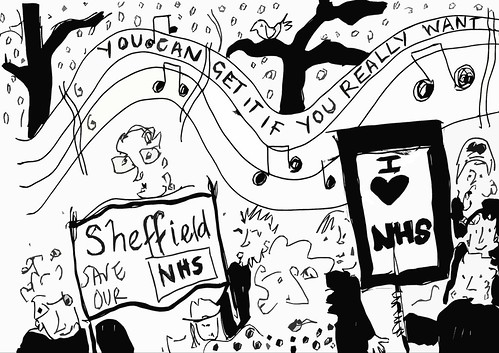
Cartoons by Samantha Galbraith @sgalbraith47
For more national information see Health Campaigns Together and Keep Our NHS Public
FUTURE EVENTS
April 14th 2018 11.45 Regional Demonstration to Save the NHS Leeds
April 25th Soviet Healthcare via Targets: Are Governments Bringing it into the NHS? Roco 2pm or 7pm
April 28th Sheffield Demonstration against proposed closure of the Minor Injuries and Walk-in Centres (see main website for details)
June 27th The NHS is 70 - but what is its life expectancy? Festival of Debate / SSONHS panel discussion and social. Roco 7pm - 11 pm.
June 30th Health Campaigns Together march for the NHS in London See main wesbite for details.
SSONHS planning and information meetings are generally on the first Monday of the month, except for bank holidays. They are usually at 6pm at the United Reform Church. Chapel Walk/Norfolk St S1
To contact us email teamssonhs@gmail.com
PREVIOUS EVENTS
In 2016 abnd 2017 we worked with Sheffield Festival of Debate and other colleagues to promote realistic discussion of the issues facing the NHS. On 4th May 2017 we had a lively meeting debating the future of hospitals and in 2016 we mounted an exhibition on NHS privatisation to coincide with a play, A DUTY OF CARE about Labour and the healthcare market. On 22nd November 2016 we held a panel-led debate on the future of the NHS with local NHS leaders, academics and campaigners. We also held a public meeting on 4th July 2016 to celebrate the NHS anniversary, discuss the STPs, the implications for privatisation in South Yorkshire and North Derbyshire and the consequences of the EU referendum result.
In March 2016 we held a successful workshop Taking Back Our NHS

For our questions to 2017 General Election candidates and canvassers about the NHS see our website campaign page
2016 8th-22nd November Exhibition on NHS privatisation How come we didn't know by London photographer Marion Macalpine
Theatre Delicatessen, The Moor
22nd November SSONHS Festival of Debate event Why is the NHS Under so much pressure? How can we save it for future generations?
Speakers included Dr Tim Moorhead, Chair, Sheffield CCG, Kevan Taylor (Sheffield Health and Social Care Trust) and Professor Sarah Salway (University of Sheffield, Public Health) + local campaigners
Taking Back Our NHS SSONHS workshop
Saturday 12th March 2016, 10am - 2pm
(2015)
Campaigning for GP practices at risk of closure
2nd July Successful SSONHS public meeting addressed by Ray Tallis and speakers from Devonshire Green and Unison.
2nd May SSONHS stall in city centre from 11.30 Come and see us.
The 38 degrees ambulance will also be in Surrey Street at 12pm and conveying the 38 degrees petitions to local Hallam candidates at Wesley Hall in Crookes for 3pm.25th April - March through Sheffield Hallam, with the People's NHS and 38 degrees
28th February 38 degrees petitioning around Sheffield http://www.thestar.co.uk/news/health/local-health/campaigners-take-to-sheffield-streets-in-fight-to-save-nhs-1-7132981
22nd November Leafleting in Sheffield City Centre from 12.00 pm in support of the NHS strikers. For A5 and A4 copies of the leaflet which has more information on it see the Campaigns Page at our website
24th November NHS picket lines from 7am to 11am. Rallies at the Hallamshire and Northern General (Herries Road) at 10 am.
We were proud to support the Jarrow to London march for the NHS, organised by Darlington Mums passing through Sheffield on August Bank Holiday Monday. http://999callfornhs.org.uk/ Thanks to everyone for helping and joining in.
Is our NHS really in crisis? Behind the headlines and soundbites
Panel discussion led by GPs and health experts from the NHS and universities.
For past activities see our website www.sheffieldsaveournhs.co.uk
Wednesday, 10 February 2016

Monday, 11 January 2016
Junior Doctors forced to strike by Hunt's intransigence
Junior doctors will face their new assignments on the picket line with strong resolve but with heavy hearts. They did not want this strike but the NHS Employers, dancing to the tune of Jeremy Hunt and the Conservative Cabinet, have failed to recognise that this is a protest against the persistent and continuous squeeze on the NHS, the brunt of which is borne by front line staff, including junior doctors as they try to maintain a good service to patients. Already over 80% of doctors work unpaid overtime as they try to complete their rostered tasks and deal with emergencies. 30% report workplace stress and the main organisation providing counselling support for doctors says that their clientele is getting younger and younger. Doctors, both in hospital and in general practice, are getting driven away from the NHS - and it can't exist without them. The leakage of nursing and medical staff into agency and locum work is a warning symptom of how further privatisation could happen.
Hunt is trying to introduce a 7 day NHS on the basis of ropey evidence and within a tight financial envelope which will not bear the strain. The 7 day NHS may be a manifesto pledge but even manifestos have to be treated with realism. The public does want proper safeguarding of their health, both within hospital and outside, but there are few signs that it wants or expects the NHS as a whole to function fully for 7 days, especially if this eventually means a dilution of services during the week.
Hunt wants to put doctors working conditions firmly in the grasp of the management of hospital Trusts, many of which are either in desperate financial straits or retain control only by squeezing their staff till they have no energy left. Doctors want to retain some control over their own conditions and not find that they are being used as elastoplast to cover up management inadequacies, shortages of staff, and financial crises. While it is reasonable to ask staff help organisations adapt to new conditions, it is not reasonable to force staff on whose decisions lives depend, to become overstretched and undervalued. Doctors are striking against what for many would be a cut in pay and a worsening in conditions. They are also striking because the government position on safety both for patients and practitioners lacks both detail and conviction.
Any inconvenience to patients is outweighed by the overall consequences for the NHS if the doctors lose their action and Hunt imposes a new contract. It is vital that the public speaks out in favour of the doctors and rejects the smears and insinuations being peddled by the government and much of the right wing press.
Hunt is trying to introduce a 7 day NHS on the basis of ropey evidence and within a tight financial envelope which will not bear the strain. The 7 day NHS may be a manifesto pledge but even manifestos have to be treated with realism. The public does want proper safeguarding of their health, both within hospital and outside, but there are few signs that it wants or expects the NHS as a whole to function fully for 7 days, especially if this eventually means a dilution of services during the week.
Hunt wants to put doctors working conditions firmly in the grasp of the management of hospital Trusts, many of which are either in desperate financial straits or retain control only by squeezing their staff till they have no energy left. Doctors want to retain some control over their own conditions and not find that they are being used as elastoplast to cover up management inadequacies, shortages of staff, and financial crises. While it is reasonable to ask staff help organisations adapt to new conditions, it is not reasonable to force staff on whose decisions lives depend, to become overstretched and undervalued. Doctors are striking against what for many would be a cut in pay and a worsening in conditions. They are also striking because the government position on safety both for patients and practitioners lacks both detail and conviction.
Any inconvenience to patients is outweighed by the overall consequences for the NHS if the doctors lose their action and Hunt imposes a new contract. It is vital that the public speaks out in favour of the doctors and rejects the smears and insinuations being peddled by the government and much of the right wing press.
Tuesday, 24 November 2015
Osborne's £3.8 billion sleight of hand
So Chancellor Osborne is claiming to be rescuing the NHS by frontloading (significant increases beginning this year) the £8billion+ it promised over 5 years, rather than backloading as originally intended.
The Government is still claiming that this will pay for a 7 day NHS (which hardly anyone wants - e.g. 2/3 of patients just surveyed by the Royal College of GPs say the government should improve existing services before stretching them) and might even allow Hunt some margin to settle with the Junior Doctors. However a good chunk of the funding will be swallowed up by the deficits already run up this year throughout the NHS. Nearly everyone outside the government agrees that the £22 billion efficiency savings which Simon Stevens imagined as balancing the books cannot be achieved so the deficit will still keep on growing.
Except that there are some private sector suppliers rubbing their hands, not in healthcare but in IT. Articles from Computer Weekly and digitalhealth.net unearthed by Our NHS state that the Department of Health, advised of course by the notorious McKinsey consultants (whose 2010 Labour commissioned report provided part of the motor for the Health and Social Care Bill), has asked the Treasury for £3.5 billion for IT investment (including electronic records) in order to save up to £8billion. I think we've heard this one before and the problems associated with the implementation of STHFT's new Lorenzo system (palmed off by the government to desperate Trusts despite its being generally regarded as unfit) hardly help the credibility of IT led solutions. But rest assured - the Department is spending money on developing a digital maturity index to be applied to CCGs and health economies by the Care Quality Commission!
So there is going to have to be a lot of pressure to try and ensure that any additional funding does actually do some good. There is an additional problem in that the budget for the following 2 to 3 years is pretty flat. Real terms investment will drop to just £500m in the third year, before rising again to £1.7bn in 2020-21. And beware of percentages - different estimates of the total Department of Health budget are being used; also details of the overall budget under tomorrow's full spending review announcement are still not clear.
And where is the money coming from? Well, partly from the non ring-fenced parts of healthcare, including nurse training, public health and the Care Quality Commission, while the cuts in social care are being allowed only a smidgeon of necessary relief by allowing councils to raise an extra 2% in council tax - for which of course they will get the resentment. And then of course from all the other services (and service users, benefit recipients, tax credit claimants etc). Announcing the NHS budget separately from all the others shows that the Treasury still has not made the connections.
It's not exactly a recipe for national health - and incidentally the government yesterday closed a short and less than token consultation on its mandate to NHS England which was not publicised and barely noticed until Keep Our NHS Public people kicked up a stink because the website would not even accept responses to the consultation! In it they claimed that improving the nation's health was one of their overarching objectives. So why cut public health expenditure? And why put out an 8 page mandate which mentions staff only once?
The Government is still claiming that this will pay for a 7 day NHS (which hardly anyone wants - e.g. 2/3 of patients just surveyed by the Royal College of GPs say the government should improve existing services before stretching them) and might even allow Hunt some margin to settle with the Junior Doctors. However a good chunk of the funding will be swallowed up by the deficits already run up this year throughout the NHS. Nearly everyone outside the government agrees that the £22 billion efficiency savings which Simon Stevens imagined as balancing the books cannot be achieved so the deficit will still keep on growing.
Except that there are some private sector suppliers rubbing their hands, not in healthcare but in IT. Articles from Computer Weekly and digitalhealth.net unearthed by Our NHS state that the Department of Health, advised of course by the notorious McKinsey consultants (whose 2010 Labour commissioned report provided part of the motor for the Health and Social Care Bill), has asked the Treasury for £3.5 billion for IT investment (including electronic records) in order to save up to £8billion. I think we've heard this one before and the problems associated with the implementation of STHFT's new Lorenzo system (palmed off by the government to desperate Trusts despite its being generally regarded as unfit) hardly help the credibility of IT led solutions. But rest assured - the Department is spending money on developing a digital maturity index to be applied to CCGs and health economies by the Care Quality Commission!
So there is going to have to be a lot of pressure to try and ensure that any additional funding does actually do some good. There is an additional problem in that the budget for the following 2 to 3 years is pretty flat. Real terms investment will drop to just £500m in the third year, before rising again to £1.7bn in 2020-21. And beware of percentages - different estimates of the total Department of Health budget are being used; also details of the overall budget under tomorrow's full spending review announcement are still not clear.
And where is the money coming from? Well, partly from the non ring-fenced parts of healthcare, including nurse training, public health and the Care Quality Commission, while the cuts in social care are being allowed only a smidgeon of necessary relief by allowing councils to raise an extra 2% in council tax - for which of course they will get the resentment. And then of course from all the other services (and service users, benefit recipients, tax credit claimants etc). Announcing the NHS budget separately from all the others shows that the Treasury still has not made the connections.
It's not exactly a recipe for national health - and incidentally the government yesterday closed a short and less than token consultation on its mandate to NHS England which was not publicised and barely noticed until Keep Our NHS Public people kicked up a stink because the website would not even accept responses to the consultation! In it they claimed that improving the nation's health was one of their overarching objectives. So why cut public health expenditure? And why put out an 8 page mandate which mentions staff only once?
The Attack On Junior Doctors Is An Attack On Us All
SSONHS was represented at the Junior Doctors October protest in Leeds. This update is by SSONHS supporter Rachel Hallam and written for the Sheffield Student Union paper Forge Press November 22, 2015
On 28 October, around 250 Sheffield students travelled up to Leeds to join a 2,000-strong protest against the new junior doctors’ contracts. This protest mirrors protests and marches taking place up and down the country (including a march of 20,000 in London) in the past two months and support has been building to oppose contracts which are unsafe for patients and unfair to doctors.
The “non-negotiable” terms of the new contract are an extension of the existing standard working time of junior doctors from 60 to 90 hours per week, changing ‘social hours’ to 7am-10pm Monday to Saturday. This means that Junior Doctors will be paid the same for working 9am on a Monday morning as they will for working 9pm on a Saturday.
The new contracts put an end to banding payments, which have built-in safeguards to prevent excessive hours and to ensure sufficient breaks. This means there will be no way of preventing unsafe hours from being worked or to guarantee junior doctors are paid when shifts overrun.
Changes to pay progression will impact heavily on part-time workers and will put junior doctors off undertaking specialist training, in addition to disadvantaging those wishing to take maternity leave.
These changes will affect the quality of life for those giving care, overall exacerbating the health inequalities already rife within the UK. Get the 83a in Sheffield from Fulwood to Ecclesfield and the life expectancy of the people around you drops by a year for every three minutes you travel. GPs who are tired and demoralised will not be able to treat their patients to the high standards NHS patients deserve.
The British Medical Association (BMA) balloted its junior members in England for industrial action, with an almost unbelievable 98% voting in favour. If strike action takes place, the BMA require the following concrete assurances before re-entering into the negotiations with NHS employers:
• Proper recognition of unsocial hours as premium time
• No disadvantage for those working unsocial hours compared to the current system
• No disadvantage for those working less than full time and taking parental leave compared to the current system pay for all work done.
• Proper hours safeguards protecting patients and their doctors
Industrial action for junior doctors poses some serious questions to medical students: do they leave their placements to support their colleagues and defend their future careers?
The General Medical Council say that a medical student is “unfit to practice” if their attendance is less than 80 per cent, so medical schools are currently unable to explicitly support their students in strike action. It will come down to the individual’s decision if they want to join the junior doctors on the picket line.
If medical students do attend placement on the days of the strike, they risk the pressure of doing more procedures unsupervised, on understaffed wards, putting themselves and patients at risk. If they don’t, they risk penalisation for their absence. Caught between a rock and a hard place, they now need as much support as possible from their peers and lecturers.
How does this fit into the NHS as a whole? Since Health Secretary Jeremy Hunt refuses to back down on the most contentious issues of the Junior Doctors contract, health workers and patients must unite to defend their NHS. If the BMA (the union Aneurin Bevan had to pay off in order to found the welfare state) isn’t safe, then nobody is.
On 28 October, around 250 Sheffield students travelled up to Leeds to join a 2,000-strong protest against the new junior doctors’ contracts. This protest mirrors protests and marches taking place up and down the country (including a march of 20,000 in London) in the past two months and support has been building to oppose contracts which are unsafe for patients and unfair to doctors.
The “non-negotiable” terms of the new contract are an extension of the existing standard working time of junior doctors from 60 to 90 hours per week, changing ‘social hours’ to 7am-10pm Monday to Saturday. This means that Junior Doctors will be paid the same for working 9am on a Monday morning as they will for working 9pm on a Saturday.
The new contracts put an end to banding payments, which have built-in safeguards to prevent excessive hours and to ensure sufficient breaks. This means there will be no way of preventing unsafe hours from being worked or to guarantee junior doctors are paid when shifts overrun.
Changes to pay progression will impact heavily on part-time workers and will put junior doctors off undertaking specialist training, in addition to disadvantaging those wishing to take maternity leave.
These changes will affect the quality of life for those giving care, overall exacerbating the health inequalities already rife within the UK. Get the 83a in Sheffield from Fulwood to Ecclesfield and the life expectancy of the people around you drops by a year for every three minutes you travel. GPs who are tired and demoralised will not be able to treat their patients to the high standards NHS patients deserve.
The British Medical Association (BMA) balloted its junior members in England for industrial action, with an almost unbelievable 98% voting in favour. If strike action takes place, the BMA require the following concrete assurances before re-entering into the negotiations with NHS employers:
• Proper recognition of unsocial hours as premium time
• No disadvantage for those working unsocial hours compared to the current system
• No disadvantage for those working less than full time and taking parental leave compared to the current system pay for all work done.
• Proper hours safeguards protecting patients and their doctors
Industrial action for junior doctors poses some serious questions to medical students: do they leave their placements to support their colleagues and defend their future careers?
The General Medical Council say that a medical student is “unfit to practice” if their attendance is less than 80 per cent, so medical schools are currently unable to explicitly support their students in strike action. It will come down to the individual’s decision if they want to join the junior doctors on the picket line.
If medical students do attend placement on the days of the strike, they risk the pressure of doing more procedures unsupervised, on understaffed wards, putting themselves and patients at risk. If they don’t, they risk penalisation for their absence. Caught between a rock and a hard place, they now need as much support as possible from their peers and lecturers.
How does this fit into the NHS as a whole? Since Health Secretary Jeremy Hunt refuses to back down on the most contentious issues of the Junior Doctors contract, health workers and patients must unite to defend their NHS. If the BMA (the union Aneurin Bevan had to pay off in order to found the welfare state) isn’t safe, then nobody is.
Monday, 7 September 2015
This is the month in which NHS bodies hold their annual meetings which are supposed to be a key part of their accountability to the public. Annual Reports are presented, together sometimes with presentations highlighting a particular piece of the Trust's work. Then there is opportunity for public questions to the Trust Board. The STHFT and SHSCT meetings are usually well attended. Whereas the CCG presents a Commissioning point of view, this is a chance to hear from the Chair and Finance Directors of providers. Expect gloomy predictions about finance. (This is the only chance to question the STHFT Board as it is the only local Trust not to allow questions at the monthly Board meetings.).
Thursday 10th Sept CCG Annual Meeting 1.30 for 2pm at the Source. Details here.
Tuesday 15 September 2015 Sheffield Children's Hospital Annual Members' Meeting 5.30pm refreshments / 6.00pm start
Helena Davies Lecture Theatre, Sheffield Children's Hospital. "The Annual Members' Meeting is a great opportunity to find out about what has been happening at the Trust during the last year and hear about our plans for the future. This year's meeting will also have a special feature on the development of the Trust's Respiratory Team. If you would like to attend please contact madeleine.parry@sch.nhs.uk."
(TUESDAY 22nd September 7pm SSONHS screening of Sell Off + guest speaker and performance. Theatre Delicatessen The Moor, S1(where the old Woolworth's used to be)
Wednesday 23 Sept 12.30-3.30 pm Sheffield Teaching Hospitals Annual Members Meeting Meeting 12.30 prompt followed by stalls highlighting research in SAHTFT. Sandwiches provided. Lecture Theatre 2, Medical Education Centre Northern General Hospital. It's usually quite full so reserve your place by emailing jane.pellegrina@sth.nhs.uk.
Thursday 24th Sept. 2pm - 4pm Sheffield Health and Wellbeing Board 2pm - 4 pm Sheffield Town Hall. Papers will be available on line from 18th Sept here . If devolution of health has featured in the local proposals submitted to government this week, this is as good a place as any to ask questions about it.
Tuesday 29 September 2015 Sheffield Health and Social Care Trust Annual Members Meeting. 12.45pm to 4pm Executive Suites, 2nd Floor, Sheffield United Football Club, John Street, Sheffield. Information about the meeting will be available on the website in the next few days. To book a place email karen.jones@shsc.nhs.uk
Tuesday 29 September 2015 Yorkshire Ambulance Service Trust Annual General Meeting (AGM) 10.45am Presentation on NHS 111 Service. 11.15am - 12.30 pm AGM. Trust Board Meeting held in public between 1.00pm and 3.30pm Doncaster Racecourse, The Grandstand, Leger Way, Doncaster, South Yorkshire, DN2 6BB. If you would like to attend the meeting and lunch, please email foundationtrust@yas.nhs.uk or telephone 01924 584416.
Thursday 1st October Sheffield CCG Governing Body meeting in public 4pm Darnall.
Thursday 10th Sept CCG Annual Meeting 1.30 for 2pm at the Source. Details here.
Tuesday 15 September 2015 Sheffield Children's Hospital Annual Members' Meeting 5.30pm refreshments / 6.00pm start
Helena Davies Lecture Theatre, Sheffield Children's Hospital. "The Annual Members' Meeting is a great opportunity to find out about what has been happening at the Trust during the last year and hear about our plans for the future. This year's meeting will also have a special feature on the development of the Trust's Respiratory Team. If you would like to attend please contact madeleine.parry@sch.nhs.uk."
(TUESDAY 22nd September 7pm SSONHS screening of Sell Off + guest speaker and performance. Theatre Delicatessen The Moor, S1(where the old Woolworth's used to be)
Wednesday 23 Sept 12.30-3.30 pm Sheffield Teaching Hospitals Annual Members Meeting Meeting 12.30 prompt followed by stalls highlighting research in SAHTFT. Sandwiches provided. Lecture Theatre 2, Medical Education Centre Northern General Hospital. It's usually quite full so reserve your place by emailing jane.pellegrina@sth.nhs.uk.
Thursday 24th Sept. 2pm - 4pm Sheffield Health and Wellbeing Board 2pm - 4 pm Sheffield Town Hall. Papers will be available on line from 18th Sept here . If devolution of health has featured in the local proposals submitted to government this week, this is as good a place as any to ask questions about it.
Tuesday 29 September 2015 Sheffield Health and Social Care Trust Annual Members Meeting. 12.45pm to 4pm Executive Suites, 2nd Floor, Sheffield United Football Club, John Street, Sheffield. Information about the meeting will be available on the website in the next few days. To book a place email karen.jones@shsc.nhs.uk
Tuesday 29 September 2015 Yorkshire Ambulance Service Trust Annual General Meeting (AGM) 10.45am Presentation on NHS 111 Service. 11.15am - 12.30 pm AGM. Trust Board Meeting held in public between 1.00pm and 3.30pm Doncaster Racecourse, The Grandstand, Leger Way, Doncaster, South Yorkshire, DN2 6BB. If you would like to attend the meeting and lunch, please email foundationtrust@yas.nhs.uk or telephone 01924 584416.
Thursday 1st October Sheffield CCG Governing Body meeting in public 4pm Darnall.
Tuesday, 28 July 2015
The future shape of NHS services in Sheffield
Sheffield CCG has been running a series of workshops in Sheffield entitled Changing the Balance - A 2020 Vision of Health and Social Care in Sheffield.
Changing the Balance - A 2020 Vision of Health and Social Care in Sheffield; (Health and Wellbeing Board) The notes of the first 2020 vision meeting in May are here. There are further similar events coming up on 12th August and in early September. See here. The introduction highlighted an expected £65m funding gap for the NHS in Sheffield by 2020 and set increasing demand caused by an ageing society, more long-term conditions and increasing expectations against supply issues: increasing costs of provision; limits to productivity gains; and reducing public expenditure. On an electronic poll most participants agreed that the NHS had to change but the changes were all discussed in terms of improving services within the current context of public provision and increased VCF participation.
This is certainly not the case in most areas outside Sheffield especially for those CCGs and parts of NHS England for whom only the private sector can deliver more cheaply and for those who continue to drive moves to an insurance based system (which the forms of Simon Stevens' Five Year Forward View' fit nicely). Sheffield may be one of the few places where there is still sufficient expertise, resource and collective commitment to make a realistic stab at delivering on its joint strategies but the history of attempts to make savings through integration, moving services into the community, increasing productivity, seven day working etc is pretty grim. See this Morning Star article by John Lister of London Health Emergency.
None of Sheffield's current rush of consultations touches the overall shape of services, decision making and accountability. The position of the biggest provider, the Sheffield Teaching Hospitals Trust, which also runs many community services, is difficult to assess and, for the first time, it expects to report a deficit this year because of the national tariff reforms. The Health and Social Care Trust is so concerned at the erosion of what others think of as its 'non-core' care services that it is considering setting up a company to bid more cheaply.
but things must shortly come to a head as the city-region faces up to George Osborne's challenges about devolution and his demand for a local decision before his autumn financial statement. Both the CCG and the Trusts are joining wider groups of similar bodies to make more regional decisions. Could 'local' (i.e. sub-regional as opposed to national) decision making (let's leave the mayor question for the moment) help Sheffield become safer in trying to pursue a continuation of publicly provided services or will the region be cast off with limited budgets, internal squabbling about financial allocations, unaccountable local processes and the final condition that the Secretary of State can prevent any action which he or she dislikes? And does devolution of NHS services itself mean the fragmentation of the NHS as a national service? The issue of localism in the NHS has tended to surface only in terms of the postcode lottery. The Medical Practitioners Union is one group arguing that moves to localism only make sense in the context of restoring the Secretary of State's duty to provide a comprehensive health service, but that won't happen for at least five years now. There is also widespread concern that this will mean local government and local politicians controlling NHS spending See John Lister again.
Locally Sheffield for Democracy has over the last year been raising significant questions about the format of the city region and its decision making, and is now taking these concerns into the devolution debate. SSONHS will also be tackling these issues in the coming weeks and raising questions for the CCG, the Council and other relevant bodies.
Changing the Balance - A 2020 Vision of Health and Social Care in Sheffield; (Health and Wellbeing Board) The notes of the first 2020 vision meeting in May are here. There are further similar events coming up on 12th August and in early September. See here. The introduction highlighted an expected £65m funding gap for the NHS in Sheffield by 2020 and set increasing demand caused by an ageing society, more long-term conditions and increasing expectations against supply issues: increasing costs of provision; limits to productivity gains; and reducing public expenditure. On an electronic poll most participants agreed that the NHS had to change but the changes were all discussed in terms of improving services within the current context of public provision and increased VCF participation.
This is certainly not the case in most areas outside Sheffield especially for those CCGs and parts of NHS England for whom only the private sector can deliver more cheaply and for those who continue to drive moves to an insurance based system (which the forms of Simon Stevens' Five Year Forward View' fit nicely). Sheffield may be one of the few places where there is still sufficient expertise, resource and collective commitment to make a realistic stab at delivering on its joint strategies but the history of attempts to make savings through integration, moving services into the community, increasing productivity, seven day working etc is pretty grim. See this Morning Star article by John Lister of London Health Emergency.
None of Sheffield's current rush of consultations touches the overall shape of services, decision making and accountability. The position of the biggest provider, the Sheffield Teaching Hospitals Trust, which also runs many community services, is difficult to assess and, for the first time, it expects to report a deficit this year because of the national tariff reforms. The Health and Social Care Trust is so concerned at the erosion of what others think of as its 'non-core' care services that it is considering setting up a company to bid more cheaply.
but things must shortly come to a head as the city-region faces up to George Osborne's challenges about devolution and his demand for a local decision before his autumn financial statement. Both the CCG and the Trusts are joining wider groups of similar bodies to make more regional decisions. Could 'local' (i.e. sub-regional as opposed to national) decision making (let's leave the mayor question for the moment) help Sheffield become safer in trying to pursue a continuation of publicly provided services or will the region be cast off with limited budgets, internal squabbling about financial allocations, unaccountable local processes and the final condition that the Secretary of State can prevent any action which he or she dislikes? And does devolution of NHS services itself mean the fragmentation of the NHS as a national service? The issue of localism in the NHS has tended to surface only in terms of the postcode lottery. The Medical Practitioners Union is one group arguing that moves to localism only make sense in the context of restoring the Secretary of State's duty to provide a comprehensive health service, but that won't happen for at least five years now. There is also widespread concern that this will mean local government and local politicians controlling NHS spending See John Lister again.
Locally Sheffield for Democracy has over the last year been raising significant questions about the format of the city region and its decision making, and is now taking these concerns into the devolution debate. SSONHS will also be tackling these issues in the coming weeks and raising questions for the CCG, the Council and other relevant bodies.
GP funding crisis update
Update 7th October. Practices are now having their special case applications considered by the CCG. Some practices with income loss have chosen to explore other solutions like mergers. The CCG is to become a Level 3 co-commissioner of primary care with NHS England which means that once again (as in the Sheffield Primary Care Trust abolished by the Coalition) commissioning decisions for Sheffield will be taken in Sheffield - though GPs are excluded from the actual decision making.
July 2015 A packed public meeting of the CCG goverening body on 16th July heard almost an hour of representations from the public, a presentation from the CCG and statements from NHS England, the Local Medical Committee and GP representatives of the four Sheffield localities. The CCG stated that the 11 practices most at risk were from different and differing areas of the city, not just disadvantaged areas but support for Devonshire Green and Page Hall was explicit, including from other GPS who supported the general principle of equalisation. In the end Members of the Board eligible to vote agreed the original proposal but with an apparently enhanced safety net (in terms of criteria rather than money)giving more weight to health inequalities, a commitment that no practice would be left unviable and an agreement to report back in public during September.
The CCG's relief was understandable. They took the risk of holding a complicated decision making meeting in public, they gave space to the public to voice their feelings, they gained a lot of useful feedback and they got their original recommendation through. Campaigners (especially the two practices most at risk) were also successful in getting very strong shows of patient support particularly from migrant communities which are not often heard, let alone seen at public meetings.
However for the most vulnerable practices the relief must have been more double edged. They could feel both pleased and relieved at some of the assurances given, but were also alarmed that little or no additional resources were being made available and that they would have to spend a considerable amount more time and effort to make very strong cases to prevent actual cuts in practice income and therefore services. The only disadvantage weighting used for the equalisation proposal has been the inadequate modified Carr-Hill formula from 2004 which does not include ethnicity or language and the new safety net measure have to recognise that this will not do and the CCG must be pushed to recognise the particular problems of serving transient populations where the list/per capita model of financing does not reflect patient demand. Development of these arguments, particularly from Devonshire Green, has been going on for a long time; NHS England and the CCG have no excuse for not producing appropriate, effective, fair and acceptable solutions. Some services will probably have to be shared with / co-delivered by neighbouring practices and as with most NHS reconfigurations, however justified, these changes may affect jobs, earnings and livelihoods as well as services.
Overall and not surprisingly GPs were overwhelmingly in favour of the equalisation policy especially now that collaboration and integration are being given a bit more emphasis than competition. All practices feel stretched and from a business point of view equalisation now makes more sense. This probably reflects the uneven development of PMS contracts where nationally some practices working with disadvantaged populations have sought to maximise the resources they can bring to meeting their health needs, but others have involved GPs finding ways of increasing their practice income without increasing services. The historical anomalies surrounding contracts have resulted in situations where neighbouring surgeries serving similar populations (including disadvantaged ones or communities with special needs) receive considerable different incomes. Interestingly the promotion of PMS income opportunities by Labour in the 2000s could be seen as reflecting Labour's belief at that time in competition and choice: unequal resources mattered less because they promoted competition between GPs which therefore increased patient choice. This is yet another of the ways in which Blairite Labour laid the foundations for Andrew Lansley.
SSONHS has actively offered support to the surgeries under threat and has received formal thanks from them. If progress on the safety net for practices is not clearly being made by September the next Business Meeting of the CCG on September 3rd and the CCG AGM on September 10th will have to be lobbied even more strongly.
July 2015 A packed public meeting of the CCG goverening body on 16th July heard almost an hour of representations from the public, a presentation from the CCG and statements from NHS England, the Local Medical Committee and GP representatives of the four Sheffield localities. The CCG stated that the 11 practices most at risk were from different and differing areas of the city, not just disadvantaged areas but support for Devonshire Green and Page Hall was explicit, including from other GPS who supported the general principle of equalisation. In the end Members of the Board eligible to vote agreed the original proposal but with an apparently enhanced safety net (in terms of criteria rather than money)giving more weight to health inequalities, a commitment that no practice would be left unviable and an agreement to report back in public during September.
The CCG's relief was understandable. They took the risk of holding a complicated decision making meeting in public, they gave space to the public to voice their feelings, they gained a lot of useful feedback and they got their original recommendation through. Campaigners (especially the two practices most at risk) were also successful in getting very strong shows of patient support particularly from migrant communities which are not often heard, let alone seen at public meetings.
However for the most vulnerable practices the relief must have been more double edged. They could feel both pleased and relieved at some of the assurances given, but were also alarmed that little or no additional resources were being made available and that they would have to spend a considerable amount more time and effort to make very strong cases to prevent actual cuts in practice income and therefore services. The only disadvantage weighting used for the equalisation proposal has been the inadequate modified Carr-Hill formula from 2004 which does not include ethnicity or language and the new safety net measure have to recognise that this will not do and the CCG must be pushed to recognise the particular problems of serving transient populations where the list/per capita model of financing does not reflect patient demand. Development of these arguments, particularly from Devonshire Green, has been going on for a long time; NHS England and the CCG have no excuse for not producing appropriate, effective, fair and acceptable solutions. Some services will probably have to be shared with / co-delivered by neighbouring practices and as with most NHS reconfigurations, however justified, these changes may affect jobs, earnings and livelihoods as well as services.
Overall and not surprisingly GPs were overwhelmingly in favour of the equalisation policy especially now that collaboration and integration are being given a bit more emphasis than competition. All practices feel stretched and from a business point of view equalisation now makes more sense. This probably reflects the uneven development of PMS contracts where nationally some practices working with disadvantaged populations have sought to maximise the resources they can bring to meeting their health needs, but others have involved GPs finding ways of increasing their practice income without increasing services. The historical anomalies surrounding contracts have resulted in situations where neighbouring surgeries serving similar populations (including disadvantaged ones or communities with special needs) receive considerable different incomes. Interestingly the promotion of PMS income opportunities by Labour in the 2000s could be seen as reflecting Labour's belief at that time in competition and choice: unequal resources mattered less because they promoted competition between GPs which therefore increased patient choice. This is yet another of the ways in which Blairite Labour laid the foundations for Andrew Lansley.
SSONHS has actively offered support to the surgeries under threat and has received formal thanks from them. If progress on the safety net for practices is not clearly being made by September the next Business Meeting of the CCG on September 3rd and the CCG AGM on September 10th will have to be lobbied even more strongly.
Tuesday, 7 July 2015
Crisis and possibly closure for some of our best GP practices
NHS England has ordered that some of the ways in which GPs are funded has to be changed. Over the last few months we have seen practices all over the country, including Devonshire Green Surgery in Sheffield fighting the abolition of the Minimum Practice Income Guarantee. Now NHS England has ordained that another form of funding, PMS, should be phased out over a much shorter time putting 11 practices at risk in Sheffield.
Since the foundation of the NHS GPs have been independent practitioners working for the NHS on a contract basis. Following the abolition of Primary Care Trusts in 2012, contracts have been overseen by NHS England, although CCGs have recently been encouraged to get involved in co-commissioning. Traditionally these contracts have been for GPs to provide General Medical Services (GMS). The terms of the contract are set nationally and have undergone significant revisions at different times, most recently in 2004. However since about 1997 and more so since 2004 many practices have been on a more flexible contract called PMS (Personal Medical Services) which was intended to allow practices to tailor their services more specifically to local needs and priorities and which made it easier to employ salaried GPs. Also in 2004 there were changes to the basis on which GP core practice income was calculated; these were intended to make the income more sensitive to practice needs (including deprivation) but when the calculations were delivered to practices there was a huge outcry because nearly every practice would lose money and many would be made financially unviable. As a result the formula was revised during a heavy week of negotiations and an emergency correction factor was introduced, the Minimum Practice Income Guarantee (MPIG) to save practices, especially those most at risk. The NHS is full of such measures which are introduced because some other decision has had unintended consequences, which is partly why NHS funding is so complicated - and often unfair.
Over the last 10 years there have been significant changes in the expectations of and demands on General Practice, especially the services they provide within surgeries and NHS England has been looking for savings or reallocations. A study they commissioned suggested that these days there is far less practical difference between GMS and PMS surgeries and that PMS practices are actually receiving a premium (i.e. extra money which is not reflected in extra services) put nationally at £260m. Whether this is correct or not is open to argument. In addition NHS England decided that the MPIG was having less and less effect overall and that it should be phased out, although it admitted that this would seriously affect the practices which MPIG was originally introduced to help, among them Devonshire Green Surgery. MPIG is already being phased out over 7 years and this is what Devonshire Green has been protesting about. Other surgeries which have been vigorously campaigning include the Limehouse Practice in Tower Hamlets. See this facebook page
NHS England has now also instructed that the PMS system should be abolished but within a much shorter period. Local CCGs have been told to distribute the savings around local GPs in whatever they determine to be an equitable manner. A report to the CCG Governing Body meeting of 2nd July recommended that this surplus ( the estimated local premium totalling around £2.9m) should be redistributed equally around local practices, subject to certain adjustments for deprivation weighting and the possibility that practices at risk could apply to the CCG for special consideration because of the services they provide.
The report said that 62 out of the 87 practices in Sheffield would lose out, with 11 practices losing more than £20 per weighted patient – a potential loss of more than £200,000 per year. Without special help, these practices may not be able to survive so that thousands of Sheffield patients, including many from vulnerable groups, face the possible closure of their General Practice during the next 18 months. The full list has not been made public because of confidentiality issues but it includes Devonshire Green Surgery and Page Hall Medical Centre. Doctors from both these surgeries attended the successful SSONHS meeting last Thursday.
The CCG had to deal with this in an extraordinary way. GPs were excluded from the decision making (because of their financial interest) leaving the CCG inquorate, so it had been decided in advance to run a contiguous sub committee of non-executive directors, CCG officers and the co-option of regular participant observers. They were told that the decision had to be taken fairly quickly or more problems would arise.
In the public questions part of the meeting the paper had been challenged by Dr Graham Pettinger from Devonshire Green Surgery and by a representative of Sheffield Save Our NHS on the basis that it contained no Equality Impact Assessment and that the criteria for special help seemed far too rigid.
Also in the preliminary discussion Dr Mark Durling from the Local Medical Committee representing all GPs said that general practice faced a catastrophe. Demand, stress, financial pressures and bureaucracy were causing many middle aged doctors to leave. The historical system of GP funding does not work properly but the current proposals, as they stood, would severely affect practices with dedicated doctors and staff who were putting all their resources into the care of their patients. The implication of Dr Durling's remarks is that these are practices which really are using their PMS money for extra services, and now risk being put out of action because of this. The notion that these practices are receiving an undeserved premium is quite wrong.
In the formal discussion on the paper the CCG officers apologised for not including an EIA and said that some of the criteria for special help could be adjusted as could the sum set aside from CCG funds. However they said that a decision was needed urgently as further uncertainty might lead doctors in some of the non PMS practices to start withdrawing services such as phlebotomy which they are having to meet out of their own core funding and sending patients to hospital instead. Board members seemed to accept during the meeting that there was not an agreed interpretation of word 'equitable' which is required by NHS England as a criterion for this redistribution. In this case we are talking both about effects on health inequalities and equity as fairness for practices. They were also troubled by the lack of information especially the EIA and decided to defer the decision for a fortnight.
SSONHS members have been supporting Devonshire Green from the start of their campaign; we alerted practices about the impending decision; and since the meeting we have been liaising with some of the GPs from the practices at risk. We want to see doctors working together to find the best way of supporting the varied need of patients across Sheffield. We do not want to see those doctors who have made huge efforts to connect with their local communities and meet their needs being hung out to dry.
There is also a further risk to practices consisting of salaried GPs and run by the Sheffield Health and Social Care Trust. These contracts are due to expire soon meaning that the practices may be put out to competitive tender and fall under the control of private companies such as Virgin. Independent research has shown that GP services run by private companies are less effective than NHS GPs on 14 out of 17 measures.
The doctors have been discussing the best way to campaign; it's not easy because the interests, needs and finances of all the practices are different making common ground more difficult to establish in detail. What's more they are forced to compete with each other for survival - which would not be happening if the overall funding to GPs was not being reduced by the Government. It is also obvious that any practice closures or service reductions will put far more financial pressure on other parts of the system.
Devonshire Green has had its own campaigning site for some months, and this will be regularly updated. See here Other practices may set up their own Save Our Surgery campaigns but will, we hope, also link up to provide a more concerted public presence.
SSONHS supporters who are patients of the practices at risk are urged to offer direct support when they identify themselves and to support any more centralised protests - see our website for updates. Things may develop quite rapidly unless the practices receive adequate assurances from the CCG. Already in the last 6 months NHS England has been forced to abandon threats of practice closure in both Sheffield and Goldthorpe when local patients have organised to protest.
Since the foundation of the NHS GPs have been independent practitioners working for the NHS on a contract basis. Following the abolition of Primary Care Trusts in 2012, contracts have been overseen by NHS England, although CCGs have recently been encouraged to get involved in co-commissioning. Traditionally these contracts have been for GPs to provide General Medical Services (GMS). The terms of the contract are set nationally and have undergone significant revisions at different times, most recently in 2004. However since about 1997 and more so since 2004 many practices have been on a more flexible contract called PMS (Personal Medical Services) which was intended to allow practices to tailor their services more specifically to local needs and priorities and which made it easier to employ salaried GPs. Also in 2004 there were changes to the basis on which GP core practice income was calculated; these were intended to make the income more sensitive to practice needs (including deprivation) but when the calculations were delivered to practices there was a huge outcry because nearly every practice would lose money and many would be made financially unviable. As a result the formula was revised during a heavy week of negotiations and an emergency correction factor was introduced, the Minimum Practice Income Guarantee (MPIG) to save practices, especially those most at risk. The NHS is full of such measures which are introduced because some other decision has had unintended consequences, which is partly why NHS funding is so complicated - and often unfair.
Over the last 10 years there have been significant changes in the expectations of and demands on General Practice, especially the services they provide within surgeries and NHS England has been looking for savings or reallocations. A study they commissioned suggested that these days there is far less practical difference between GMS and PMS surgeries and that PMS practices are actually receiving a premium (i.e. extra money which is not reflected in extra services) put nationally at £260m. Whether this is correct or not is open to argument. In addition NHS England decided that the MPIG was having less and less effect overall and that it should be phased out, although it admitted that this would seriously affect the practices which MPIG was originally introduced to help, among them Devonshire Green Surgery. MPIG is already being phased out over 7 years and this is what Devonshire Green has been protesting about. Other surgeries which have been vigorously campaigning include the Limehouse Practice in Tower Hamlets. See this facebook page
NHS England has now also instructed that the PMS system should be abolished but within a much shorter period. Local CCGs have been told to distribute the savings around local GPs in whatever they determine to be an equitable manner. A report to the CCG Governing Body meeting of 2nd July recommended that this surplus ( the estimated local premium totalling around £2.9m) should be redistributed equally around local practices, subject to certain adjustments for deprivation weighting and the possibility that practices at risk could apply to the CCG for special consideration because of the services they provide.
The report said that 62 out of the 87 practices in Sheffield would lose out, with 11 practices losing more than £20 per weighted patient – a potential loss of more than £200,000 per year. Without special help, these practices may not be able to survive so that thousands of Sheffield patients, including many from vulnerable groups, face the possible closure of their General Practice during the next 18 months. The full list has not been made public because of confidentiality issues but it includes Devonshire Green Surgery and Page Hall Medical Centre. Doctors from both these surgeries attended the successful SSONHS meeting last Thursday.
The CCG had to deal with this in an extraordinary way. GPs were excluded from the decision making (because of their financial interest) leaving the CCG inquorate, so it had been decided in advance to run a contiguous sub committee of non-executive directors, CCG officers and the co-option of regular participant observers. They were told that the decision had to be taken fairly quickly or more problems would arise.
In the public questions part of the meeting the paper had been challenged by Dr Graham Pettinger from Devonshire Green Surgery and by a representative of Sheffield Save Our NHS on the basis that it contained no Equality Impact Assessment and that the criteria for special help seemed far too rigid.
Also in the preliminary discussion Dr Mark Durling from the Local Medical Committee representing all GPs said that general practice faced a catastrophe. Demand, stress, financial pressures and bureaucracy were causing many middle aged doctors to leave. The historical system of GP funding does not work properly but the current proposals, as they stood, would severely affect practices with dedicated doctors and staff who were putting all their resources into the care of their patients. The implication of Dr Durling's remarks is that these are practices which really are using their PMS money for extra services, and now risk being put out of action because of this. The notion that these practices are receiving an undeserved premium is quite wrong.
In the formal discussion on the paper the CCG officers apologised for not including an EIA and said that some of the criteria for special help could be adjusted as could the sum set aside from CCG funds. However they said that a decision was needed urgently as further uncertainty might lead doctors in some of the non PMS practices to start withdrawing services such as phlebotomy which they are having to meet out of their own core funding and sending patients to hospital instead. Board members seemed to accept during the meeting that there was not an agreed interpretation of word 'equitable' which is required by NHS England as a criterion for this redistribution. In this case we are talking both about effects on health inequalities and equity as fairness for practices. They were also troubled by the lack of information especially the EIA and decided to defer the decision for a fortnight.
SSONHS members have been supporting Devonshire Green from the start of their campaign; we alerted practices about the impending decision; and since the meeting we have been liaising with some of the GPs from the practices at risk. We want to see doctors working together to find the best way of supporting the varied need of patients across Sheffield. We do not want to see those doctors who have made huge efforts to connect with their local communities and meet their needs being hung out to dry.
There is also a further risk to practices consisting of salaried GPs and run by the Sheffield Health and Social Care Trust. These contracts are due to expire soon meaning that the practices may be put out to competitive tender and fall under the control of private companies such as Virgin. Independent research has shown that GP services run by private companies are less effective than NHS GPs on 14 out of 17 measures.
The doctors have been discussing the best way to campaign; it's not easy because the interests, needs and finances of all the practices are different making common ground more difficult to establish in detail. What's more they are forced to compete with each other for survival - which would not be happening if the overall funding to GPs was not being reduced by the Government. It is also obvious that any practice closures or service reductions will put far more financial pressure on other parts of the system.
Devonshire Green has had its own campaigning site for some months, and this will be regularly updated. See here Other practices may set up their own Save Our Surgery campaigns but will, we hope, also link up to provide a more concerted public presence.
SSONHS supporters who are patients of the practices at risk are urged to offer direct support when they identify themselves and to support any more centralised protests - see our website for updates. Things may develop quite rapidly unless the practices receive adequate assurances from the CCG. Already in the last 6 months NHS England has been forced to abandon threats of practice closure in both Sheffield and Goldthorpe when local patients have organised to protest.
Subscribe to:
Posts (Atom)